Buying off-plan means you pay for a home before it exists. Most of the time, the biggest unknown is not the price. It is the date you get the keys.
Delays are part of the current market. Savills' Q3 2026 Dubai residential report (October 2026) notes delayed project completions, and its Q2 report says projects once expected to take about three years are now generally expected to take about four.
This guide is for two groups of people:
Before you buy: you want to understand delay risk and price it in.
After a delay: your handover date has moved and you want to know your options.
We explain what counts as a delay, what really protects you, what is not guaranteed, how to check a project's official status, which remedies exist, and how to estimate what a delay costs you. If you want the full step-by-step route from reservation to keys, read our guide to the off-plan buying process.
This is general information, not legal advice. Every sale and purchase agreement (SPA) is different. For your own case, speak to a qualified lawyer. The English versions of Dubai laws say that the Arabic text prevails if there is a difference.
What counts as a handover delay
The anticipated completion date and the extension in your SPA
Your SPA usually gives an anticipated completion date. But that date is often not the last possible date.
A 2019 briefing by the law firm Afridi & Angell noted that SPAs often let the developer extend the anticipated completion date by a further 12 months, or treat some construction delays as force majeure. This is contract practice, not law, and terms vary, so check your own SPA.
So a project can be "late" against the date in the brochure but still on time under the contract. In practice, it helps to read two dates in your SPA: the anticipated completion date, and the latest date after any extension. If you are not sure how SPAs work in general, read what an SPA is and how it works.
Reasons the law treats as beyond the developer's control
Dubai's rules list some reasons that are treated as beyond the developer's control. Executive Council Resolution No. 6 of 2010 (Art. 21) names these, plus "any other reasons determined by RERA": expropriation; government suspension for re-planning; structures, excavations or utility lines found on site; master-developer changes to site boundaries.
Whether a specific delay is excused depends on the facts and on your SPA, which is why legal advice matters.
What protects you, and what is not guaranteed
Several rules protect off-plan buyers in Dubai. None of them promises that you will get your keys on a certain date. This table shows what each protection does and does not do.
Protection | What it does | What it does not do | Source |
|---|---|---|---|
Escrow account (Law No. 8 of 2007) | Under Dubai's escrow law (Law No. 8 of 2007), off-plan payments go into an escrow account opened for that project and used only to build it. | Escrow controls how your money is spent. It does not guarantee a handover date or compensation for delay. | Law No. 8 of 2007 |
Interim register (Oqood) | The SPA must be registered in the interim register within 90 days of signing. | It records your purchase. It does not set or protect a handover date. | Dubai Land Department (DLD) |
Official completion percentage | Completion percentages calculated under DLD's official guide (Administrative Resolution No. 12 of 2022) are binding on buyers and developers. | It tells you how far the building is. It does not tell you when it will finish. | Administrative Resolution No. 12 of 2022 |
RERA technical audit and project cancellation | RERA can cancel a project on grounds set out in Executive Council Resolution No. 6 of 2010 (Art. 23), for example if the developer fails without valid justification to start construction, shows no genuine intention to build, or fails through gross negligence. | Cancellation is for serious cases. It is not a remedy for every late project. | Executive Council Resolution No. 6 of 2010 (Art. 23) |
Your SPA's delay terms | Many SPAs let the developer extend the anticipated completion date and treat some delays as force majeure. | The escrow law has no delivery-date or compensation provision. Any compensation depends on what your SPA says. | Afridi & Angell briefing (2019); Law No. 8 of 2007 |
How to check your project's status and completion percentage
You do not need to rely only on the developer's updates. DLD gives buyers official ways to check a project. These tools help you understand where a project stands; they are not a buying checklist.
DLD Project Status enquiry
Search by land number, project number or project name on the DLD website or Dubai REST app, or via WhatsApp on 8004488 (DLD's virtual assistant).
The enquiry starts on DLD's Project Status page. It is a good idea to note the date each time you check, so you can see whether the completion percentage is moving.
Asking for a consultant letter before a construction-linked payment
Many payment plans link instalments to building stages. DLD's FAQ says that when a developer requests a construction-linked payment, you can ask for the current completion percentage in a letter from the project's DLD-approved consultant.
This gives you an official figure to compare with what you are being asked to pay. If the figure and the payment request do not match, talk to a lawyer before you decide what to do.
A completion report from RERA's technical auditor
DLD's FAQ lists a fee of AED 15,000 for a completion report from RERA's technical auditor (checked 4 November 2026). This is a paid option. It may be worth it if you need an independent view of progress, for example before a large payment.
Escrow in a delay: what it does and does not cover
Escrow is one of the strongest protections for off-plan buyers, but it is often misunderstood.
Under Dubai's escrow law (Law No. 8 of 2007), off-plan payments go into an escrow account opened for that project and used only to build it. DLD's FAQ adds that, as a general rule, payments made from an escrow account are only for payments to the contractors, consultants and marketing.
Escrow controls how your money is spent. It does not guarantee a handover date or compensation for delay.
So, in a delay, escrow helps make sure your money goes into your project and not somewhere else. It does not make the building finish faster. If you want to confirm that your project uses a registered escrow account, read how to verify an off-plan escrow account.
Your options if the handover is delayed
If your date has moved, it helps to think of your options as a ladder. You usually start with the simplest step and only move up if you need to. Your SPA and your lawyer decide which steps fit your case.
Talk to the developer and get the new date in writing
Start with the developer. Ask for the reason for the delay and the revised completion date, and ask for both in writing. Compare the new date with the dates and extension terms in your SPA. A written answer is more useful than a phone call if you later need advice or have a dispute.
Check the official status
Use the DLD Project Status enquiry and, before a construction-linked payment, the consultant letter described above. These give you official facts to set beside the developer's explanation.
Court or arbitration under your SPA
If you cannot agree, the next step is usually legal. Your SPA should say whether disputes go to court or to arbitration.
Be careful with one common belief. Executive Council Resolution No. 6 of 2010 (Art. 20) lists grounds on which a purchaser may go to court to terminate. These are refusal to deliver the final sale agreement, refusal to link payments to RERA milestones, material deviation from specs, defects after handover, and "other circumstances … in accordance with the general legal rules". Delay is not named in that list. Whether a long delay gives you a right to end your contract depends on your SPA and the general law, so a lawyer needs to look at your case.
Project cancellation and refunds
In the most serious cases, the regulator can step in. RERA can cancel a project on grounds set out in Executive Council Resolution No. 6 of 2010 (Art. 23), for example if the developer fails without valid justification to start construction, shows no genuine intention to build, or fails through gross negligence.
If work never started for reasons beyond the developer's control, or RERA cancels the project, the developer must refund all payments, following the procedures in Law No. 8 of 2007 (Law No. 19 of 2020, Art. 11(b)).
Get legal advice before you act. This article does not tell you to stop paying or to end your contract. The right option depends on your SPA, your payment history and the facts of your project.
Completion percentage and the developer's rights if a buyer stops paying
This section is about a different situation: a buyer who stops paying. We include it because some buyers think about stopping payments when a project is late. Before you do that, you should know the rules on buyer default.
Law No. 19 of 2020 (which replaced Article 11 of Law No. 13 of 2008) sets these rules:
If a buyer doesn't pay, the developer must notify DLD, which gives the buyer 30 days' written notice. If the default isn't fixed, then depending on the project's completion: over 80%: the developer may keep the contract and claim the balance, ask DLD to sell the unit at auction, or terminate and keep up to 40% of the unit price; 60–80%: terminate and keep up to 40%; below 60% (with work started): terminate and keep up to 25%. Any excess is refunded within one year of termination, or within 60 days of resale if sooner.
The law also says the buyer can still go to court or arbitration.
In simple terms, stopping payments can put a large part of what you have paid at risk, even if you are unhappy with the delay. Speak to a lawyer first.
Calculating what a delay costs you
A delay is not only stressful. It also costs money. You can estimate the main costs with a simple formula:
Cost of delay ≈ months of delay × monthly rent you pay (or rent you don't receive) + other costs of waiting
Worked example (illustrative)
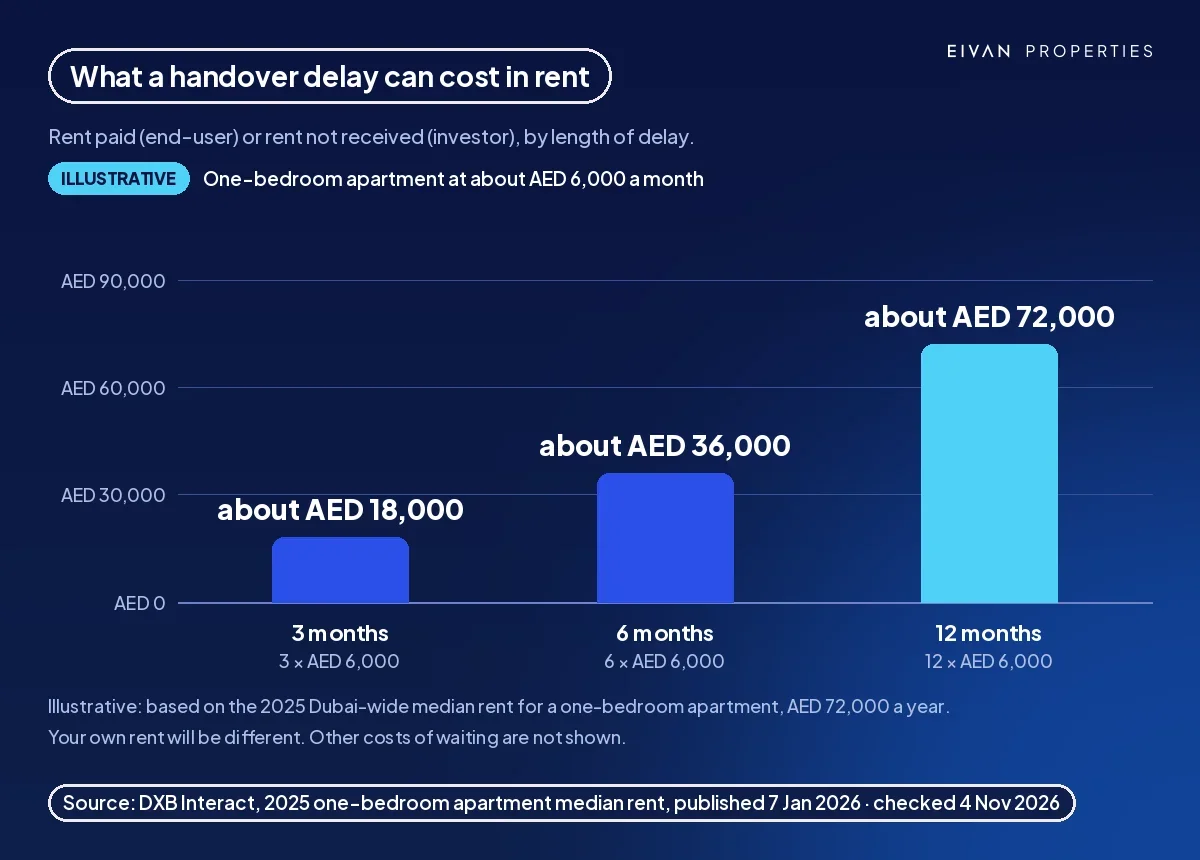
Illustrative: a one-bedroom apartment renting at the 2025 Dubai-wide median of AED 72,000 a year (DXB Interact) is about AED 6,000 a month of rent paid or lost for each month of delay.
Delay | Rent paid (end-user) or rent not received (investor), illustrative one-bedroom at AED 6,000 a month | Basis |
|---|---|---|
3 months | about AED 18,000 | 3 × AED 6,000 |
6 months | about AED 36,000 | 6 × AED 6,000 |
12 months | about AED 72,000 | 12 × AED 6,000 |
Illustrative figures based on the 2025 Dubai-wide one-bedroom apartment median rent (DXB Interact, published 7 Jan 2026). Your own rent will be different.
Other costs to think about
Rent is usually the clearest cost, but it is not the only one.
Payment-plan exposure: the money you have already paid is tied up in a home you cannot use or rent out yet. The more you pay before handover, the more a delay affects you. Our guide to payment plan strategies explains how plans differ.
Mortgage timing: if you plan to finance the final payment, a new handover date can change when you need the loan. Check with your bank early.
Opportunity cost: money waiting in a delayed project is money you cannot use for something else.
We do not give figures for these costs because they depend on your own plan and finances.
Reducing delay risk before you buy
You cannot remove delay risk, but you can reduce it before you sign. Look at the developer's record of finishing projects, read the SPA's completion and extension terms, and check the project's official status.
We cover the full set of pre-purchase checks in the 10 due diligence checks before you buy off-plan, and how to judge a developer's track record in how to evaluate a developer.
If delay risk is a dealbreaker for you, a ready home may suit you better. Our comparison of off-plan vs ready property explains the trade-offs.
The bottom line
Off-plan delays happen in Dubai, so every buyer should plan for them. Escrow, the interim register and official completion figures give you real protection, but none of them guarantees a handover date or compensation. Your SPA matters most. Read its dates and extension terms, check the official status yourself, and get legal advice before you take any step in a dispute.
Thinking about an off-plan project? If you would like to talk through a project's status before you buy, you can talk to an adviser. For legal questions or a dispute about your contract, please speak to a qualified lawyer.