
How to Evaluate a Developer in Dubai: Delivery Record, Quality and Risk Checklist
Buying a Dubai property is not only about location, price, and payment plan. It is also about the developer behind the project. A strong developer can protect your timeline, build quality, resale value, and rental performance. A weak developer can create delays, defects, service-charge pressure, and exit risk.
That is why how to evaluate a developer in Dubai should be one of the first questions a buyer asks. In Dubai, buyers can verify whether a developer is approved by Dubai Land Department, check project status, review off-plan project details, and monitor key project information through official channels such as Dubai REST. Dubai Land Department also states that off-plan buyer funds are deposited into a project escrow account designed to regulate construction and protect investors’ rights.
This guide gives you a practical risk checklist. It is written for end users, investors, and overseas buyers who want a clear process before they reserve a unit.
Why developer quality matters more than brochure quality
A polished sales gallery does not prove delivery strength. What matters is whether the developer is properly approved, whether the specific project can be tracked on official channels, whether the escrow structure is in place for off-plan sales, and whether the firm has a history of handing over projects in acceptable condition. Dubai Land Department offers an approved developers service, a project status enquiry service, and permit verification tools, while Dubai REST provides completion percentage, actual project pictures, and the escrow account number for off-plan projects.
In simple terms, your real risk is not only “Will this area perform?” but also “Will this developer deliver what was promised, at the quality level expected, and on a timeline that still works for my plan?” That is the core of how to evaluate a developer in Dubai.
How to evaluate a developer in Dubai before you pay a booking amount
Start with official verification. Before you discuss finishes or incentives, confirm that the developer appears on Dubai Land Department’s approved developers list. Then check whether the exact project can be found through the project status enquiry service or Dubai REST. If the project is off-plan, verify that the escrow framework exists, because DLD says escrow accounts are used for off-plan buyer funds and are intended to protect investors’ rights.
After that, move to delivery evidence. Ask for a list of the developer’s handed-over projects in Dubai. Do not rely only on a brand presentation. Visit completed assets if possible. You are looking for consistency across lobbies, corridors, parking areas, façade condition, lift quality, gym upkeep, pool finishing, and the condition of units after occupancy.
Then review contract risk. Dubai Land Department notes that contract termination disputes are not simply decided by DLD at a buyer’s request and may need court action if a project is not cancelled. That means buyers should understand payment schedules, delay clauses, specifications, and variation language before signing.
The 7-point developer due diligence checklist
1) Confirm the developer is officially approved
Your first filter is simple. Check the developer through the Dubai Land Department approved developers service. DLD describes this service as a way for customers to view the list of developers approved by the Land Department. If a buyer skips this step, they are ignoring the most basic gatekeeper check.
2) Check the exact project status, not just the master brand
A good brand does not remove project-level risk. DLD’s project status enquiry allows users to search by land number, project number, or project name and view project completion percentage and details. Dubai REST also gives real-time project information for off-plan beneficiaries. That means your due diligence should be project specific, not only developer specific.
3) Review escrow protection for off-plan projects
For off-plan projects, escrow is one of the most important protection layers. DLD states that amounts collected from off-plan purchasers are deposited into a real estate escrow account, and that the account is meant to regulate construction and protect investor rights. DLD also says all amounts received from off-plan buyers are deposited into the project escrow account.
4) Verify permits and licensing documents
DLD provides a license and permit verification service through the Trakheesi system. Use it to verify relevant licenses and permits rather than accepting screenshots or marketing files at face value. This is especially important when multiple sales agents and channel partners are involved.
5) Inspect build quality in completed projects
This step is not fully digitized. You need site evidence. Visit at least one delivered project by the same developer, and preferably two. Check paint lines, joinery alignment, bathroom waterproofing signs, façade aging, corridor ventilation, common-area cleanliness, and the quality of materials in high-traffic spaces. A developer that looks excellent in the show apartment but weak in handed-over stock deserves extra caution.
6) Assess after-sales and defect response
A handover is not the end of risk. It is the start of live building performance. Ask owners, tenants, and brokers how quickly snagging issues were addressed, how warranty communication was handled, and whether building management stabilized quickly after handover. Service quality after delivery often tells you more than the launch event.
7) Study reputation through evidence, not noise
Market reputation matters, but only when you separate evidence from marketing. A useful reputation review includes completed-project visits, broker feedback, owner feedback, leasing speed, and resale depth in the developer’s existing communities. A developer with repeat buyer interest and stable end-user demand usually has stronger market trust than a developer that only wins attention during launch week.
Handover history: what buyers should actually measure
When buyers discuss delivery record, many only ask whether a project was handed over. That is too basic. You should ask four sharper questions.
First, did the developer hand over projects that were broadly aligned with the promised product level? Second, how did those buildings age after occupancy? Third, were common areas still attractive after one or two years of use? Fourth, did the handover support resale and rental demand?
Use a consistent scoring method. Do not change the benchmark from one project to another. Compare lobby quality to lobby quality, façade condition to façade condition, and owner feedback to owner feedback. That keeps your review clean and stops emotion from distorting the decision.
A strong delivery record is not perfection. It is repeatability. If the developer repeatedly produces acceptable quality, manages the handover process well, and supports the building after completion, risk is lower.
Build quality: what to inspect beyond the sample apartment
The sample apartment is designed to sell. Your job is to evaluate what happens in the real building. Start with common areas because they reveal cost discipline. If corridors, parking, lift lobbies, and amenities feel weak, the issue is usually bigger than one unit.
Inside the unit, inspect straightness of finishes, edge details, closing quality of doors, wardrobe fit, silicone lines in wet areas, drainage slope, AC diffuser placement, and noise insulation where possible. In kitchens, look at cabinet alignment and hinge quality. In bathrooms, look for practical detailing, not only visual styling.
Also assess layout quality. A developer can use decent materials and still produce a weak product if circulation is poor, storage is insufficient, or balcony space is unusable. Real quality is the combination of finish, planning, and long-term functionality.
How to evaluate a developer in Dubai for risk, not just for branding
This is the part many buyers miss. How to evaluate a developer in Dubai is really a risk exercise. You are testing execution risk, legal process risk, handover risk, and exit risk.
Execution risk is reduced when the developer is approved, the project is visible in official project-status channels, and the off-plan escrow structure is in place. Legal process risk is reduced when permits can be verified and contract clauses are reviewed carefully. Handover risk is reduced when the developer has a solid record in completed assets. Exit risk is reduced when the delivered product still attracts tenants and resale buyers after completion.
How to evaluate a developer in Dubai with a simple scorecard
Use this editorial scorecard for internal comparison. It is a practical assessment model, not an official DLD rating.
Approval and permit verification: 20 points
Project status and escrow visibility: 20 points
Delivery record in completed projects: 20 points
Build quality inspection: 15 points
After-sales and snagging response: 10 points
Market reputation among owners and brokers: 10 points
Resale and rental depth in delivered stock: 5 points
Total: 100 points
Interpretation:
85 to 100: strong developer profile
70 to 84: acceptable, but review project-specific risks closely
Below 70: higher caution; only proceed if pricing clearly compensates for the risk
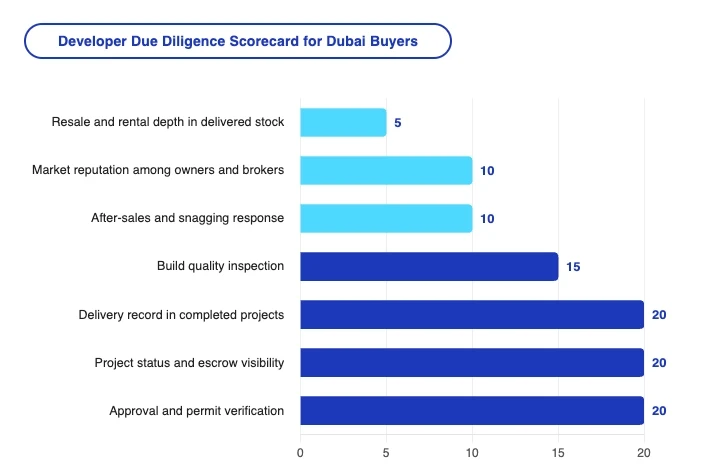
Because this is your own scorecard, the numbers stay consistent across every developer you compare. That solves the common buyer mistake of changing standards from one launch to the next.
Red flags that should slow your decision
Be cautious if the sales team avoids giving clear project identifiers, if the specific project is hard to verify on official channels, if permit verification is vague, or if the developer leans too heavily on future promises instead of delivered evidence. Be equally cautious if the show unit is impressive but completed stock tells a weaker story.
Another red flag is when buyers cannot get a clear explanation of handover quality, defect handling, or building operations after completion. A serious developer should be able to point to real delivered product, not only renders.
Should you buy only from big-name developers?
Not always. Scale helps, but scale alone is not the answer. A large brand can still launch a project that does not fit your budget, layout needs, or investment timeline. A smaller developer can still be a valid option if its approvals, project status, escrow framework, quality evidence, and delivery track record are strong.
The right question is not “Is the name famous?” The right question is “Can this developer and this project pass my checklist?”
Final verdict
The smartest way to buy is to treat developer selection as a formal part of property due diligence. In Dubai, buyers have access to practical official tools: the approved developers list, project status enquiry, Dubai REST project data, escrow-related information, and permit verification. Those checks should come before emotion, incentives, or launch-day pressure.
If you want a safer buying process, use a consistent checklist, inspect completed projects, and review every project on its own merits. That is the real answer to how to evaluate a developer in Dubai.
For buyers who want on-ground guidance, Eivan Properties brings more than 25 years of real estate experience in Dubai and can help you compare developers, review project risk, and shortlist options that fit your goals. Explore opportunities at eivanproperties.ae.