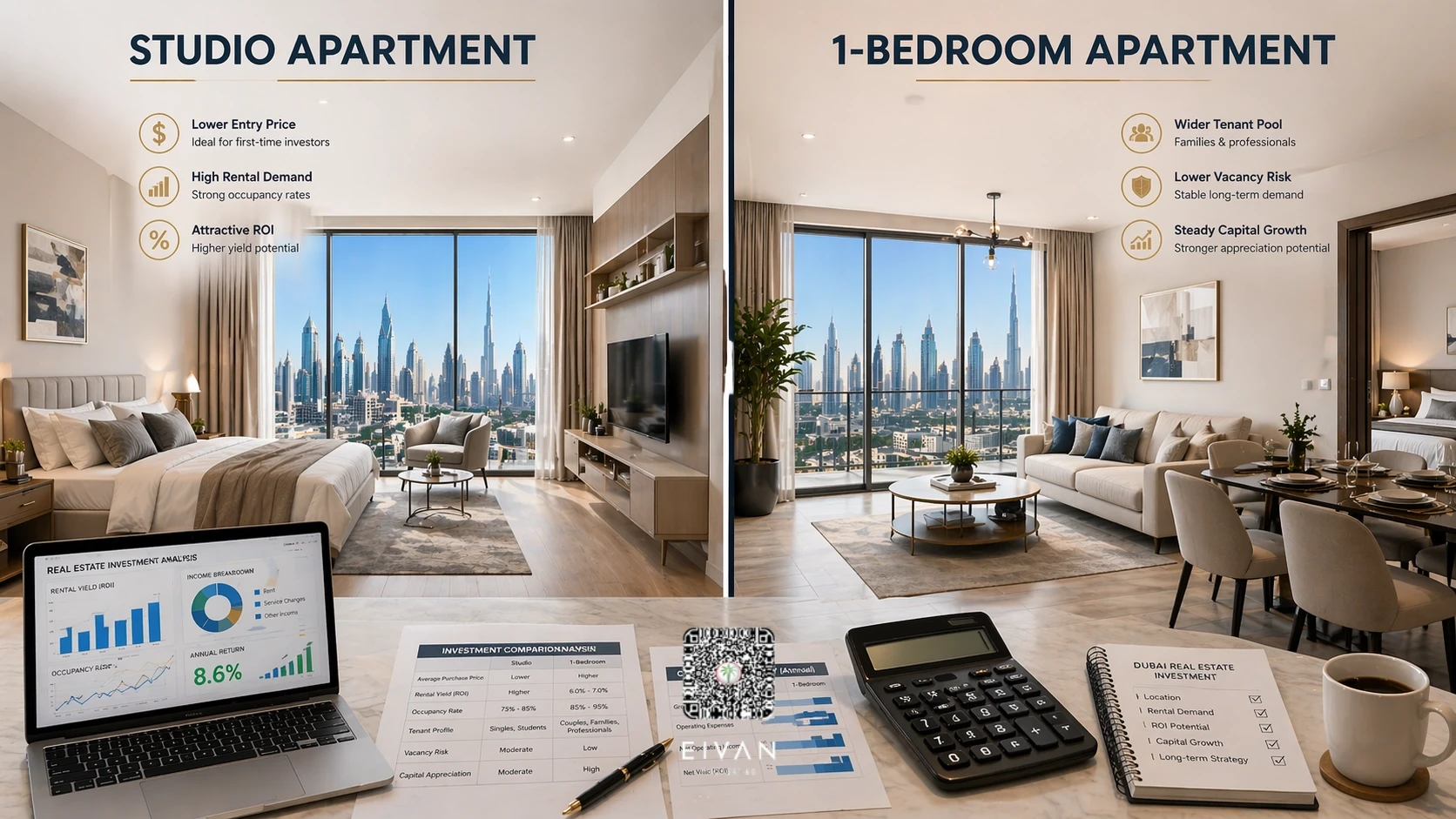
Off-Plan vs Ready Property Dubai: Which One Is Better for Investors in 2026?
Dubai property investors are asking one main question in 2026: should you buy off-plan or should you buy ready stock?
The answer is not the same for everyone. Some investors want lower entry prices and stronger capital appreciation. Others want rental income from day one and lower execution risk. That is why the off plan vs ready property Dubai debate matters more in 2026 than it did a few years ago.
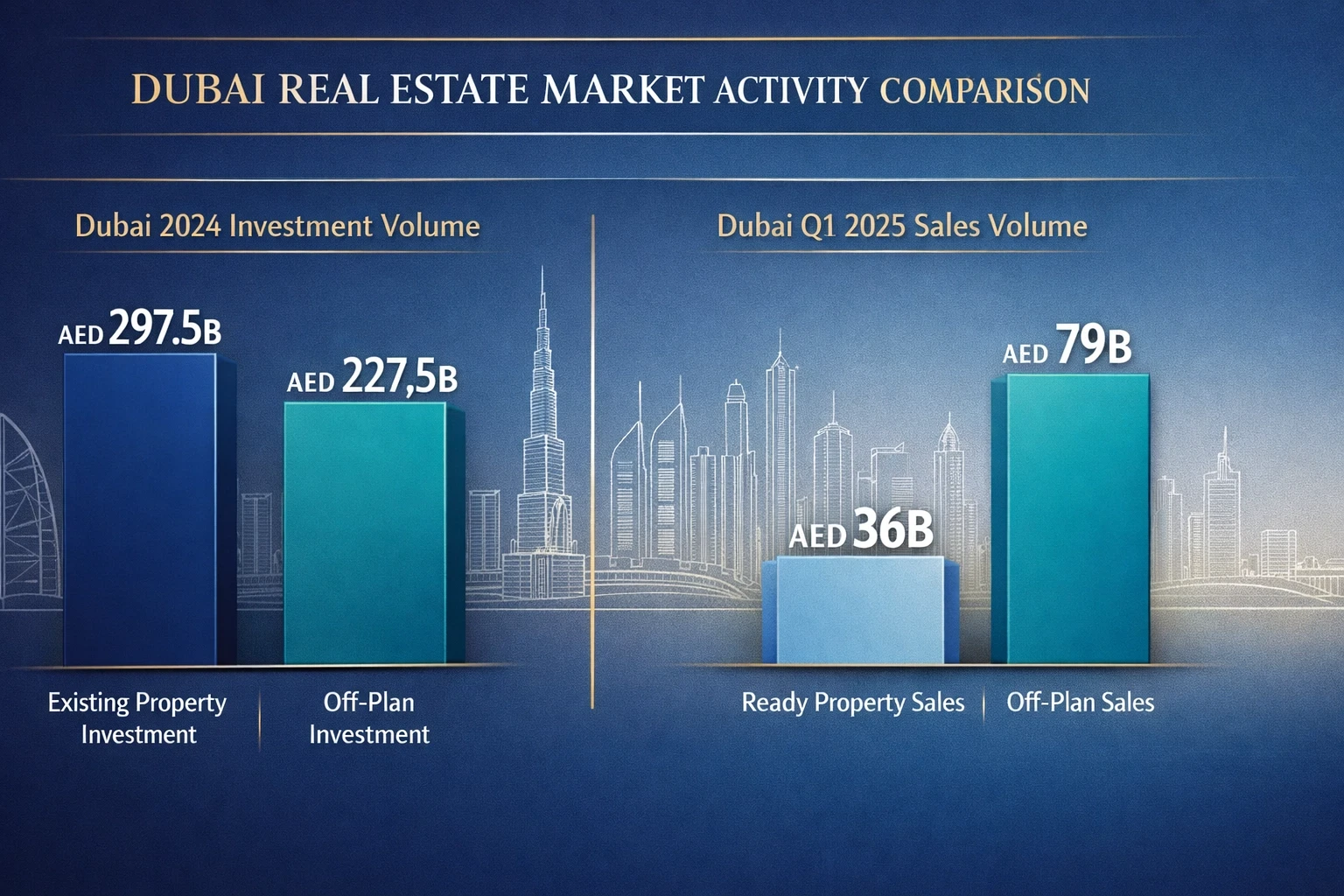
The market backdrop is strong. Dubai Land Department reported AED 522.4 billion in sales transactions in 2024, up from AED 410.2 billion in 2023. Sales made up nearly 69% of total transaction value. In the same official report, off-plan investment value reached AED 227.5 billion in 2024, while existing property investment value reached AED 297.5 billion. CBRE then showed that momentum continued into 2025, with Q1 sales value at AED 115 billion, of which AED 79 billion came from off-plan and AED 36 billion from ready property.
So, the market is not choosing one side only. Both segments are active. The better option depends on your investment objective, your cash-flow needs, and your risk tolerance.
Off plan vs ready property Dubai: the investor decision in 2026
For most investors, the choice comes down to four filters: entry cost, cash flow, upside, and risk.
Off-plan property usually wins on entry strategy. Developers often launch with phased payment plans and pricing that is lower than comparable completed stock in the same area. In a market where new launches keep attracting demand, that matters. Dubai Land Department’s 2024 report also showed strong off-plan participation, with 129.9 thousand off-plan investments and 98.5 thousand off-plan investors in 2024.
Ready property usually wins on visibility. You can inspect the exact building, check the finish level, study live rental performance, and start generating income after transfer. That is why ready property remains attractive for investors who care more about immediate yield than future upside. DLD’s 2024 report recorded AED 297.5 billion in existing property investment value and 86.2 thousand existing-property investments.
In simple terms, off-plan is a forward-looking strategy. Ready property is a present-day income strategy.
What off-plan property offers investors in Dubai
Off-plan works best when you want to enter early and ride the project cycle.
The strongest advantage is the payment structure. Instead of paying the full purchase price at transfer, buyers usually follow a construction-linked plan. That reduces the upfront capital burden. It can make premium locations more accessible, especially for investors who prefer to spread capital across multiple assets.
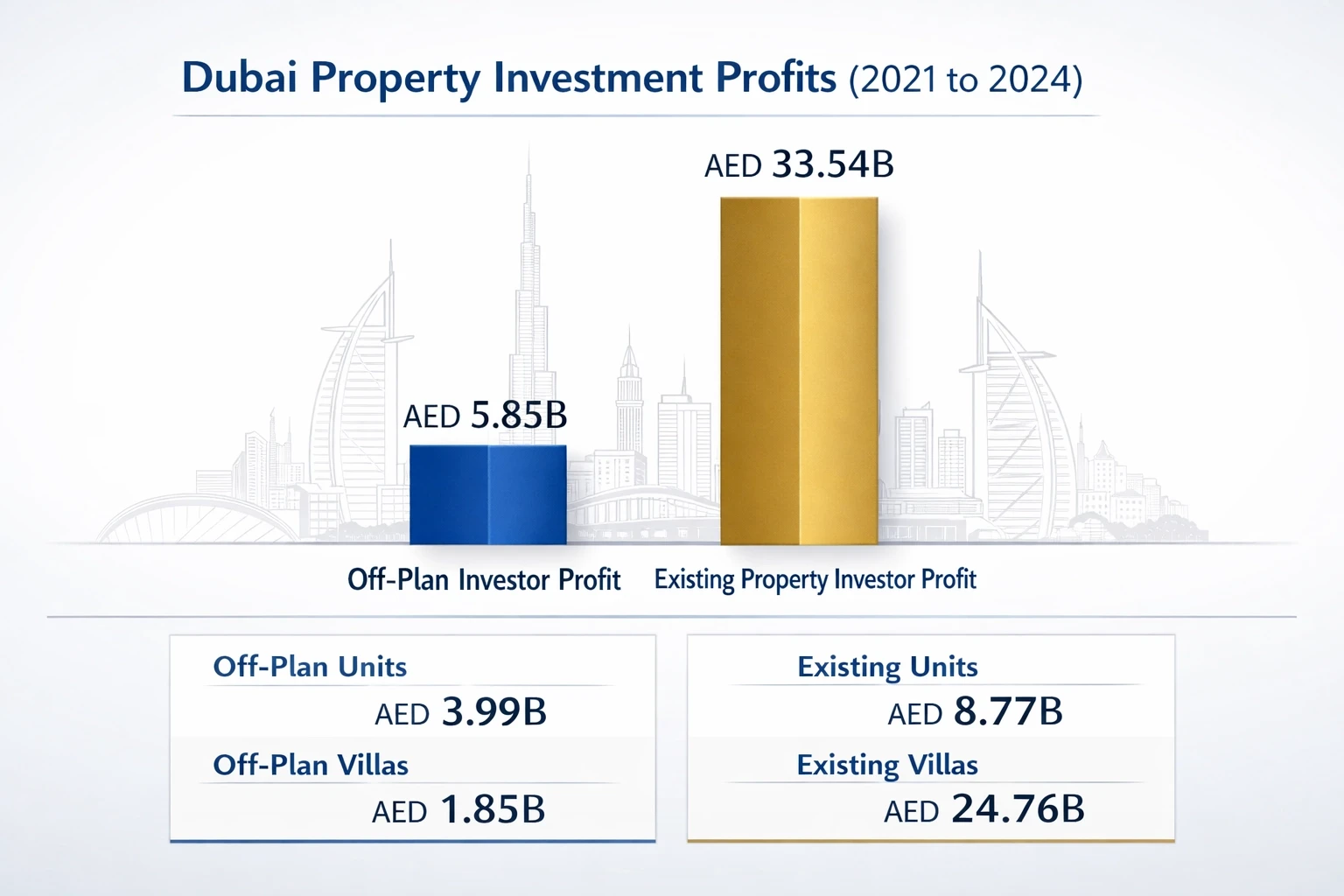
The second advantage is appreciation potential. DLD’s profitability analysis for 2021 to 2024 showed total realized investor profit of AED 5.85 billion from off-plan resales, with units contributing AED 3.99 billion and villas AED 1.85 billion. The same analysis noted that unit resale outperformed villa resale in absolute off-plan profit, helped by stronger liquidity and broader demand in apartment-led communities.
That point matters in 2026. If your plan is to buy below future market value and exit near handover, off-plan apartments in strong communities still offer a credible path. DLD’s own strategic takeaway was clear: off-plan remains a strategic entry point when paired with strong developers and desirable locations.
There is also a market-share argument. CBRE reported that in Q1 2025, off-plan accounted for 69% of residential sales value in Dubai. That tells you where launch-led demand is concentrated.
But off-plan is not risk free. Delivery timing can shift. Market conditions can change before handover. And the real outcome depends heavily on developer quality, project location, future supply, and the payment plan structure.
Why ready property still works in 2026
Ready property remains the cleaner choice for investors who want proof, not promises.
The main benefit is immediate cash flow. Once you complete transfer and fit-out requirements, the asset can be rented. In a high-demand rental market, that is a major advantage. Bayut’s 2025 sales report showed that apartment rental yields in popular communities ranged from 8% to 10%, while strong villa communities averaged above 6%. Examples from its 2025 data include 8.76% ROI in Dubai Sports City, 7.91% in Dubai Silicon Oasis, and 7.42% in Jumeirah Village Circle.
Ready property also gives you clearer pricing intelligence. You can compare recent transactions, current rent, service charges, vacancy, building quality, and even tenant demand by unit type. That makes underwriting easier.
DLD’s profitability analysis for existing-property resales also shows why many investors still like this segment. From 2021 to 2024, total realized investor profit from existing properties reached AED 33.54 billion, with villas contributing AED 24.76 billion and units AED 8.77 billion. That is much larger in absolute terms than the off-plan profit pool in the same study period.
This does not mean ready property is always the better investment. It means ready stock can produce strong outcomes when bought in the right micro-market and at the right price, especially in supply-constrained villa communities and established apartment districts.
off plan vs ready property Dubai for cash flow
Cash flow is where the difference is easiest to understand.
With ready property, rent can begin soon after transfer. That makes it suitable for investors who want income to support mortgage payments or who measure performance quarter by quarter.
With off-plan, there is no rent during construction. Your return depends more on price appreciation, resale demand, or future rent after handover. That is why off-plan is usually weaker for immediate cash flow and stronger for staged capital growth.
Rental conditions in Dubai remained supportive through 2025. Bayut reported apartment rents generally increased by 4% to 10% in 2025, while villa rents in some communities rose much faster because of limited quality supply.
For a yield-first investor, ready property usually wins. For a growth-first investor, off-plan can still outperform if the entry price is right and the project is delivered into strong demand.
off plan vs ready property Dubai for capital appreciation
Capital appreciation is where off-plan often gets more attention.
The reason is simple. Buyers enter earlier in the price cycle. If the developer launches at an attractive level, and if the area improves before handover, the investor can benefit from both project progress and market growth.
DLD’s off-plan profitability pages support that logic. Investors who bought off-plan and later resold generated AED 5.85 billion in total realized profit between 2021 and 2024. The report also highlighted that 2022 was the most profitable entry year in that analysis.
Still, ready property should not be underestimated. Existing villas and selected completed communities performed very strongly in the same broad cycle. DLD recorded AED 33.54 billion in realized profit from existing-property investors over 2021 to 2024, helped by limited inventory in prime villa communities and a sharp post-pandemic shift toward larger homes.
So the appreciation question is not just off-plan versus ready. It is bad asset versus good asset. A well-bought ready villa in a supply-constrained community can outperform a weak off-plan launch. A top off-plan apartment bought early in a strong corridor can outperform average completed stock.
Cost, leverage, and investor risk
Investors also need to compare transaction cost and leverage.
Dubai’s standard property transfer cost benchmark remains the 4% DLD registration fee on transfer, and DLD service pages also show fixed administrative charges such as AED 4,200 for certain sale registrations plus map and title deed fees in relevant cases.
On financing, the UAE Central Bank rulebook shows that for a first property, maximum loan-to-value can reach 85% for UAE nationals on properties up to AED 5 million, and 80% for non-UAE nationals on properties up to AED 5 million, with lower caps above that threshold.
That matters because ready property is usually easier to model with mortgage-backed cash flow. Off-plan financing can be more restrictive and more developer-specific, especially before completion. So leveraged investors often prefer ready units if stable financing is central to the plan.
Risk is also different in each segment.
With off-plan, key risks are developer execution, construction delays, launch pricing, future supply, and handover quality.
With ready property, key risks are overpaying for current market stock, hidden maintenance issues, lower-than-expected rent, higher service charges, and weak building management.
Neither segment is low risk by default. The safer choice is the one you understand better and underwrite more carefully.
Which investor should buy off-plan in 2026?
Off-plan is usually better for investors who fit these profiles.
First, investors with a medium-term horizon. If you do not need income today and can wait through the build cycle, off-plan can make sense.
Second, investors targeting appreciation over yield. DLD’s off-plan resale profitability data shows that gains have been real, not just theoretical, especially for well-selected units.
Third, investors who can evaluate developer quality. The gap between top-tier and weaker launches is wide. Escrow structure, payment plan logic, prior delivery history, finish standards, and launch price discipline all matter.
Fourth, investors building a portfolio. Spreading staged payments across multiple assets can improve capital efficiency.
Which investor should buy ready property in 2026?
Ready property is usually better for a different kind of buyer.
It fits investors who want rental income from the start. It also suits mortgage users who need an asset that can support financing and income tests more clearly.
It works well for defensive investors too. In an uncertain rate or supply environment, seeing the exact asset, exact building, and exact rent roll has real value.
Ready property can also be the better option for overseas buyers who want immediate operational control. You can appoint property management, track occupancy, and benchmark performance faster.
Final verdict: what is better for investors in 2026?
The best answer to off plan vs ready property Dubai in 2026 is this:
Choose off-plan if your priority is lower entry pricing, staged payments, and capital appreciation potential.
Choose ready property if your priority is immediate rental income, easier underwriting, and lower execution risk.
For many investors, the smartest move is not choosing one side forever. It is using both. A balanced Dubai portfolio can pair one income-producing ready asset with one growth-focused off-plan asset. That gives you current cash flow and future upside at the same time.
If you are investing in Dubai in 2026, do not buy based on headlines alone. Compare the developer, the handover timeline, live rental demand, service charges, payment schedule, and exit strategy. Then match the asset to your actual goal.
After 25+ years in the Dubai market, Eivan Properties helps investors compare off-plan and ready opportunities with a real underwriting lens, not sales talk. Visit eivanproperties.ae to review the right communities, compare ROI scenarios, and build an investment plan that fits your budget and timeline.