
Off Plan Buying Process Dubai: From EOI to Handover
Buying an off-plan unit in Dubai is not just about picking a tower and paying a booking amount. The real process starts before the sale and continues until the unit is handed over, inspected, and fully registered. If you understand each stage, you reduce risk, manage cash flow better, and avoid delays that often come from weak paperwork or poor project checks.
The off plan buying process Dubai buyers follow usually moves through these stages: project and developer due diligence, EOI or reservation, signing the sale and purchase agreement, Oqood registration, staged construction payments, pre-handover checks, final settlement, and title deed issuance after completion. Dubai’s legal framework also gives structure to this sequence. Off-plan disposals must be registered on the Interim Real Estate Register, and sales made before the required approvals and project registration are treated as void under Dubai’s framework for off-plan sales.
For buyers, that matters because process is protection. Dubai Land Department states that the initial off-plan sale is registered through the provisional register service in Oqood, the sale and purchase contract must be registered within 90 days of signing, and the official service fee is 4% of the sale value, split as 2% seller and 2% purchaser, plus AED 10 knowledge fee and AED 10 innovation fee.
Why the off plan buying process Dubai buyers follow starts before reservation
Before paying an EOI or reservation amount, the first check is not the brochure. It is the project’s legal and operational standing. Dubai’s rules require developers to obtain approvals before launching, marketing, and selling off-plan units. The project must be registered, and off-plan sales are tied to the DLD interim register system. Buyer payments for off-plan units are also deposited into the project escrow account, which exists to protect buyer funds and channel them into project development.
A buyer should confirm five basics before moving forward. First, the developer should be properly registered. Second, the project should be launched with the required approvals. Third, the unit details in the reservation form and SPA should match what is being marketed. Fourth, the payment plan should be written clearly, with dates or construction-linked milestones. Fifth, the project status should be trackable through Dubai Land Department’s project-status tools, which DLD says provide completion percentage and project status data.
This early stage is where many smart buyers win. They compare not only price per square foot, but also escrow discipline, construction pace, handover history, and contract clarity. A cheap launch price does not automatically mean better value. In off-plan, the process quality is part of the product.
Step 1: EOI and reservation in the off plan buying process Dubai market uses
An EOI, or expression of interest, is usually the first soft commitment. It is common during pre-launch or early launch phases, especially when demand is strong and buyers want priority access to unit selection. The exact EOI amount is not fixed by a single Dubai-wide official rule, so buyers should treat it as developer-specific and confirm whether it is refundable, when it converts into a reservation, and what happens if the selected unit is not allocated.
After that comes the reservation stage. At this point, the buyer normally submits identification documents and signs a reservation form. For individuals, DLD’s initial sale registration requirements show the core identity documents used later in the process: a copy of the sale and purchase contract, a valid UAE ID if applicable, and a valid passport for non-residents. Company purchases require extra documents such as trade license papers, shareholder documents, and in some cases legalized Arabic translations and free-zone NOCs.
This is the point where buyers should lock in the exact unit number, net area, gross area if relevant, floor, view, parking allocation, expected completion date, and payment schedule. Many disputes later come from buyers assuming the brochure is enough. It is not. The reservation form and later SPA should say exactly what is being bought.
What to check before paying the reservation amount
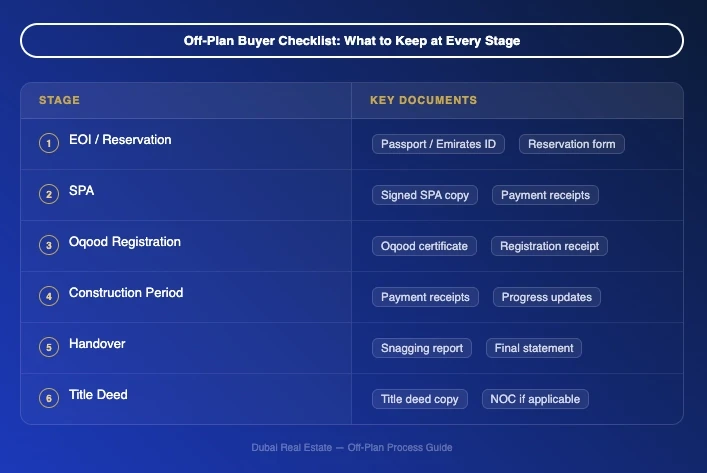
Read the reservation terms line by line. Confirm whether the amount is adjustable against the purchase price, whether the booking is transferable, and whether any admin charge is non-refundable. Also verify how long the developer gives you to sign the SPA after reservation. If the unit is being bought through a broker, make sure the broker is properly authorized and the broker’s role is clear.
For investors, this is also the right moment to model cash flow. Look at the full payment curve, not just the first deposit. Many off-plan buyers focus on entry cost and forget that the real test is whether they can meet the next milestone on time.
Step 2: Signing the SPA
The Sale and Purchase Agreement is the real contract. This document should set the purchase price, payment schedule, unit specification, project name, expected handover timing, default clauses, delay terms, termination mechanics, and dispute framework. Dubai’s investor-rights guidance also notes that Law No. 9 of 2009 sets out a process for a developer to terminate an off-plan sales contract where a purchaser defaults on payment obligations. That means buyers should understand the consequences of missing instalments before signing.
A strong SPA review focuses on practical points. Does the unit description match the reservation form? Are the milestones date-based or construction-based? Does the contract define what counts as handover readiness? Is there a grace period? Are service-charge expectations disclosed? Is parking included? Is there any clause allowing major layout changes?
This is also where foreign buyers should check ownership structure and eligible area rules. Dubai’s framework permits foreign ownership in designated areas, but the exact project and plot details should still be confirmed in the sale paperwork and registration path.
Step 3: Oqood registration
This is one of the most important legal steps in the off plan buying process Dubai investors should never ignore. Dubai Land Department’s service page states that the initial sale of units sold off-plan is registered in the provisional register through Oqood. The official service page also says the SPA must be registered within 90 days from signing. Once completed, the output is a provisional registration e-certificate.
The fee on that same service page is clear: 2% of the sale value for the seller and 2% for the purchaser, which makes the total registration fee 4% of the sale value, plus AED 10 knowledge fee and AED 10 innovation fee. The page also lists a AED 1,000 self-registration fee for developers on the Oqood portal.
From a buyer’s point of view, the main issue is not just paying the fee. It is making sure the registration actually happens and the unit appears properly in the provisional system. Off-plan registrations that are not properly recorded create risk later when financing, resale, or final title transfer is needed.
Why Oqood matters in the off plan buying process Dubai buyers follow
Oqood matters because Dubai law treats registration seriously. DLD’s investor guide states that disposals relating to off-plan units must be registered on the Interim Real Estate Register, otherwise those disposals would be considered null and void. That is why buyers should keep the provisional registration certificate, payment receipts, SPA copy, and all developer correspondence in one file from day one.
Step 4: Construction-linked payments and escrow protection
After registration, the transaction moves into the instalment phase. Some projects use fixed-date schedules. Others use construction-linked milestones. Either way, the buyer should follow both the payment calendar and the project’s physical progress.
Dubai Land Department’s FAQ states that all amounts received from buyers of off-plan units must be deposited into the project escrow account. DLD also explains that escrow disbursements are tied to verified construction milestones, and only eligible project-related payments can be released. It further states that 5% of the total amount paid into the escrow account is retained for one year after project completion as a guarantee for defects that are clear on completion or appear within one year after handover.
That is one of the strongest protections in the system. It does not remove project risk, but it does reduce the chance that buyer funds are treated as general-purpose developer cash. For buyers, the practical takeaway is simple: monitor progress, keep proof of every instalment, and compare milestone invoices against actual site advancement and official project updates where available.
Step 5: Pre-handover inspection and snagging
When the project nears completion, buyers move from paper risk to physical risk. This is the stage for snagging. The goal is to inspect the unit for defects, missing finishes, equipment problems, water leaks, sealant gaps, alignment issues, damaged surfaces, and MEP faults.
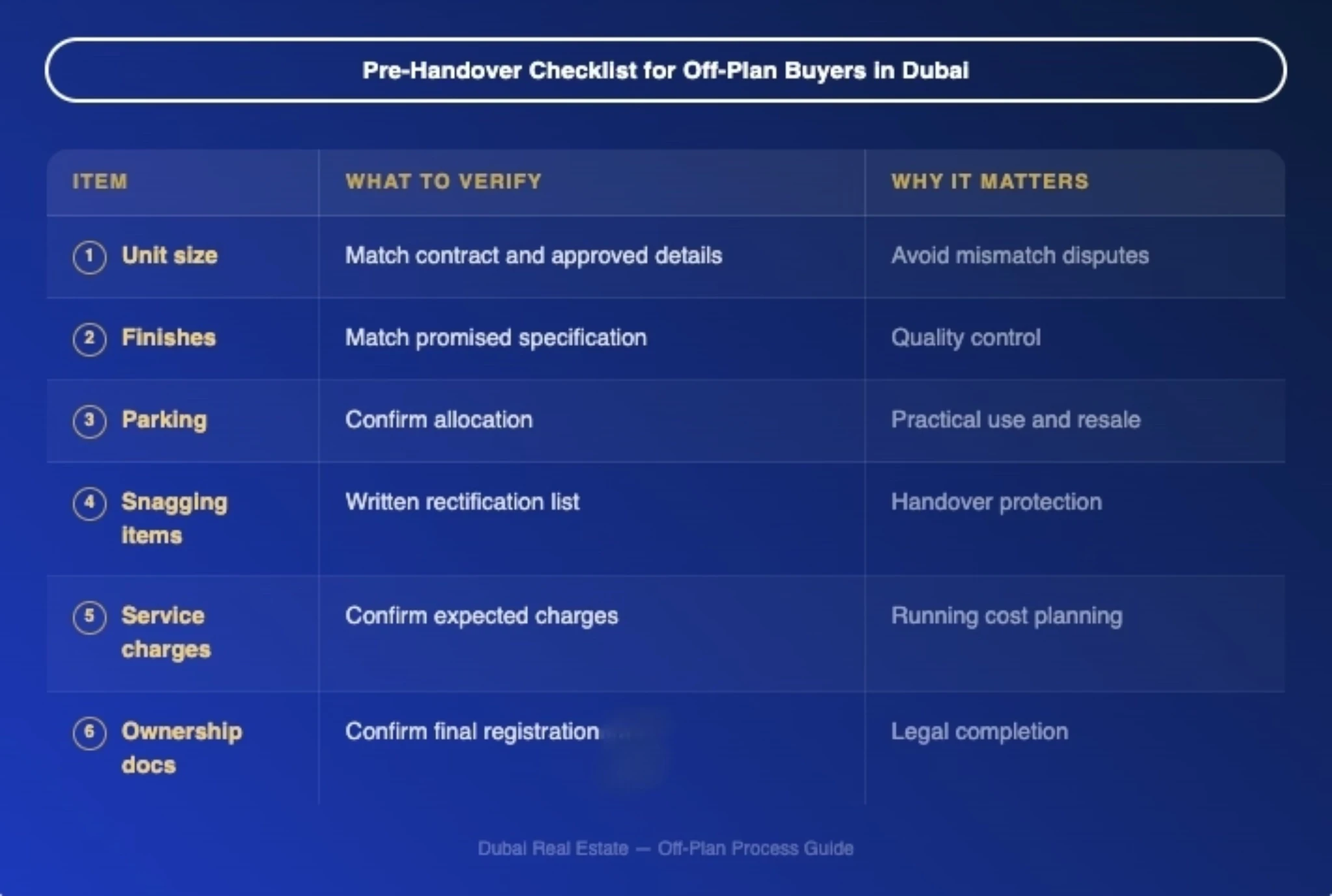
Dubai’s investor-rights guide states that developers are liable to repair structural defects for 10 years and minor defects for 1 year from the date of the building completion certificate in jointly owned properties. That does not mean buyers should skip inspection. It means buyers should inspect early, document everything clearly, and push for written rectification timelines before final acceptance.
A good snagging report should include room-by-room observations, photos, unit references, and a clear severity rating. For end users, this reduces moving-in stress. For investors, it protects leasing timelines because unresolved defects can delay furnishing, tenant onboarding, and rent commencement.
Step 6: Final payment, handover, and title deed
Handover usually comes after the project reaches completion, the developer calls for final settlement, and the buyer clears outstanding amounts. At this stage, the buyer should receive the final statement, handover notice, snagging status, community or building information, and instructions for final ownership registration.
Dubai Land Department’s service page for completing initial procedures data lists these fees where the registration fee has already been collected: AED 250 title deed fee for an apartment, villa, or land; AED 250 map fee for a real estate unit or villa; plus AED 10 knowledge fee and AED 10 innovation fee. The page states a service time of 6 business days.
From a buyer’s perspective, handover is not the finish line until three things are done. First, the unit condition is accepted or snagging is formally tracked. Second, all financial obligations are settled and documented. Third, final ownership documents are issued correctly. A beautiful handover event means little if registration paperwork remains incomplete.
The biggest mistakes buyers make
The most common error is rushing into a launch because of price pressure. The second is treating Oqood as a back-office item instead of a legal priority. The third is failing to read the SPA default and delay clauses. The fourth is underestimating the cash flow needed after booking. The fifth is accepting handover too quickly without a detailed inspection.
A disciplined buyer treats each stage as a checkpoint. That is the safest way to move through the off plan buying process Dubai market participants use every day.
Final takeaway
The best way to buy off-plan in Dubai is to think like both an investor and an auditor. Check the developer. Check the project status. Read the SPA. Confirm Oqood registration. Track instalments against progress. Inspect before handover. Close only when the unit and the paperwork are both right.
That is how the off plan buying process Dubai buyers follow turns from a sales journey into a controlled acquisition process.
For buyers who want expert help comparing projects, reviewing payment plans, and filtering stronger developers, Eivan Properties can support the full path from project shortlist to handover. With more than 25 years of experience in Dubai real estate, the team can help you assess launch quality, due diligence, and exit potential before you commit. Explore projects and advisory support at eivanproperties.ae.