How to Buy Property in Dubai: Step-by-Step Guide for Foreign Buyers
Dubai remains one of the easiest global cities for overseas buyers to enter. Foreign nationals can own freehold property in designated areas, and they can also hold other property interests such as usufruct or long lease rights in line with Dubai’s legal framework. The transfer process is formalized through Dubai Land Department, and the market offers both ready and off-plan options for international investors.
That sounds simple. But buyers still lose time and money when they skip due diligence, underestimate closing costs, or choose the wrong property type. This guide explains how to buy property in Dubai step by step, with the legal structure, cost checkpoints, and practical process a foreign buyer needs to follow.
Can foreigners buy property in Dubai?
Yes. Foreign nationals are permitted to buy freehold property in Dubai’s designated foreign ownership areas. Dubai Land Department’s investor guidance also states that foreign buyers may acquire other rights, including usufruct and long-term lease interests of up to 99 years. That is the legal foundation that makes Dubai accessible to non-UAE buyers.
This matters because your first filter is not just budget. It is ownership eligibility. Before you reserve any unit, confirm that the property is in an approved foreign ownership area and that the seller or developer has the right registration structure in place. For off-plan purchases, DLD’s Oqood system is part of that regulatory framework.
Step 1: Choose the right area and property type
The first real step in how to buy property in Dubai is choosing the right product. Buyers usually decide between:
ready property in the secondary or completed market
off-plan property purchased from a developer
apartment, villa, townhouse, branded residence, or plot
Ready property gives you a clearer view of the actual asset, service quality, and rental readiness. Off-plan can offer lower entry pricing and staged payment plans, but it requires closer review of developer track record, escrow protection, construction progress, and expected handover timeline. Dubai REST gives off-plan buyers access to project progress information, escrow-related details, and project updates.
For foreign buyers, the best choice depends on your objective:
How to buy property in Dubai for rental income
If your target is fast rental income, a ready property is usually easier. You can inspect the exact unit, estimate vacancy risk, and complete transfer faster. That reduces construction and delivery risk.
How to buy property in Dubai for long-term capital growth
If your goal is long-horizon appreciation, off-plan may fit better, but only if the developer is credible, the escrow structure is compliant, and the location has real end-user demand. DLD’s off-plan registration system exists to regulate that market, but regulation does not remove all commercial risk.
Step 2: Set your full budget, not just the purchase price
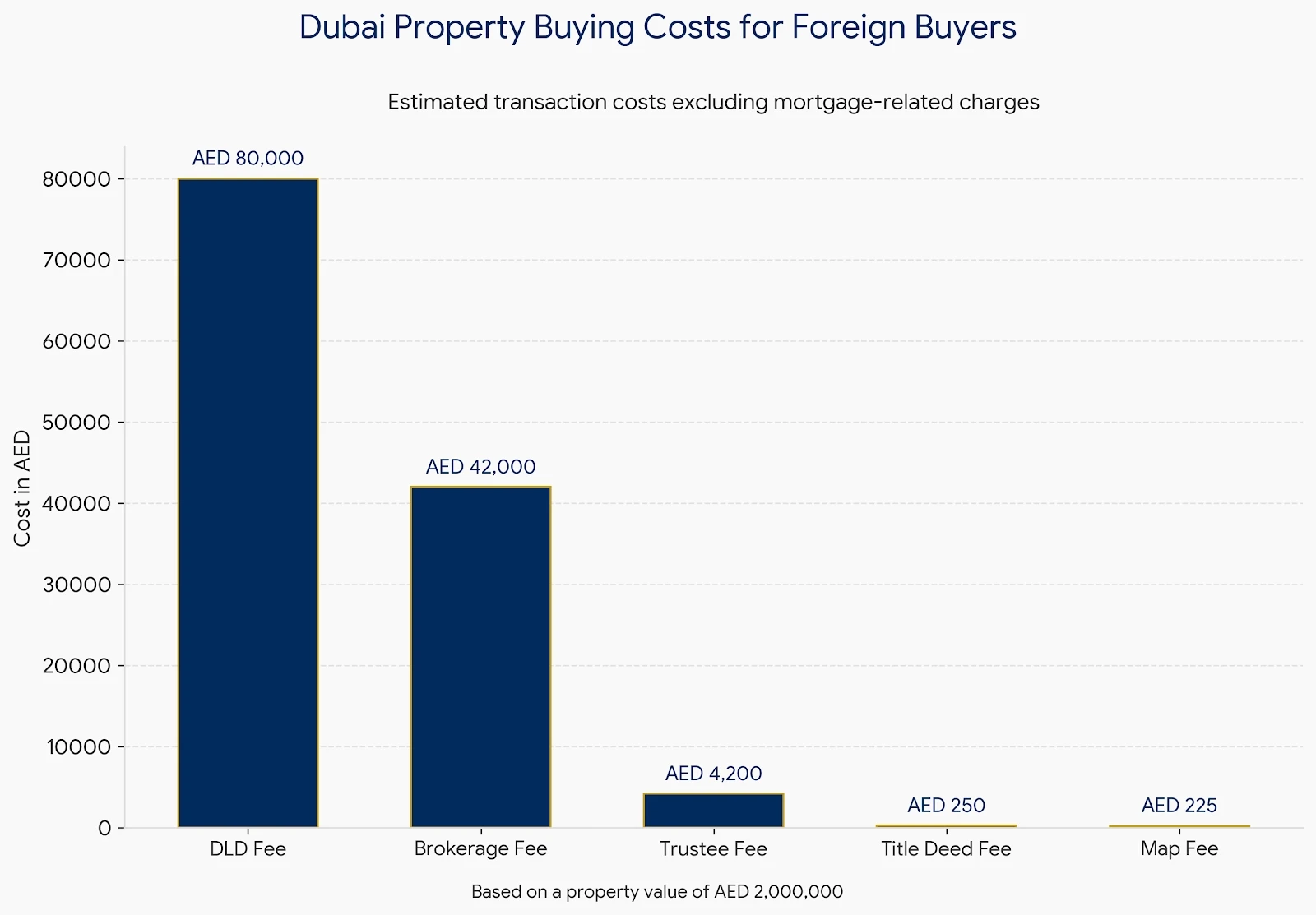
Many buyers focus only on ticket price. That is a mistake. The true cost includes DLD registration, trustee fees, title deed and map charges, brokerage, and possibly mortgage-related expenses. For a standard property sale registration, DLD lists a 4% transfer fee, commonly shown as 2% seller and 2% buyer in the fee schedule, plus trustee partner fees of AED 4,000 + VAT for property value of AED 500,000 or more, or AED 2,000 + VAT below that threshold. DLD also lists AED 250 for title deed issuance and map-related charges that vary by asset type.
In practice, buyer-broker commission in Dubai is commonly around 2% of the purchase price plus 5% VAT, although it can be negotiated in some cases.
Typical cost breakdown for foreign buyers
For a ready property purchase, your working budget often includes:
DLD transfer fee: 4% of property value
Trustee office fee: AED 4,000 + VAT if value is AED 500,000 or more
Title deed fee: AED 250
Map fee: AED 225 for unified map or AED 250 for villas/apartments in the listed fee structure
Brokerage fee: typically 2% + 5% VAT
Mortgage charges: vary by lender and structure
That means a buyer should normally model acquisition costs well above the headline sale price.
Step 3: Decide between cash and mortgage
Foreign buyers can buy in cash or with finance. Mortgage lending in the UAE is regulated by the Central Bank. Banks then apply their own product rules, income thresholds, and LTV limits within that framework.
Resident expat mortgage products commonly advertise financing up to 80% of property value, while some non-resident products are much lower. For example, ADCB publicly advertises financing up to 80% for expatriates and up to 50% for non-residents, with shorter tenors for non-residents. Emirates NBD also advertises resident expat home loans up to 80% and separate non-resident options.
So, before you reserve a property, get one number clear: your real down payment. If you are a non-resident buyer, your required equity is usually higher than a UAE resident’s.
Documents often requested for mortgage buyers
Bank document lists vary, but non-resident mortgage pages commonly ask for:
passport copy
salary certificate or income proof
bank statements
tax returns or financial records
property details for the selected unit
That is why pre-approval matters. It saves you from reserving a property you cannot finance.
Step 4: Reserve the property and verify the paperwork
Once you pick the property, the next stage is reservation and legal verification.
For a ready property, confirm:
seller identity
title deed status
any mortgage on the unit
service charge history
building quality and occupancy status
whether the broker is properly licensed
For off-plan, confirm:
project registration
developer credentials
escrow setup
payment plan
expected handover date
contract terms for delays, default, and cancellation
DLD offers property status inquiry services, and Dubai REST provides visibility on off-plan project information. Those tools should be part of your due diligence checklist.
This is where experienced agency support adds value. A buyer should not rely only on brochure language or verbal promises. Eivan Properties can support foreign buyers with area selection, due diligence coordination, cost planning, and transaction handling across ready and off-plan purchases.
Step 5: Sign the agreement
For ready property, the transaction typically moves to a formal sale agreement before transfer. In the resale market, this stage often includes the negotiated terms, deposit structure, timelines, and any conditions such as mortgage approval or seller mortgage release. The transfer itself is then completed through DLD’s sale registration process.
For off-plan property, the developer sale contract and Oqood-related registration process become central. DLD states that the initial sale registration service is used by developers to register units sold off-plan in the provisional register.
How to buy property in Dubai with an off-plan contract
Read the payment schedule line by line. Check what is due on booking, during construction, at handover, and after handover if a post-handover payment plan is offered. Also check the clauses covering delays, force majeure, cancellation, and refund mechanics. DLD’s off-plan framework helps regulate the process, but the SPA still controls many economic details that affect your risk.
Step 6: Complete the transfer and pay the government fees
For completed properties, sale registration is the point where the ownership change is formalized. DLD’s Property Sale Registration service covers the registration of sale transactions between seller and buyer, or their authorized representatives. DLD lists a standard 20-minute service time for the transaction workflow, assuming the documentation and payment instruments are in order.
The key fees for standard ready-property transfer include the 4% transfer fee, trustee partner fee, title deed issuance fee, and map charges. If the unit is mortgaged, extra mortgage-release and related registration fees can also apply.
For off-plan units, registration occurs in the provisional register before final title deed issuance later in the lifecycle. DLD also lists a separate process for completing the initial procedures and issuing title-related outputs once the project reaches the required stage.
Step 7: Receive title deed or complete handover
For ready property, this is the clean finish line. After registration, the new owner receives the title deed and takes possession according to the agreed handover terms.
For off-plan, handover comes later. Buyers should track:
construction progress
snagging and defect process
service charge expectations
final payment due
title deed conversion after provisional registration stage
Dubai REST is useful here because DLD states that it enables off-plan beneficiaries to see project completion information, actual project images, escrow account information, and payments due.

Can buying property help you get a Dubai Golden Visa?
Yes, in some cases. Dubai Land Department’s investor service states that a real estate investor owning property with a purchase value of AED 2 million or more can apply for a renewable 10-year residence permit. The UAE government’s official platform also states a minimum capital threshold of AED 2 million for this route. DLD further notes that for a mortgaged property, proof that AED 2 million has been paid may be required.
That does not mean every AED 2 million purchase automatically results in approval without conditions. Visa processing depends on the current immigration criteria and supporting documentation. Buyers should treat the visa as a benefit to verify, not a substitute for sound investment analysis.
Common mistakes foreign buyers should avoid
1. Confusing freehold with “available to all buyers”
A property must be in an approved ownership structure for foreigners. Never assume every listing is open to international buyers.
2. Underestimating transaction costs
The purchase price is not the full budget. DLD fees, trustee fees, title deed charges, brokerage, and mortgage costs can materially change your cash requirement.
3. Buying off-plan without checking project visibility
Use Dubai REST and verify project registration and payment terms.
4. Skipping mortgage pre-approval
Non-resident financing can be more restrictive than resident financing. Know your actual borrowing capacity first.
5. Treating visa eligibility as the main buying reason
A Golden Visa can add value, but the asset still needs to make financial sense.
Final thoughts on how to buy property in Dubai
The process is straightforward when you break it into stages. Confirm that the property is open to foreign ownership. Set a full acquisition budget. Decide cash or mortgage. Verify the seller or developer. Sign the right agreement. Complete DLD registration. Then move to title deed issuance or handover. That is the practical sequence for how to buy property in Dubai as an overseas buyer.
The good news is that Dubai has a structured property system, clear registration channels, and a legal framework designed to support international participation. The better news is that a strong advisor can make the process faster and safer. With more than 25 years of market experience, Eivan Properties can help foreign buyers shortlist the right communities, compare ready versus off-plan opportunities, estimate full costs, and manage the purchase process from search to transfer. Explore opportunities at eivanproperties.ae.