Is Dubai Real Estate a Bubble 2026? Data Backed Market Analysis
Dubai property has moved through a very strong growth cycle. That is why many buyers, sellers, and investors are now asking the same question: Is Dubai real estate a bubble 2026?
The best answer is not emotional. It has to come from data.
A bubble usually has four signs. Prices run far ahead of fundamentals. Debt becomes excessive. End user demand is weak. New supply builds faster than the market can absorb it.
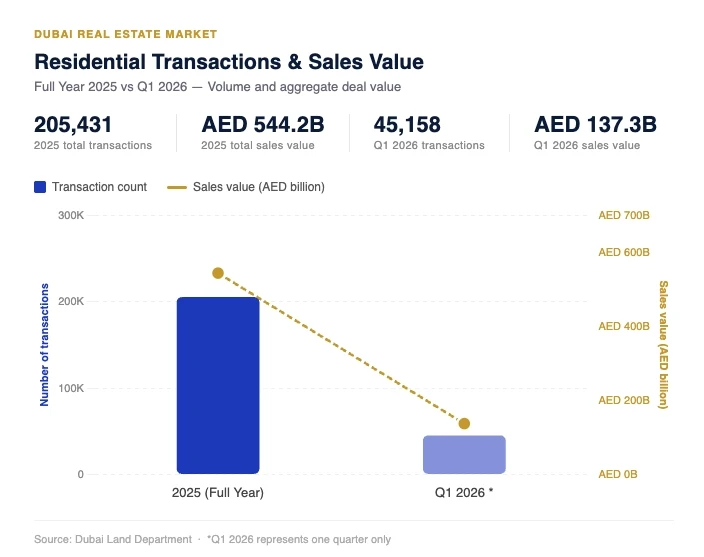
Dubai does show some late cycle features in 2026. Price growth has slowed. The market is highly dependent on investor confidence. Off plan still dominates. A large supply wave is scheduled. But the data does not yet support the idea of a classic debt fueled bubble. Residential sales in Dubai still reached 45,158 transactions worth AED 137.3 billion in Q1 2026, while 72% of those deals were off plan. Citywide residential prices also continued to rise, reaching AED 1,933 per sq ft, up 10.5% year on year.
The more accurate conclusion is this: Dubai in 2026 looks like a late cycle market with correction risk in some segments, not a market that has already broken into a full bubble. That distinction matters for investors, end users, and landlords.
Is Dubai real estate a bubble 2026 or just a late cycle market?
To answer Is Dubai real estate a bubble 2026, we need to separate headlines from structure.
Dubai’s residential market came into 2026 after a record 2025. According to Knight Frank, the residential sector recorded 205,431 deals worth AED 544.2 billion in 2025. If you look at the broader all real estate market, Dubai’s official media office said the emirate recorded more than 270,000 transactions worth AED 917 billion in 2025 across all property types. These are not the same measures, so they should not be mixed. Residential data shows housing activity only. The larger number covers the wider property market.
That scale of activity matters. Bubbles usually crack when volume dries up before pricing adjusts. In Dubai, volume is still high. Even after a slower March, the market still posted 45,158 residential deals in Q1 2026. That is why calling the entire market a bubble is too simplistic.
At the same time, the pace is no longer as hot as before. Knight Frank described the market as entering “late cycle” territory, with annual price growth slowing from 12.7% in 2025 to 10.5% in Q1 2026. That is not collapse. It is moderation.
So the first takeaway is clear. Dubai is not behaving like a market that has already burst. It is behaving like a market that is becoming more selective.
The strongest argument against a bubble is low systemic leverage
One of the biggest reasons I would not call Dubai a classic bubble is leverage.
In many historic property bubbles, heavy mortgage debt turns a price slowdown into a crash. When buyers are over borrowed, forced selling follows. Fitch said UAE banks had already reduced real estate loan exposure from 20% of total gross loans in 2022 to 14% by the time it warned of possible price declines. That means banking system exposure is lower than it was earlier in the cycle.
That does not remove market risk. It reduces systemic risk.
Dubai’s market is also different because a large share of activity is cash led or supported by developer payment plans rather than high household leverage. Reuters, citing Fitch, warned that prices could fall by up to 15% through the second half of 2025 and into 2026 because of incoming supply. But the same report also noted that banks and developers were in a better position to absorb that shock than in past cycles.
This is a key point in the Is Dubai real estate a bubble 2026 debate. A market can correct without being a debt bubble. In Dubai, that is the more realistic downside case.
Prices are still rising, but the rate of growth is slowing
Price direction matters, but the speed of price growth matters more.
In Q1 2026, Knight Frank said Dubai’s citywide residential prices reached AED 1,933 per sq ft, up 10.5% year on year. Apartment values reached AED 1,872 per sq ft. Villa values reached AED 2,369 per sq ft, with villa pricing up 13.5% year on year.
Those numbers do not show a flat market. They show continuing growth.
But they also show a market cooling from a faster pace. That is important because bubbles usually need accelerating price growth to keep momentum alive. Dubai now looks more like a market shifting from broad based surge to segment by segment pricing.
Prime areas also show that not all submarkets move the same way. Knight Frank reported average prices in its prime neighbourhood basket at AED 4,317 per sq ft at the end of Q1 2026, up 13% year on year, but also said prime prices dipped 0.8% quarter on quarter. That suggests the market is still strong on an annual basis, while short term sentiment has become more cautious.
That is not what a clean bubble story looks like. It looks more like dispersion.
Is Dubai real estate a bubble 2026 when off plan is 72% of transactions?
This is the part that deserves the most attention.
Knight Frank reported that 72% of all residential transactions in Q1 2026 were off plan, equal to 32,607 off plan sales versus 12,551 ready home transactions.
A high off plan share can be read in two ways.
The bullish view says buyers are betting on Dubai’s future growth, population inflow, infrastructure, and developer led community expansion.
The cautious view says off plan markets are more sensitive to confidence shocks. Buyers can delay resale, postpone commitments, or try to exit before completion if sentiment changes.
Knight Frank explicitly warned that any erosion of confidence could trigger divestment in off plan assets and add downside pressure to mainstream pricing. That does not mean this will happen. It means off plan is where bubble like risk is most concentrated.
So when people ask, Is Dubai real estate a bubble 2026, the better answer is not “yes” or “no” for the entire market. The sharper answer is this: the highest risk sits in lower quality off plan stock, not in every Dubai residential segment.
Supply is the biggest risk, but scheduled supply is not the same as delivered supply
Supply is the core bear case in 2026.
ValuStrat said Dubai’s residential supply pipeline for 2026 is 131,234 units, with 81% apartments and 19% villas and townhouses. That is a large pipeline by any standard.
But headline pipeline is not the same as actual handover.
Knight Frank said that while previously forecast completions for 2026 were 144,888 units, it now expects only 95,649 units to be completed on time. It also noted that 34% of the units due this year were still below 20% completion stage, and that the materialisation rate between 2021 and 2025 was 60%.
That changes the analysis.
Yes, supply risk is real. But the actual delivery profile may be much lower than launch headlines suggest. In other words, Dubai faces a supply pressure story, not yet a proven oversupply outcome.
That distinction is one of the most important points in this market.
End user demand is stronger than many bubble narratives suggest
A pure bubble needs weak real demand hidden behind speculation.
Dubai does not fully fit that pattern.
The emirate’s official channels show the resident population reached 4.248 million at the end of 2024. At the same time, the UAE economy continued to expand, with Reuters reporting 6.2% real GDP growth in 2025 and 6.8% growth in non oil GDP. Those are not direct housing demand measures, but they do support the broader case for continued household formation, employment growth, and migration led housing need.
That helps explain why residential transactions remain elevated even as affordability gets tighter.
ValuStrat’s 2026 outlook also expects residential rent growth to be broadly 0% in 2026, not because demand disappears, but because affordability ceilings are being tested and a softer leasing cycle is emerging. That points to a market that is maturing, not vanishing.
So end user demand is not absent. It is being reshaped by affordability, location choice, and product quality.
What the data backed answer really is
The cleanest answer to Is Dubai real estate a bubble 2026 is this:
No, not in the classic sense. But parts of the market do carry bubble like risk.
Why I would not call it a full bubble:
Residential transactions are still high. Prices are still above last year. Bank exposure is lower than before. Demand is supported by migration, wealth inflow, and a diversified non oil economy.
Why I would stay cautious:
The off plan share is very high. A large supply pipeline is coming. Price growth is slowing. Confidence matters more now than it did earlier in the cycle. Analysts including Fitch have already warned that price declines are possible if supply lands faster than demand absorbs it.
That means 2026 is not the year for blind buying. It is the year for underwriting discipline.
What buyers and investors should do in 2026
If you are an end user, focus on ready property or near handover homes in proven communities. That reduces execution risk.
If you are an investor, do not underwrite deals based on 2024 or early 2025 price momentum. Underwrite based on realistic rents, slower resale velocity, and actual handover risk.
If you are considering off plan, compare the developer’s delivery history, the completion stage, service charge assumptions, and the true competing supply in the same micro market. In 2026, project selection matters more than market selection.
This is also the right time to work with advisors who understand both headline market data and on ground absorption. Eivan Properties brings more than 25 years of Dubai real estate experience and can help you assess whether a deal is priced for upside or already priced for perfection. Explore opportunities at eivanproperties.ae.
Final verdict
So, Is Dubai real estate a bubble 2026?
Based on the current data, the answer is no, not as a broad market call. Dubai looks more like a late cycle market where weaker stock may correct, while stronger communities and better developers continue to attract demand. The biggest risks are supply timing, off plan concentration, and confidence shocks. The biggest supports are lower systemic leverage, real migration led demand, and still solid transaction depth.
That means the smartest position in 2026 is neither panic nor hype. It is selectivity.