
Dubai Off Plan Market vs Secondary Market: Where Demand Is Moving in 2026
Dubai’s residential market entered 2026 with strong activity, but demand is not spreading evenly across every segment. The biggest shift is clear: buyers are still favoring the Dubai off plan market vs secondary market in terms of transaction share, but the reasons behind that choice are becoming more selective than they were in the past two years. Q1 2026 recorded about 44,200 to 44,743 residential transactions worth roughly AED 139.1 billion to AED 143.1 billion, depending on the reporting source. Both major reports agree on the same market direction: off plan remains dominant, while the ready or secondary market is losing share.
The cleanest way to read the market is this: off plan is winning on payment flexibility, launch pricing, and buyer affordability, while the secondary market is still winning on immediate usability, rental income visibility, and execution certainty. That means demand is moving toward off plan at the market level, but not every buyer should follow that flow blindly.
Dubai off plan market vs secondary market in 2026: what the numbers say
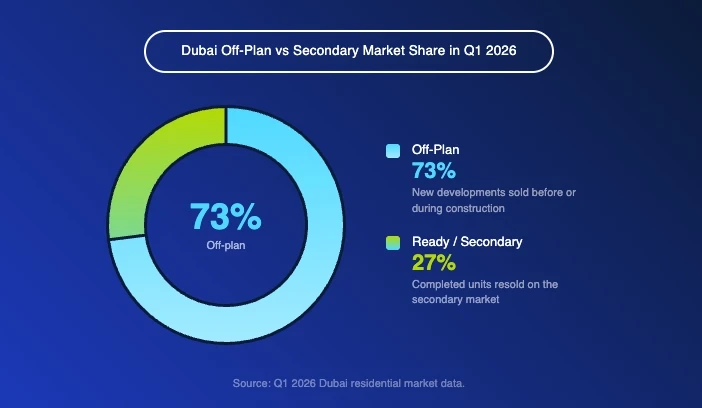
In Q1 2026, off plan accounted for the majority of Dubai residential sales. One Q1 2026 report put the off plan share at 67.3% of total residential sales, while another put it at 73%. The difference comes from methodology and dataset scope, but both reports point to the same conclusion: off plan is still the clear leader in demand.
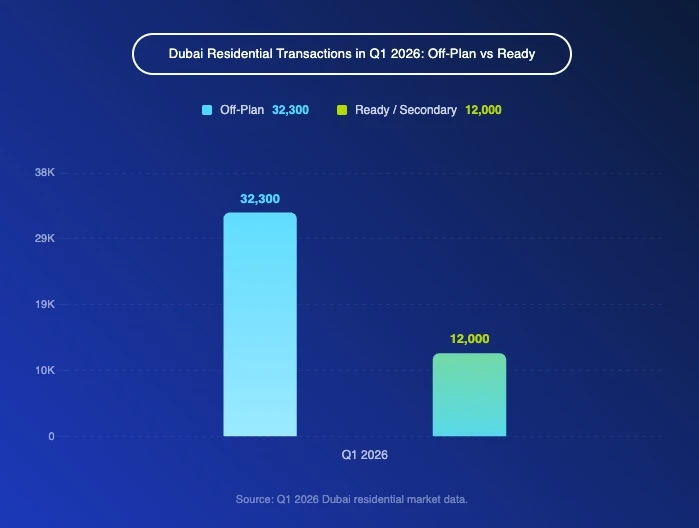
Using the more detailed Q1 2026 breakdown, off plan recorded around 32,300 transactions, while the ready segment recorded around 12,000 transactions. Off plan transaction value reached about AED 105.5 billion, compared with about AED 33.6 billion for ready properties. Off plan transaction volume rose 10.5% year on year, while ready transactions fell 8.7% year on year. That is the clearest sign that market demand is still shifting toward newly launched stock rather than resale inventory.
The wider market context also matters. CBRE reported that Dubai’s residential sector logged over 45,000 residential transactions worth AED 137 billion at the start of 2026, while also noting that price and rental growth are moderating and a larger wave of completions is expected later in the year. That combination supports a market where buyers stay active, but become more price sensitive and more selective about location and product quality.
Why off plan demand is still ahead
The off plan market is not leading by accident. It is leading because it solves the biggest friction points for buyers.
First, of plan gives buyers staged payment plans. That matters in a market where many investors want to preserve liquidity instead of deploying full capital on day one. Second, developers continue to push launch phase pricing and incentives, which makes the entry point look more attractive than many ready units. Third, off plan product is often newer, more design led, and better aligned with what current buyers want in terms of amenities, layouts, and branding.
There is another important signal inside the off plan segment. In Q1 2026, about 91.7% of off plan transactions were initial sales direct from developers, while only 8.3% were off plan resales. That tells you demand is concentrating at the developer launch stage, not in the flip market. Buyers still want off plan, but they are showing a clear preference for direct developer inventory rather than buying someone else’s contract at a markup.
That is a key difference from a more speculative cycle. In 2026, the market is not simply saying “buy anything off plan.” It is saying “buy the right project, at the right entry price, from the right developer.”
Why the Dubai off plan market vs secondary market gap widened
The gap widened because off plan offers a better answer to affordability and cash flow management. A buyer comparing the Dubai off plan market vs secondary market today often sees three immediate advantages in off plan:
Lower upfront cash pressure through payment plans
Access to newly launched stock before handover pricing moves higher
More modern unit mix in communities still building future supply pipelines
By contrast, secondary market buyers usually face full transfer processes, faster funding timelines, and pricing that already reflects current market sentiment. Ready property remains attractive, but it feels less flexible at the point of purchase.
Why the secondary market still matters
Even with off plan in the lead, the secondary market remains essential. It serves end users, yield focused investors, and buyers who care more about current reality than future promise.
A ready property gives buyers immediate visibility on the actual building, service levels, community maturity, tenant profile, and rent level. That reduces uncertainty. For many investors, especially those focused on income rather than appreciation alone, that certainty still has real value.
The secondary market also becomes more relevant when price growth moderates. In a fast rising market, buyers often accept future delivery risk because price momentum can cover mistakes. In a more disciplined market, buyers start paying more attention to true resale liquidity, handover risk, and net yield after costs. That tends to support high quality ready stock in established communities.
Another point is execution. A ready property can start producing rental income immediately. An off plan unit cannot. So even though off plan is attracting more transactions, the secondary market still has an advantage for investors who need cash flow now rather than later.
Where demand is moving in 2026
Demand is moving toward selective off plan, not broad off plan. That is the most accurate reading of 2026.
The data shows fewer launches than the previous year. In Q1 2026, around 90 projects were launched, with roughly 22,900 units introduced. That was down 58.1% and 56.9% year on year respectively. So off plan is still dominant in sales, but the launch pipeline has cooled from the very high levels seen before.
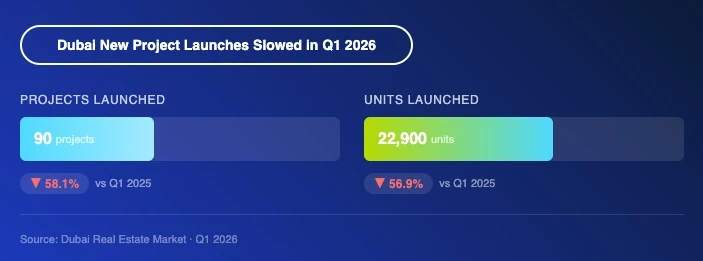
That shift matters. When launches slow while off plan still captures most demand, buyers become more concentrated in fewer projects and stronger developers. This usually benefits projects with better locations, better payment structures, and stronger delivery credibility. It also means weaker projects may struggle more than headline market data suggests.
Dubai off plan market vs secondary market by buyer type
The Dubai off plan market vs secondary market split now looks different by buyer profile.
Investor buyers are still leaning toward off plan because payment plans improve leverage efficiency and future upside potential. That is especially true in apartment led projects, which made up 80.5% of off plan transactions in Q1 2026.
End users are more mixed. Some still choose off plan to access a better home at a lower entry point. Others prefer ready homes because they can inspect the product, move in faster, and avoid construction wait time.
Income focused buyers often prefer secondary stock because rent and occupancy are visible from day one. In a market where future supply is rising, that visibility becomes more valuable. Reuters reported Fitch expects more supply pressure into 2026, which is one reason some investors are becoming more cautious on pricing assumptions.
What this means for pricing power
Off plan currently has stronger demand power, but secondary market pricing can become more competitive as more stock completes and as buyers compare promised product against delivered product.
This does not automatically mean secondary will outperform off plan in volume. It means pricing negotiations may become sharper. If supply keeps increasing and buyers become more rational, the secondary market could recover part of its appeal through better value, faster possession, and real rental evidence.
At the same time, off plan pricing will likely remain strongest where three things overlap: trusted developer, constrained micro location, and an attractive payment plan. Everywhere else, buyers will compare harder than before.
What smart buyers should do now
A buyer should not treat the 2026 market as a simple off plan versus ready debate. The smarter framework is this:
Buy off plan when the project has strong launch pricing, a credible developer, good future end user demand, and a payment plan that fits your cash strategy.
Buy secondary when the unit is in a mature community, the rental profile is proven, the price per square foot is competitive, and you want immediate visibility on the real asset.
Avoid relying only on headline transaction share. The fact that off plan leads the market does not mean every off plan project is a good buy. It only means buyer appetite is still flowing there in aggregate. In 2026, project selection matters more than ever.
Final verdict: where demand is moving in 2026
The answer is clear. Demand in 2026 is still moving more strongly toward off plan than the secondary market, but the nature of that demand has changed. It is more disciplined, more developer led, and less dependent on easy flipping. The secondary market is weaker in transaction share, yet still important for buyers who want immediate use, visible yields, and lower execution risk.
So the best conclusion is not “off plan wins” or “secondary wins.” The real conclusion is this: off plan is winning the volume war, while secondary remains critical for value discovery and income certainty. In a maturing market, both segments matter, but they serve different buyer goals.
For buyers, sellers, and investors who want to position correctly in this cycle, working with an experienced advisor matters. Eivan Properties, with more than 25 years of real estate experience in Dubai, can help you compare off plan and ready opportunities using actual market logic, not just launch marketing. Explore suitable options and expert guidance at eivanproperties.ae.