
Fixed vs Variable Mortgage in Dubai: Which Home Loan Structure Is Better?
Choosing between a fixed and variable rate is one of the biggest decisions in home financing. In Dubai, that decision matters even more because many mortgage products are priced around EIBOR plus a bank margin, while many “fixed” offers are only fixed for an introductory period before switching to a variable structure. Emirates NBD’s home loan key facts statement, for example, defines one option as fixed for an initial 2, 3, or 5 years and then variable, while the other is fully variable for the whole loan term.
So when buyers search
, the real question is not only “Which rate is lower today?” The better question is: which structure fits your income stability, holding period, risk tolerance, and view on future rates? That is the framework that usually leads to the right decision.
What fixed and variable mortgage options usually mean in Dubai
In Dubai, a variable home loan is commonly linked to EIBOR plus a fixed margin. That means your interest rate can move when the benchmark changes, and your EMI can change too. Emirates NBD states that variable pricing may be linked to 1 month or 6 month EIBOR, with reviews happening monthly or every 6 months depending on the structure.
A fixed mortgage in Dubai often does not mean the same rate for the full 20 or 25 years. In many bank offers, it means a fixed rate only for an introductory period, such as 2, 3, or 5 years, after which the loan shifts to a variable rate linked to EIBOR plus margin. That distinction is critical because many borrowers compare only the teaser fixed period and ignore what happens after it ends.
That is why the fixed vs variable mortgage Dubai decision should be viewed in two layers. First, compare the starting rate and monthly payment. Second, compare what happens after the fixed window expires. In practice, the second layer often matters more.
Mortgage rules and key costs Dubai buyers should know first
Before comparing rate structures, buyers should understand the financing rules and transaction costs that apply regardless of whether the mortgage is fixed or variable.
Under UAE Central Bank mortgage rules, the maximum loan to value for expatriates is up to 80% for a first property valued at AED 5 million or less, and up to 65% for a first property above AED 5 million. For second and subsequent homes, the cap is 60% for expatriates. The rulebook amendment also notes that first time buyer limits were increased by 5 percentage points.
Dubai Land Department lists the mortgage registration fee as 0.25% of the mortgage value, plus AED 250 for title deed issuance, plus AED 10 knowledge fee and AED 10 innovation fee for each drawing. The same DLD page also lists service partner fees of AED 4,000 plus VAT for ordinary mortgage processing and AED 5,000 plus VAT for provisional Oqood cases.
Banks also add their own charges. In one current Emirates NBD key facts statement, the loan processing fee is 1.05% of the loan amount, early settlement or foreclosure is 1.05% of the outstanding principal or AED 10,500, whichever is lower, and a completed property valuation example is listed at AED 3,150 inclusive of VAT. These are bank specific examples, not a marketwide rule, but they show why borrowers must compare all in cost and not just the headline rate.
Fixed vs variable mortgage Dubai, the core difference
The main advantage of a fixed rate period is certainty. Your payment is more predictable during the fixed term. That makes budgeting easier for salaried buyers, families with school fees, and anyone who wants protection from short term benchmark movements. If your cash flow is tight, payment stability has real value even when the initial rate is slightly higher.
The main advantage of a variable rate is flexibility to benefit if benchmark rates move lower. Because variable loans are linked to EIBOR plus margin, the borrower may see lower payments when the benchmark declines. But the same structure works against the borrower when EIBOR rises. Emirates NBD’s KFS explicitly notes that EMI changes with the actual EIBOR on the review date.
So the fixed vs variable mortgage Dubai decision comes down to one trade off: do you want payment certainty now, or do you want exposure to possible future rate declines?
Fixed vs variable mortgage Dubai for end users
For owner occupiers, the strongest reason to choose a fixed period is budget protection. Mortgage payments are only one part of ownership cost. Buyers also face service charges, insurance, maintenance, and day to day living costs. A stable mortgage installment reduces the chance that a rise in benchmark rates squeezes the household budget at the wrong time.
A variable structure can still work well for end users when income is strong, savings are healthy, and the buyer can absorb payment swings. It can also suit borrowers who expect to refinance, sell, or prepay within a relatively short period. But that must be weighed against prepayment fees and switching costs, which banks may charge.
When a fixed mortgage is usually the better choice
A fixed structure is usually the better choice in five situations.
First, your budget is tight. If a rate increase would make your monthly finances uncomfortable, stability matters more than chasing a lower starting cost.
Second, you are buying your primary residence and want certainty during the early years. This is especially useful when you are also paying moving costs, furnishing costs, and school fees.
Third, you believe current rates are acceptable and you want to protect yourself from near term uncertainty. Since many Dubai fixed products are only fixed for 2, 3, or 5 years, a fixed option can act like a shield for the period when your finances are most exposed.
Fourth, you are naturally conservative. Some buyers simply sleep better knowing the payment will not move during the fixed window. That peace of mind has value.
Fifth, you are stretching close to your approved borrowing limit. In that case, a payment spike under a variable loan could become a real problem.
When a variable mortgage is usually the better choice
A variable mortgage is often the better choice in four different situations.
First, you expect benchmark rates to fall or stay manageable. In that case, you may benefit from lower payments than a fixed introductory rate would offer.
Second, your income is strong and irregular. Business owners, commission earners, and high savings households may be better equipped to handle fluctuations.
Third, you plan to hold the property only for a short period. If you think you may sell, refinance, or repay early, locking into a higher fixed period may not deliver enough value. But you still need to check early settlement charges before assuming flexibility is free.
Fourth, you want quicker exposure to lower benchmark pricing. Emirates NBD notes that variable options may be reviewed monthly or every 6 months depending on whether the loan tracks 1 month or 6 month EIBOR. That matters because it affects how quickly your EMI can adjust.
A simple bank example that shows how the numbers can move
A representative Emirates NBD example helps illustrate the trade off. For a property price of AED 1,000,000, with AED 200,000 down payment, AED 800,000 loan amount, and 25 year term, the KFS shows:
Introductory fixed option: 2.99% per annum for 3 years, EMI AED 3,789 for the first 3 years, then AED 3,481 from year 4 based on an assumed 1 month EIBOR of 0.25% plus 1.89% margin
Fully variable option: 2.14% per annum based on 0.25% 1 month EIBOR + 1.89% margin, EMI AED 3,446
Sensitivity example: if the 1 month EIBOR is 0.50%, EMI becomes AED 3,545 on the variable example; if it reaches 1.00%, EMI becomes AED 3,748
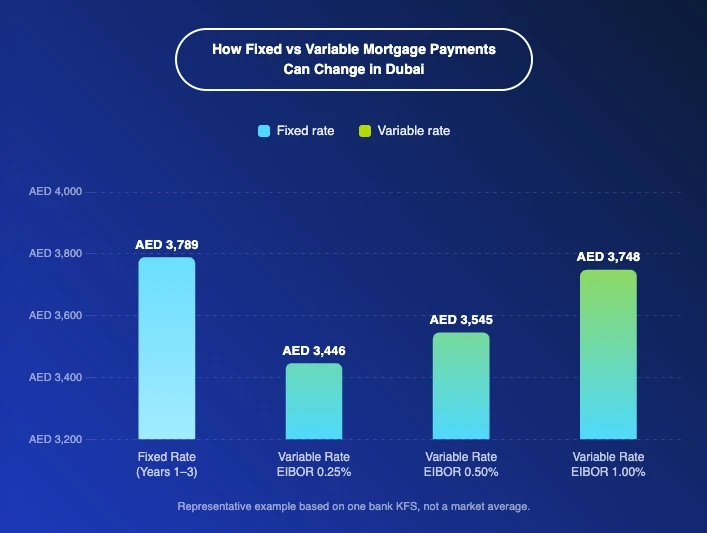
This is not a market benchmark. It is one bank’s representative example. But it clearly shows the structure. The fixed option starts with a higher payment in exchange for certainty. The variable option starts lower, but the payment can rise when the benchmark rises.
The rate outlook matters, but your risk tolerance matters more
Many borrowers spend too much time trying to predict where rates will go next. That matters, but not as much as people think. Most homebuyers are not traders. They are choosing a debt structure that they will live with for years.
The better approach is to stress test your own budget. Ask one question: if your payment rises, can you still stay comfortable? If the answer is no, fixed is usually safer. If the answer is yes, variable may be worth considering.
This is especially true in Dubai, where many variable structures directly reference EIBOR. The Central Bank publishes EIBOR history, and bank product documents confirm that variable mortgage pricing is commonly benchmark linked. That means payment volatility is not hypothetical. It is built into the product design.
What many Dubai borrowers get wrong
The most common mistake is comparing only the first year or first three year offer. That is incomplete. A fixed product with a strong headline rate may become variable later. A variable product with a low starting rate may become more expensive faster than expected if benchmarks rise. Emirates NBD’s own KFS makes both mechanics clear.
The second mistake is ignoring transaction and exit costs. Processing fees, valuation charges, insurance, DLD mortgage registration costs, and early settlement fees can materially change the real cost of borrowing. That is why buyers should calculate total first year cash outflow, not just EMI.
The third mistake is borrowing at the maximum approved level. Just because the bank approves an amount does not mean that amount is comfortable.
Best choice by buyer type
For first time end users, a fixed period is often the safer default because it gives budgeting clarity during the most fragile ownership phase.
For investors with strong cash buffers, a variable mortgage can make sense if the property is expected to generate enough rental income cushion and the investor accepts benchmark risk.
For short hold buyers, the answer depends on exit timing and penalty math. A variable loan may look attractive, but only if prepayment or refinancing costs do not erase the benefit.
For cautious buyers comparing fixed vs variable mortgage Dubai, the practical winner is usually fixed. For flexible and well capitalized buyers, variable can be the smarter option.
Which home loan structure is better?
There is no universal winner. The better structure depends on your financial profile.
Choose fixed if you want stable budgeting, lower stress, and protection from near term benchmark volatility.
Choose variable if you have strong cash reserves, higher risk tolerance, and a reason to believe benchmark linked pricing will work in your favor over your holding period.
For most primary home buyers in Dubai, the better question is not “Which rate is cheaper today?” It is “Which structure still feels safe if conditions change?” In real life, that question usually leads to a better borrowing decision.
If you are comparing mortgage options before buying in Dubai, speak with Eivan Properties. With 25+ years of experience in the market, Eivan Properties helps buyers shortlist the right communities, estimate real acquisition costs, and approach financing decisions with a clearer property strategy. Visit eivanproperties.ae to explore homes and get guidance before you commit to a mortgage structure.