
Dubai Mortgage Guide for Non Residents and Residents: Rates, Down Payment and Approval
Dubai remains one of the easiest cities for international buyers to finance property, but the smartest buyers still start with the numbers. A mortgage decision in Dubai is not only about the rate. It is about loan-to-value limits, the cash deposit, Dubai Land Department fees, mortgage registration costs, and how quickly a bank can issue a final approval. This Dubai mortgage guide for non residents explains the process in a practical way for both overseas and UAE-based buyers.
The first point to understand is that the UAE mortgage market is regulated at the federal level, while the property transfer and mortgage registration costs in Dubai sit with Dubai Land Department. That means your borrowing limit is shaped by Central Bank rules and bank credit policy, while your purchase closing costs follow DLD’s published fee schedule.
Dubai mortgage guide for non residents: what is different?
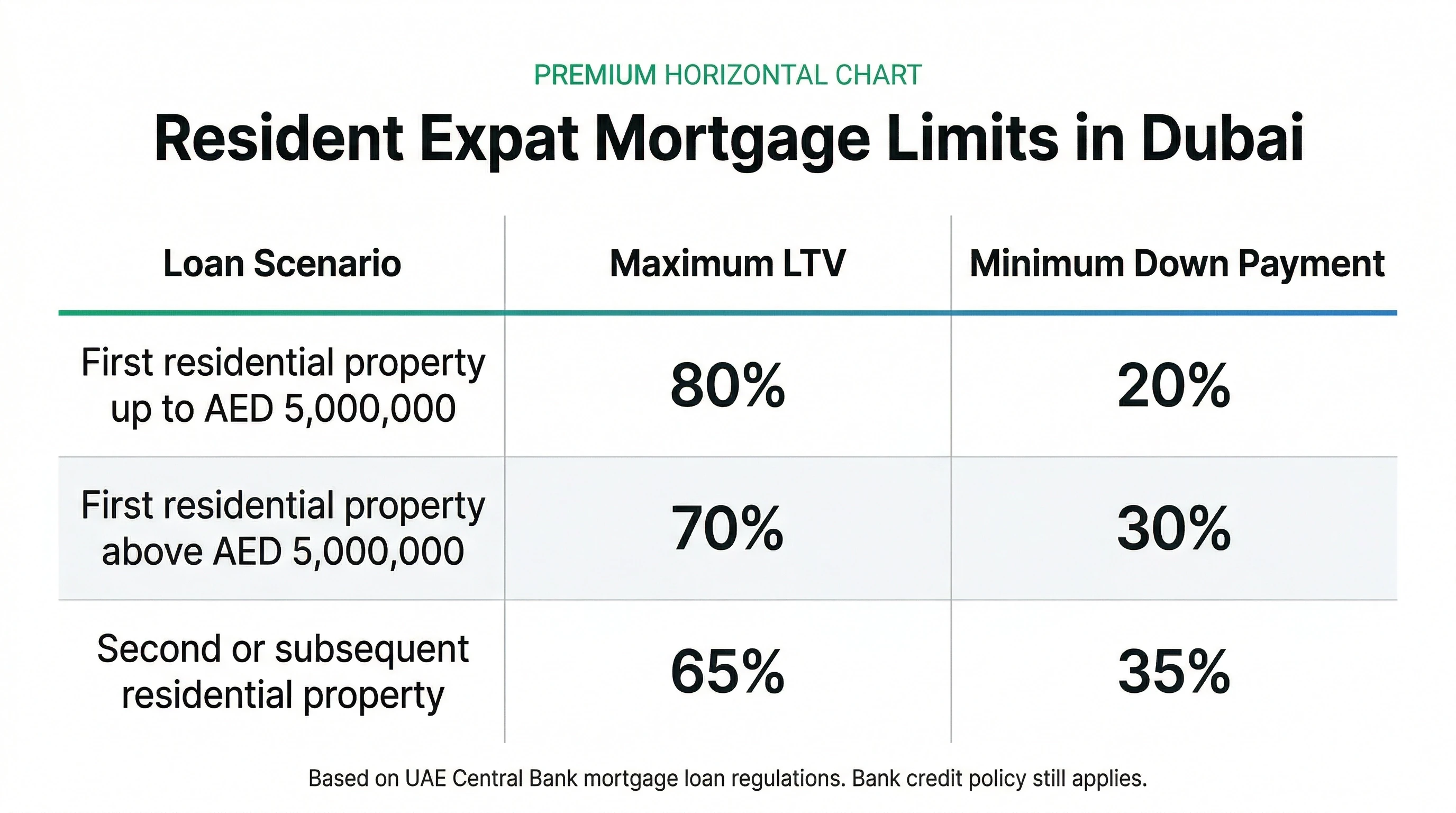
For UAE resident expat buyers, the published Central Bank cap for a first residential property priced at AED 5 million or less is a maximum loan-to-value of 80%. For a first property above AED 5 million, the cap drops to 70%. For a second or subsequent residential property, the cap is 65%. That is why resident buyers usually plan around a minimum down payment of 20% on a first home up to AED 5 million.
For non-residents, bank policy matters more because lender appetite is not presented to buyers in one single public cap page in the same way. Current lender pages confirm that non-resident programs are active, but they are more selective. FAB openly markets mortgages for non-UAE residents and highlights loan amounts up to AED 10 million. Dubai Islamic Bank also markets a dedicated non-resident program, including ready and resale purchases, with flexible tenure structures. In practice, this means overseas buyers should expect stricter underwriting, closer income verification, and property-by-property review even when a bank is open to financing.
That is the practical reason this Dubai mortgage guide for non residents matters. A resident buyer can often start with a clear rule-of-thumb deposit. A non-resident buyer should start with lender screening first, then shortlist properties second. That order saves time and reduces failed negotiations.
Dubai mortgage rates in 2026
There is no single Dubai mortgage rate. Rates depend on residency status, salary transfer, employer profile, property type, fixed versus variable structure, and the bank’s current campaign. Still, April 2026 lender pages give a clear market snapshot. FAB published fixed rates for resident mortgages at 3.99% to 4.44%, depending on tenure and banking relationship. Standard Chartered UAE showed benchmark home finance rates updated on 10 April 2026 at 4.05% for 12 months, 4.12% for 24 months, 4.19% for 36 months, and 4.26% for 60 months. Emirates NBD’s online estimator showed a tentative 3.99% reducing rate and described variable pricing linked to 1-month EIBOR plus 1.99%, with the final rate set at disbursal.
The takeaway is simple. In today’s market, headline resident pricing starts around the high-3% range on some bank pages, but your real offer can move higher depending on profile and structure. Non-resident pricing is often less transparent on public pages because banks tend to quote after reviewing nationality, income source, country of residence, and the exact property. FAB’s non-resident page, for example, promotes competitive variable rates but does not publish one universal rate card for every overseas borrower.
How much down payment do you need in Dubai?
For a UAE resident expat buying a first residential property worth AED 5 million or less, the standard planning number is a 20% down payment because the maximum loan is 80%. For a property above AED 5 million, the resident first-home down payment rises to 30%. For a second property, buyers should plan around 35% because the financing cap falls to 65%.
Dubai mortgage guide for non residents down payment example
For non-residents, the safest advice is to plan for a larger cash contribution than a resident borrower until a bank confirms eligibility. Even where banks run active non-resident programs, the final financing level remains credit-driven. In other words, non-resident buyers should not commit to a property assuming resident-style leverage. A stronger deposit usually improves both approval odds and pricing.
Now add the closing costs. Dubai Land Department lists the sale registration fee at 4% of the sale value, split on its service page as 2% seller and 2% buyer, plus additional title deed and trustee-related charges. For a mortgaged purchase, DLD also lists a mortgage registration fee of 0.25% of the mortgage value, along with title deed issuance and service partner fees.
Here is one consistent worked example for a resident expat buying a first home at AED 2,000,000 with 80% financing:
Property price: AED 2,000,000
Loan amount: AED 1,600,000
Down payment: AED 400,000
DLD transfer fee at 4%: AED 80,000
Property sale service partner fee: AED 4,000 + VAT = AED 4,200
Title deed issuance fee: AED 250
Knowledge + innovation fee on sale registration: AED 20
Mortgage registration fee at 0.25% of AED 1,600,000: AED 4,000
Mortgage title deed issuance fee: AED 250
Knowledge + innovation fee on mortgage registration: AED 20
Mortgage service partner fee: AED 4,000 + VAT = AED 4,200
Total cash needed before lender-side fees and insurance options: AED 492,940.
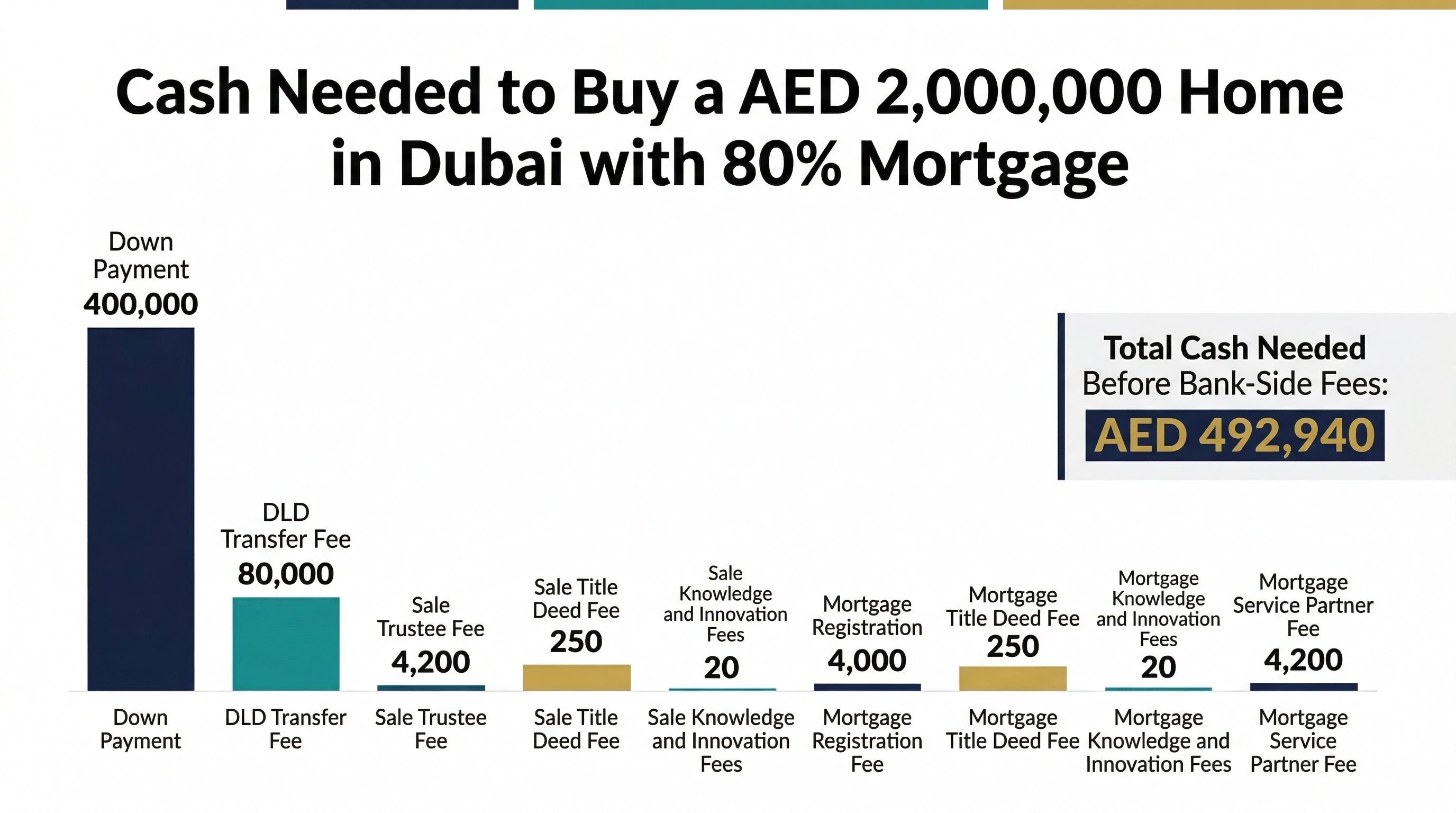
That example is important because many buyers only budget for the deposit. In reality, the cash-to-close is deposit plus transfer costs plus mortgage registration. This is where a good broker or advisor adds value quickly.
How mortgage approval works in Dubai
The cleanest sequence is: pre-approval, property selection, valuation, final offer, transfer, and registration. Banks first assess income, liabilities, credit conduct, and basic eligibility. Once you have a pre-approval, you shop with a real budget instead of a guessed budget. After you sign on a target unit, the lender orders valuation and moves toward final approval. Then the property transfer and mortgage registration happen through the DLD process. DLD’s mortgage registration page confirms the workflow includes bank submission, departmental audit, fee payment, and digital delivery of outputs.
Pre-approval validity is not fixed by one universal Dubai rule, but current UAE guidance from mortgage market specialists still points to around 60 days as the most common benchmark, with some banks stretching to 90 days. Buyers should treat 60 days as the safe planning window unless the bank letter says otherwise.
Documents you usually need
For residents, banks commonly ask for passport, visa, Emirates ID, salary evidence or business income documents, recent bank statements, and liability details. Emirates NBD’s resident mortgage page also confirms that its expatriate home loan is available to salaried and self-employed applicants, with a minimum salary of AED 15,000 on the published page.
For non-residents, expect more scrutiny. DLD’s mortgage registration requirements explicitly state that a passport copy is used for non-resident foreigners. Lenders will usually also want overseas bank statements, proof of address, income evidence from the home country, and sometimes more detailed source-of-funds checks than a UAE resident applicant.
What many buyers forget about Dubai mortgages
A mortgage in Dubai is not legally complete until it is registered. DLD’s FAQ states that an insurance mortgage is not valid unless registered with Dubai Land Department. The same FAQ also states that the mortgagor bears the mortgage contract costs unless both parties agree otherwise.
There is also a useful consumer-protection point on exits. The UAE Central Bank fee cap for early settlement on home loans is a maximum of 1% of the outstanding balance or AED 10,000, whichever is lower. That cap matters for buyers who plan to refinance, sell early, or repay with rental income and bonuses.
Should residents and non-residents choose fixed or variable?
A short fixed period can work well when the buyer wants payment certainty at the start. In April 2026, published fixed structures from major banks still sit in a tight band around the 4% level on selected products. Variable pricing can become attractive later, but only if you understand the benchmark and margin. Standard Chartered’s published benchmark sheet and Emirates NBD’s EIBOR-linked example both show how common benchmark-linked pricing remains in the UAE.
For non-residents, fixed-versus-variable is often a secondary decision. First, secure a bank that is comfortable with your residency status and income geography. Then compare rate structure, prepayment flexibility, and total closing cash.
Best strategy for buyers in 2026
Resident buyers should start with a realistic cash plan. If the unit is AED 2 million and you are targeting 80% finance, your deposit alone is AED 400,000, but the realistic cash-to-close is far higher once DLD and mortgage registration costs are included.
Non-resident buyers should start with lender fit before property fit. This Dubai mortgage guide for non residents shows why. The mortgage exists, the products exist, and major banks do serve overseas buyers, but the path is more selective. That makes pre-approval and document readiness even more important than rate shopping in the first step.
Final word
Dubai mortgage financing is very workable in 2026, but the winning approach is disciplined budgeting. Know your LTV limit, know your rate structure, know your DLD costs, and never confuse deposit with total cash required. For residents, the framework is relatively straightforward. For overseas buyers, the opportunity is strong, but execution matters more.
If you want a mortgage-ready buying plan, Eivan Properties can help structure the search around budget, approval strength, and area selection. Eivan Properties brings more than 25 years of Dubai market experience, and you can connect with the team at eivanproperties.ae.