
Cash vs Mortgage Dubai Property: A Complete Numbers Comparison for Investors
Dubai investors usually ask one practical question before they buy: should I pay cash, or should I use mortgage leverage?
The answer is not emotional. It is numerical.
In Dubai, the gap between a cash deal and a financed deal is shaped by four hard inputs: your down payment, your financing cap, your interest rate, and your transaction costs. For a resident expatriate, banks can finance up to 80% of the property value for a first property. For non-residents, financing is typically capped at 50%. Dubai Land Department sale registration fees are 4% of the sale value, and mortgage registration adds 0.25% of the mortgage amount. Current bank pages also show mortgage pricing from around 3.99% in advertised offers, while HSBC’s current variable example shows 6.18% based on margin plus 3-month AED EIBOR.
This means the cash vs mortgage Dubai property decision is really a trade-off between three things: higher liquidity, lower total borrowing cost, and amplified return on equity. Cash buyers usually get simpler closings and zero financing risk. Mortgage buyers preserve capital, but they accept interest cost and refinancing or rate-reset risk.
To keep every number consistent in this article, I will use one model from start to finish:
Assumptions used throughout this article
Property price: AED 2,000,000
Buyer type: resident expatriate, first property
Maximum loan-to-value used: 80%
Loan amount: AED 1,600,000
Down payment: AED 400,000
Interest rate used for comparison: 6.18%
Loan term: 20 years
DLD transfer fee: 4% of property value = AED 80,000
Registration trustee fee used: AED 4,200
Title deed fee used: AED 250
Mortgage registration fee: 0.25% of mortgage amount = AED 4,000
These caps and fees are aligned with current UAE mortgage regulation references and Dubai Land Department fee pages. The monthly repayment for a AED 1.6 million, 20-year loan at 6.18% is about AED 11,629.66.
What cash buyers really pay in Dubai
For the same AED 2 million property, the cash buyer needs the full property price plus transfer-related costs at closing.
Using the assumptions above, the cash purchase cost is:
Property price: AED 2,000,000
DLD fee: AED 80,000
Registration trustee fee: AED 4,200
Title deed fee: AED 250
Total upfront cash needed = AED 2,084,450.
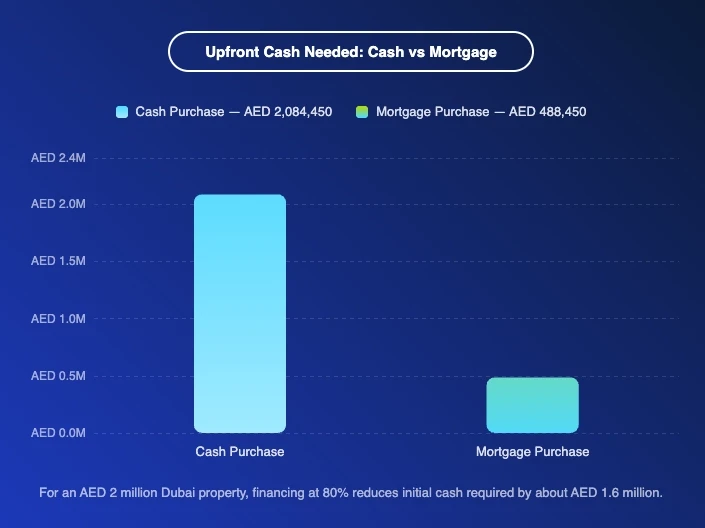
That is the biggest strength and weakness of cash at the same time. The buyer has no monthly debt service, no mortgage registration fee, no interest cost, and no exposure to rate changes. But they also lock more than AED 2.08 million into one asset on day one. In pure liquidity terms, cash is the most capital-intensive route.
What mortgage buyers really pay in Dubai
Now let us use the exact same property and compare the financed route.
With an 80% loan, the buyer puts down AED 400,000. The same transfer costs still apply, and the financed buyer also pays the official mortgage registration fee of 0.25% of the mortgage value, which in this model is AED 4,000. That creates this opening cash requirement:
Down payment: AED 400,000
DLD fee: AED 80,000
Registration trustee fee: AED 4,200
Title deed fee: AED 250
Mortgage registration fee: AED 4,000
Total upfront cash needed = AED 488,450.
So the mortgage buyer preserves about AED 1,596,000 of liquidity compared with the cash buyer. That difference alone explains why many investors choose leverage. They are not only buying one asset. They are protecting optionality. They keep capital available for a second unit, emergency reserves, renovations, or another market cycle entry.
Cash vs mortgage Dubai property: monthly cost and total borrowing cost
The monthly mortgage payment in this model is AED 11,629.66, or about AED 139,555.97 per year. In the first 12 months, the outstanding balance falls from AED 1,600,000 to about AED 1,558,151.87, which means about AED 41,848.13 of principal is repaid in year one. The rest of the annual payment is interest.
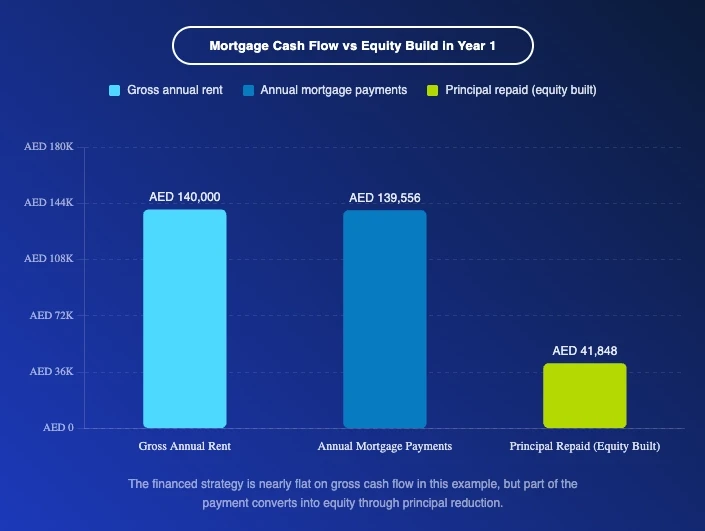
That point matters. Investors often treat the full mortgage payment as a pure cost. It is not. Part of it is forced equity creation through principal reduction. In this model, the first-year payment of about AED 139,556 contains around AED 41,848 in principal and around AED 97,708 in interest. That means the debt service feels heavy in cash flow terms, but not all of it is lost money.
Still, the long-term cost of debt is real. If this same loan stayed at 6.18% for the full 20 years, the buyer would pay a very large cumulative interest bill over time. That is why cash usually wins on total cost, while mortgage often wins on capital efficiency. The correct choice depends on whether your priority is minimizing lifetime outflow or maximizing return on the cash you personally deploy.
Cash vs mortgage Dubai property in a real ROI model
Now let us add a simple income scenario so the ROI difference becomes easier to see.
Assume the AED 2 million property generates 7% gross annual rent, which equals AED 140,000 per year. This is just a modeling input for comparison, not a market-wide claim. Under this scenario:
Cash strategy:
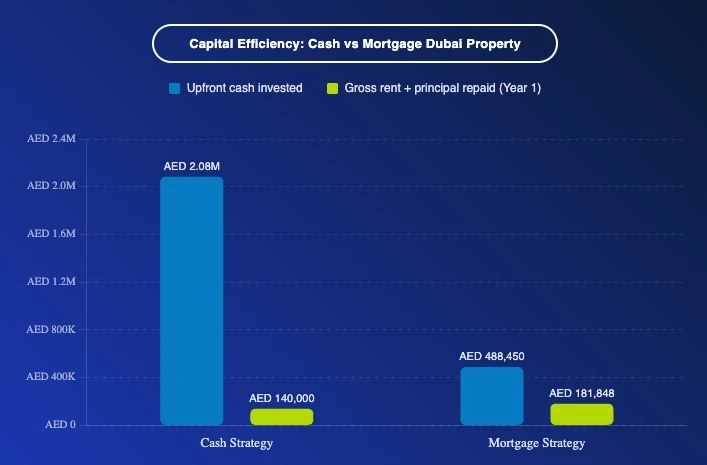
Total cash invested = AED 2,084,450
Gross rent = AED 140,000
Gross yield on total cash invested = 6.72%
Mortgage strategy:
Total upfront cash invested = AED 488,450
Gross rent = AED 140,000
Annual mortgage payments = AED 139,555.97
On pure pre-expense cash flow, the financed buyer is nearly flat before other property operating costs. But that is not the whole picture, because the financed buyer also repaid AED 41,848.13 of principal in year one. On an equity-growth basis, that principal repayment improves the effective return on initial cash.
If we combine gross rent plus first-year principal reduction, the mortgage strategy creates AED 181,848.13 of gross value movement before operating expenses and before price appreciation. Compared with the initial cash invested of AED 488,450, that is a much higher equity efficiency ratio than the cash strategy. This is why leverage can sharply improve apparent ROI when rent is healthy and vacancies stay low. But it also increases downside pressure if rent falls, rates rise, or the property sits empty.
When cash is the better strategy
Cash usually makes more sense for investors in five cases.
First, cash fits buyers who want the lowest risk structure. There is no bank approval risk, no debt-service ratio issue, and no repayment burden. UAE mortgage rules also cap debt burden ratio at 50%, so not every borrower can actually access the maximum financing they want.
Second, cash works better when the expected property yield is not much higher than the mortgage rate. In this article’s model, the rent input is 7% and the financing input is 6.18%. That spread is positive, but not huge. Once vacancy, service charges, maintenance, and leasing costs are added, the advantage of leverage can narrow fast. In that type of deal, cash often gives a calmer and cleaner result.
Third, cash is attractive for buyers who care most about net income today, not leveraged equity growth. A debt-free property can generate much stronger spendable monthly income.
Fourth, cash is often stronger for buyers targeting short holding periods. Some lenders charge early settlement fees. HSBC’s current UAE mortgage page, for example, says the early settlement charge on its variable 3-month EIBOR home loan is 1% of the outstanding amount or AED 10,000, whichever is less, subject to VAT wording on the page.
Fifth, cash is powerful in uncertain rate environments. Variable-rate loans move with benchmark rates. If rates rise, the monthly payment rises too. HSBC’s example page shows exactly how payment changes when 3-month AED EIBOR moves.
When mortgage is the better strategy
Mortgage becomes stronger when the investor values liquidity and scalability over absolute simplicity.
In this article’s model, the mortgage route frees up almost AED 1.6 million versus the cash route. That is not a small gap. It can become reserve capital, fit-out capital, diversification capital, or a second acquisition fund. For investors building a portfolio, that flexibility is often more important than minimizing interest.
Mortgage also becomes more compelling when the asset is expected to appreciate. With leverage, price growth is earned on the full asset value, not only on the investor’s down payment. For example, a 10% property price increase on a AED 2 million unit equals AED 200,000 of value gain. On a cash purchase, that is a return on more than AED 2.08 million invested. On the financed route, it is a return on about AED 488,450 initially invested, before selling costs and interest effects. That is the math behind leveraged upside. It is also the math behind leveraged downside if prices fall.
The key risk in cash vs mortgage Dubai property decisions
The biggest mistake is using leverage on a property that only works under perfect conditions.
A financed deal should still make sense under stress. Test the asset with lower rent, one vacant month, a rate that is 1% higher, and higher service charges. If the numbers break too easily, the mortgage strategy is too aggressive.
For Dubai buyers, this stress testing matters even more because financing caps differ by profile. Current regulation references show up to 80% financing for resident expatriates on a first property up to AED 5 million, 75% above AED 5 million, 65% for second and subsequent properties, and 50% for non-residents. That means your cash requirement can change sharply depending on residency status and portfolio position.
Final verdict: which one should investors choose?
The cleanest answer is this:
Choose cash if your goal is lower risk, stronger immediate net income, no exposure to rate resets, and the lowest operational complexity.
Choose mortgage if your goal is better capital efficiency, higher liquidity, and potentially stronger return on equity, provided the property still works after financing cost.
Using this article’s consistent model, the cash buyer needs about AED 2,084,450 upfront. The mortgage buyer needs about AED 488,450 upfront and pays around AED 11,629.66 per month on a 20-year loan at 6.18%. That makes cash better on simplicity and total borrowing cost, while mortgage is far stronger on liquidity and scaling power.
For most investors, the winning option is not the one with the lowest headline cost. It is the one that best matches holding period, risk tolerance, expected rental performance, and portfolio strategy.
If you want to structure the right purchase in Dubai, Eivan Properties can help you compare cash and mortgage scenarios property by property, area by area, and building by building. With more than 25 years of experience, the team can help you review real acquisition costs, financing impact, and exit strategy before you commit. Visit eivanproperties.ae for a tailored investment review.