Short Term vs Long Term Rentals Dubai: Which Strategy Makes More Money?
Dubai gives landlords two very different ways to earn income from the same asset. One path is the standard annual lease. The other is the licensed holiday home model. On paper, short stays often look more profitable. In practice, the answer depends on occupancy, operating costs, regulation, and how much hands on work the owner is willing to accept.
That is why the real question is not whether short stays can charge more per night. They usually can. The real question is whether that higher top line revenue survives vacancy, platform fees, cleaning, furnishing, maintenance, and compliance costs. In many Dubai submarkets, short term wins only when the unit is in a prime visitor corridor and operations are disciplined. Long term rentals usually win on simplicity, stability, and lower income volatility. Dubai’s tourism base remains strong, with 19.59 million international overnight visitors in 2025, while hotel occupancy averaged 80.7% in 2025. At the same time, Dubai’s leasing market is also deep: DLD said registered rental contracts exceeded 900,000 in 2024, up 8% from 2023.
Short term vs long term rentals Dubai: the simple answer
For most investors, long term rentals produce the more predictable risk adjusted return, while short term rentals can produce the higher absolute return only in the right location and with strong execution. That means a furnished unit in Downtown Dubai, Dubai Marina, Palm Jumeirah, or near major tourism and business demand can outperform on net income. But the margin is usually smaller than many first time investors expect after real operating costs are included. Dubai’s tourism and hospitality numbers support the demand case for short stays, but regulation and operating intensity are real. DET requires holiday homes to be registered and approved before listing, and the operator must handle permit and Tourism Dirham obligations.
What makes short term rentals attractive in Dubai?
The short term model benefits from Dubai’s visitor economy, event calendar, winter seasonality, and constant inflow of business travelers, remote workers, and family visitors. In 2025, Dubai welcomed 19.59 million overnight visitors, and average hotel occupancy reached 80.7%. That demand base supports premium nightly pricing in the strongest areas. It also means short stays can react faster to market conditions than annual leases. If rates rise during peak season, the owner can capture that upside immediately rather than waiting for lease renewal.
The short term model can also be useful for owners who want flexibility. A landlord can block dates for personal use, hold the asset while waiting for a better sale window, or switch pricing by season. That flexibility has value, especially for overseas owners who use the property occasionally. But flexibility is not free. The unit has to be furnished, guest ready, cleaned repeatedly, and actively marketed. DET’s holiday home framework also adds compliance steps and annual permit costs. Issuing a new holiday home permit costs AED 300 per bedroom plus AED 50 per unit for the classification certificate, plus AED 10 knowledge fee and AED 10 innovation fee, for a stated total of AED 370. Renewal is AED 300 per bedroom per year plus AED 10 knowledge fee and AED 10 innovation fee, for a stated total of AED 320, capped at AED 1,200 per unit.
What makes long term rentals attractive in Dubai?
Long term leasing is usually the lower friction income strategy. The income stream is easier to forecast, tenant turnover is lower, and the owner avoids constant booking management, repeated cleaning, guest communication, and seasonal pricing changes. This matters more than many investors admit. A slightly lower gross yield with stable occupancy and lower operating drag can outperform a higher grossing but operationally messy short stay unit.
Dubai also gives long term landlords a clear framework for rent adjustments. Since January 2025, DLD’s Smart Rental Index has been the benchmark for deciding whether a rent increase is justified. The index uses building classification, area averages, and contract data. DLD also states that landlords must give at least 90 days’ notice before lease expiry if they want to apply an increase. Under Decree No. 34 of 2013, increases start at 0% when current rent is less than 10% below market rent and can go up to 20% in the highest gap band. That does not guarantee an increase, but it gives long term investors a rules based income reset mechanism instead of relying only on renegotiation.
Short term vs long term rentals Dubai using one fixed income model
To keep the comparison clean, use one illustrative underwriting example throughout this article. These numbers are not claimed market averages. They are a single scenario so the math stays consistent from section to section.
Assumed unit
A 1 bedroom apartment in a prime Dubai rental location
Fixed assumptions
Property value: AED 1,800,000
Annual service charges and routine owner costs: AED 18,000
Long term model assumptions
Annual rent: AED 120,000
Vacancy loss: 0 during lease term
Leasing and minor turnover cost reserve: AED 6,000
Annual service charges and routine owner costs: AED 18,000
Short term model assumptions
Average daily rate: AED 650
Occupancy: 72%
Booked nights per year: 262.8
Gross booking revenue: AED 170,820
Management and platform cost: 20% of gross revenue = AED 34,164
Cleaning, laundry, consumables, and guest turnover costs: AED 12,000
Annual service charges and routine owner costs: AED 18,000
Holiday home permit renewal and admin allowance: AED 320
Net income result
Long term net income: AED 120,000 - AED 6,000 - AED 18,000 = AED 96,000
Short term net income: AED 170,820 - AED 34,164 - AED 12,000 - AED 18,000 - AED 320 = AED 106,336
Net yield on property value
Long-term net yield: AED 96,000 / AED 1,800,000 = 5.33%
Short-term net yield: AED 106,336 / AED 1,800,000 = 5.91%
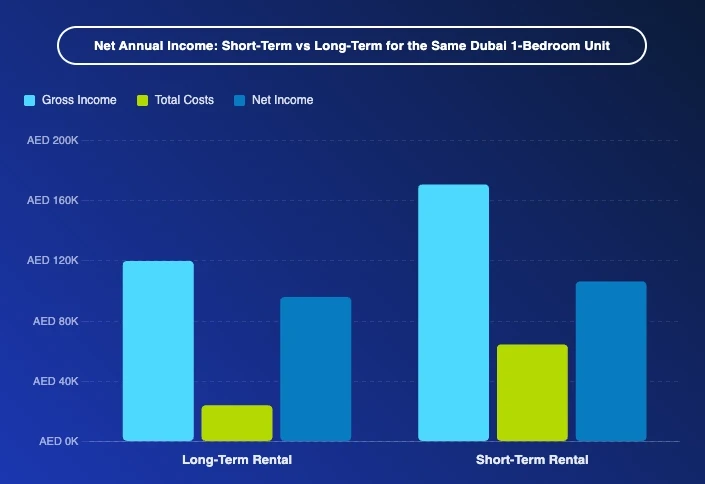
In this exact model, short term earns AED 10,336 more per year than long term. That is a real advantage, but it is not a huge gap. A small drop in occupancy or a rise in operating costs can erase it fast. That is the key lesson most investors miss when they compare short term vs long term rentals Dubai. The better strategy is often the one with the wider error margin, not just the higher theoretical top line.
Where short term usually wins
Short term usually wins where three conditions are present. First, the location must attract steady tourism or corporate stay demand. Second, the building and unit must photograph well and support premium positioning. Third, the owner or operator must manage turnover efficiently.
That usually points to districts such as Downtown Dubai, Dubai Marina, Palm Jumeirah, JBR, Business Bay, and selected waterfront or branded projects. These locations benefit more directly from the city’s tourism flow and event driven demand. Dubai’s 2025 tourism performance supports the idea that prime short stay units can stay active, because visitor volumes reached a record 19.59 million and hotel occupancy remained above 80%.
In the example above, short term outperforms because 72% occupancy at AED 650 ADR is strong enough to absorb a 20% management and platform drag. If occupancy falls to 65% and everything else stays the same, booked nights drop to 237.25, gross revenue falls to AED 154,212.50, and net income drops to about AED 93,050. That would put short term below the long term net income of AED 96,000. That is why short term is more sensitive to execution error.
Where long term usually wins
Long term usually wins in buildings where tenant demand is deep but transient demand is weaker, or where the building is less suitable for hospitality style operations. It also wins for owners who value predictable cash flow, lower workload, and easier financing conversations.
Dubai’s residential market still has strong long term demand. CBRE said annual residential rents in Dubai were up around 6% in 2025, with apartments up 7% and villas up 1%. DLD also said more than 900,000 lease contracts were registered in 2024. That scale matters. It means the long term market is not just stable. It is massive.
Long term also tends to preserve the condition of the unit better when compared with high turnover guest use. Furnishing requirements are lower. Utility and consumables leakage is lower. Complaints are fewer. Vacancy events are less frequent. For landlords who live abroad or want low involvement, that can outweigh the extra AED 10,336 shown in the short term example.
Regulation matters more than many owners think
The long term model operates through the standard tenancy framework, including Ejari registration and rent increase rules tied to DLD’s Smart Rental Index. The short term model is different. DET requires holiday homes to be registered and approved before listing. Operators also have to deal with permit issuance, renewals, and monthly Tourism Dirham reporting obligations.
This is not just paperwork. It affects execution speed, compliance risk, and the type of management partner you can trust. Investors comparing short term vs long term rentals Dubai should treat regulation as part of the cost structure, not as a side note.
Which strategy makes more money in 2026?
In 2026, the answer is still conditional.
If your property is in a prime visitor zone, fully furnished, professionally managed, and capable of maintaining strong occupancy, short term can make more money. That case is helped by Dubai’s visitor growth and strong hospitality performance in 2025.
If your property is in a more residential location, or if you want easier operations and steadier income, long term remains the stronger strategy. That case is helped by the size of Dubai’s leasing market and the Smart Rental Index framework, which supports transparent renewals and regulated rent adjustments.
Using the fixed example in this article, short term wins by AED 10,336 per year. But that lead disappears if occupancy weakens. So the correct investor question is not “Which model has the higher gross revenue?” It is “Which model can my asset sustain after costs, compliance, and vacancy?”
Final verdict
For hands on investors in prime tourism led locations, short term can produce the better income result.
For most investors seeking durable, lower volatility returns, long term is still the safer and often smarter strategy.
That is the practical conclusion on short term vs long term rentals Dubai. The winning model is asset specific. The unit, building rules, location, and operator quality matter more than generic headlines about nightly rates.
Before you buy or switch strategy, underwrite both models on the same property with one consistent assumption set. That is where good decisions happen.
If you want a real underwriting comparison on a Dubai unit, speak with Eivan Properties, a Dubai real estate agency with 25+ years of experience. Their team can help you compare annual leasing, holiday home potential, expected operating costs, and exit strategy before you commit. Visit eivanproperties.ae.