
Service Charges in Dubai Explained: How They Impact Property ROI
Many buyers focus on purchase price, rent, and expected appreciation. That is not enough. One line item can change the full investment case: service charges. If you ignore them, your projected return may look stronger than the real number you will actually keep.
That is why service charges in Dubai ROI analysis matters. In Dubai, service charges for jointly owned properties are regulated through the Dubai Land Department and RERA framework, and approved charges can be checked through the official Service Charge Index. These charges are tied to the common parts of a building or community, not to your private in unit utility bill.
For investors, this affects three things immediately. First, it reduces net rental income. Second, it changes buyer demand when you later resell. Third, it influences whether one building in the same area is actually a better investment than another. Two apartments in the same location can have similar rents but very different net returns once service charges are deducted.
This guide explains what service charges are, how the Dubai system works, how to calculate their effect on returns, and how to compare buildings the right way before you buy.

What service charges mean in Dubai real estate
Service charges are the recurring costs used to manage, maintain, repair, operate, and administer the common parts of jointly owned property. In practice, this can include cleaning, security, common area electricity, landscaping, lift maintenance, shared systems, and other building or community operating costs. Dubai’s legal framework for jointly owned property is set by Law No. 6 of 2019, and approved service charges are handled through the Mollak system and the DLD Service Charge Index.
The official DLD Service Charge Index exists so an owner or buyer can check the approved fees for a jointly owned property. That matters because the approved invoice is the reference point in disputes. Dubai Land Department has also stated that, unless the lease says otherwise, the owner remains liable for service and usage charges, and unpaid charges can accumulate into serious legal and financial problems.
That makes service charges more than a routine expense. They are a regulated ownership cost that directly affects investment performance.
Why service charges in Dubai ROI is not a minor detail
A lot of marketing material still highlights gross yield. Gross yield is useful, but it is incomplete. It only shows annual rent divided by purchase price. It does not deduct service charges, vacancy, leasing costs, maintenance inside the unit, or financing costs.
For a serious investor, service charges in Dubai ROI should be reviewed before any offer is made because service charges are a recurring annual cost. A property with a strong gross yield can become average once service charges are deducted. A building with lower annual charges can outperform a nearby project even if its headline rent is slightly lower.
This is especially important in Dubai because service charge levels are approved at the building or jointly owned property level. You should not assume all buildings in the same area carry the same cost profile. The official index is property specific, and budgets are submitted for approval through Mollak.
How service charges in Dubai ROI calculations really work
The clean way to assess an income property is to use both gross yield and net yield.
Gross yield formula
Annual rent ÷ purchase price × 100
Net yield formula
(Annual rent − annual service charges − other annual ownership costs) ÷ purchase price × 100
To isolate the effect of service charges alone, use this version:
Service charge adjusted net yield
(Annual rent − annual service charges) ÷ purchase price × 100
Here is a simple worked example with consistent numbers:
Purchase price: AED 1,200,000
Annual rent: AED 90,000
Unit size: 800 sq ft
Approved service charge: AED 18 per sq ft per year
Annual service charge: 800 × 18 = AED 14,400
Now calculate the returns:
Gross yield = 90,000 ÷ 1,200,000 × 100 = 7.50%
Net yield after service charge only = (90,000 − 14,400) ÷ 1,200,000 × 100 = 6.30%
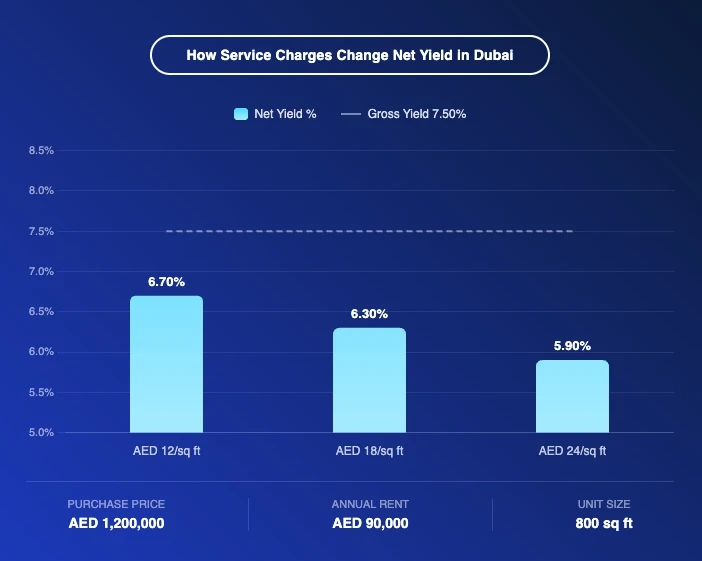
That is a drop of 1.20 percentage points. In money terms, your annual income before other costs falls by AED 14,400.
This is exactly why service charges in Dubai ROI should be treated as a core underwriting input, not as a footnote.
Example of service charges in Dubai ROI on two similar units
Now compare two apartments with the same purchase price and same rent:
Unit A
Purchase price: AED 1,200,000
Annual rent: AED 90,000
Size: 800 sq ft
Service charge: AED 18 per sq ft
Annual service charge: AED 14,400
Net yield after service charge only: 6.30%
Unit B
Purchase price: AED 1,200,000
Annual rent: AED 90,000
Size: 800 sq ft
Service charge: AED 12 per sq ft
Annual service charge: AED 9,600
Net yield after service charge only: 6.70%
The gross yield is identical at 7.50% for both units. But Unit B delivers a higher service charge adjusted return because the recurring annual cost is AED 4,800 lower.
Over 5 years, assuming no change in rent or charges, Unit B keeps AED 24,000 more income than Unit A. That gap matters in real life. It can cover vacancy, part of a refurbishment, or improve total cash on cash performance.
Why high service charges can also affect resale
Investors do not buy yield alone. End users and future buyers also care about annual running costs. When service charges are high, the buyer pool may narrow, especially in segments where the market compares monthly affordability and annual holding cost closely.
A buyer might accept a higher charge if the project offers premium amenities, branded services, beachfront positioning, or strong prestige. But the resale question is simple: does the market see enough value in those costs?
If the answer is yes, pricing holds better. If the answer is no, resale becomes harder because buyers compare your asset to another building with similar location and size but lower annual holding cost.
That is why service charges influence resale positioning in two ways:
First, they affect investor underwriting. Buyers looking for income will adjust the price they are willing to pay once they calculate net yield.
Second, they affect end user affordability. Even cash buyers think about annual ownership cost. Over time, buildings with well controlled charges often look more efficient and easier to own.
What the Dubai legal framework means for owners
Dubai’s framework is useful for investors because it is structured and review based. The DLD Service Charge Index lets users inquire about approved service fees for jointly owned properties. Budget approval for service and usage charges is processed through Mollak. Under Law No. 6 of 2019, Dubai also gives the Rental Disputes Settlement Centre jurisdiction over disputes related to the rights and obligations created by the law.
Dubai Land Department has also publicly clarified that the owner is liable for service and usage charges unless the lease states otherwise, and that approved RERA invoices are the reference in disputes.
This gives investors a practical checklist:
Check the approved service charge through the official index.
Confirm what is included in the budget.
Review whether the building’s amenity profile justifies the cost.
Model the effect on net yield, not only gross yield.
Compare the building against real alternatives in the same area.
How to evaluate whether a service charge is reasonable
Do not ask whether the charge is high or low in isolation. Ask whether it is efficient for that building type.
A high rise with concierge, multiple lifts, large pools, extensive landscaping, and hotel style common areas will usually cost more to run than a simpler mid rise. A branded residence may still perform well if rent and resale demand support the extra cost. On the other hand, an ordinary building with premium level service charges deserves deeper scrutiny.
Use these filters:
1) Compare rent per square foot against service charge per square foot
A building can support higher charges if rent levels are strong enough. If rent is average but the annual service charge is heavy, net yield can compress fast.
2) Check amenity intensity
More amenities usually mean more operating cost. That does not automatically make a project unattractive. It just means the extra cost must produce either higher rent, better occupancy, stronger resale demand, or all three.
3) Review age and maintenance profile
As buildings age, maintenance patterns can change. Lift systems, façades, shared MEP systems, and common area refurbishment needs may affect budgets over time. Dubai Law No. 6 of 2019 also states that the developer remains liable for one year from handover for repairing or replacing certain defective installations in jointly owned real property.
4) Assess who your exit buyer is
If your most likely future buyer is an ROI focused investor, service charges matter even more because they directly impact underwriting. If your buyer is a luxury lifestyle purchaser, the market may tolerate higher charges more easily.
The due diligence mistake many investors make
Many buyers compare only area, size, rental estimate, and launch price. That is not enough. The better comparison is building versus building, not just area versus area.
A smart due diligence process should include:
title deed and unit details
current approved service charge from the DLD index
annual rent evidence or market rent comparables
occupancy and tenant profile
building age and maintenance quality
amenity load
future resale audience
That gives a more realistic picture of service charges in Dubai ROI than a simple brochure yield claim.

A practical investor model you can use before buying
Use this 5 step model before you commit:
Step 1: Get the annual rent assumption
Use conservative rent, not peak asking rent.
Step 2: Get the official approved service charge
Check the DLD Service Charge Index for the relevant property.
Step 3: Convert the charge into annual dirham cost
Unit size × service charge per sq ft
Step 4: Calculate service charge adjusted net yield
(Annual rent − annual service charge) ÷ purchase price × 100
Step 5: Compare with at least two alternatives
Use the same method for each building. This is where the best opportunity usually becomes obvious.
Should service charges stop you from buying?
Not necessarily.
High service charges are not automatically bad. Some projects command them because they deliver premium positioning, better tenant appeal, and stronger long term brand value. What matters is whether the charge is productive.
A productive service charge helps support rent, occupancy, image, and resale.
An unproductive service charge only eats income.
That is the distinction investors should make.
Final verdict
Service charges are one of the clearest differences between a brochure return and a real return. In Dubai, they sit inside a regulated framework, they are officially checkable, and they can materially change net performance.
The right way to judge a deal is not to ask, “What is the gross yield?”
The right question is, “What is the yield after approved annual building costs?”
That is where service charges in Dubai ROI becomes the deciding metric.
For investors, the lesson is simple: never buy on rent alone. Buy on net income quality.
If you want to compare buildings, communities, or specific units in Dubai with a proper ROI lens, Eivan Properties can help structure the analysis. With more than 25 years of market experience, the team can help you review approved running costs, rental positioning, and exit potential before you commit. Visit eivanproperties.ae for tailored Dubai investment support.