Freehold vs Leasehold Property in Dubai: What Buyers Need to Know
Dubai gives buyers more than one way to own or control property. That sounds simple, but it changes everything. Your rights, your exit options, your inheritance planning, and even your long term return can depend on whether you buy freehold or leasehold.
This is why freehold vs leasehold property Dubai is one of the first questions serious buyers should understand before they sign anything.
At a basic level, freehold gives ownership without time restriction in designated areas, while leasehold gives a right to use or occupy a property for a fixed term, often up to 99 years, without full land ownership. Dubai’s official rules for non UAE nationals confirm that freehold can be held without time restriction, while usufruct and lease rights can be granted for up to 99 years in the designated framework. Foreign ownership is permitted in Dubai’s designated freehold areas.
The practical point is clear. Freehold is usually the stronger choice for buyers who want full control, resale flexibility, and long term family ownership. Leasehold can still work, but only when the price, location, and contract terms make sense for the remaining term and your specific goal.
What does freehold vs leasehold property Dubai mean?
In Dubai, freehold vs leasehold property Dubai is about the legal depth of your ownership.
A freehold buyer owns the property outright, with ownership registered through the Dubai Land Department. In designated areas, foreign buyers can acquire freehold rights without time restriction. That gives the owner stronger control over sale, transfer, inheritance, and long term holding.
A leasehold buyer does not get perpetual ownership of the asset. Instead, the buyer gets a contractual right to occupy, use, or benefit from the property for a fixed period. In Dubai, official references commonly frame that long term right at up to 99 years. When that term ends, the position depends on the contract and the governing legal structure.
That is the first big difference. Freehold is open ended ownership. Leasehold is time bound control.
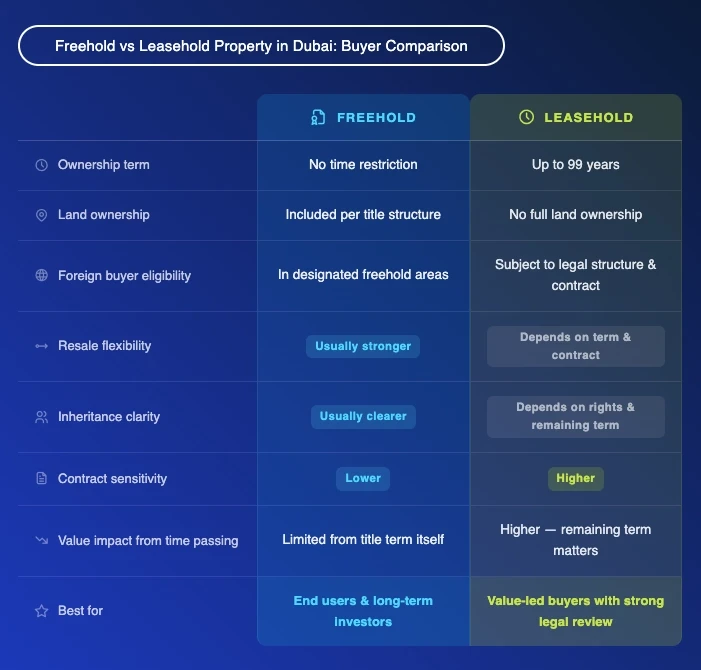
Freehold vs leasehold property Dubai ownership rights explained
This is the part buyers should slow down and review carefully.
With freehold, the owner normally has the right to sell the property, lease it out, transfer it, or pass it to heirs, subject to the laws and regulations that apply to the specific asset and community. Dubai’s legal framework and investor guidance place freehold ownership and registration at the center of enforceable property rights in the emirate.
With leasehold, your rights come from the contract, not from perpetual ownership of the underlying land. That means the contract term, renewal clauses, restrictions on alterations, and transfer conditions matter much more. Two leasehold properties in the same area can feel very different if the remaining years and contract terms are different.
For buyers, that changes valuation. A freehold asset is usually easier to explain to a future buyer. A leasehold asset needs the next buyer to accept the remaining term and the exact legal limitations in the contract.
Can foreigners buy freehold property in Dubai?
Yes, but only in designated freehold areas. The UAE government’s official guidance states that in Dubai, foreigners and expatriate residents may buy property in areas designated as freehold. Dubai has also continued adjusting the map of eligible ownership zones. In January 2025, Dubai Land Department announced that private property owners in Sheikh Zayed Road and Al Jaddaf could convert their ownership status to freehold for all nationalities.
That matters for two reasons.
First, buyers should never assume a location is freehold just because it is popular. The exact plot, project, and title status must be verified.
Second, Dubai’s market is dynamic. Area status can evolve through new resolutions or conversion initiatives. A buyer should confirm the current title structure before paying a booking amount or signing a sale agreement.
Why freehold usually suits end users and long term investors better
For most end users and long hold investors, freehold is simpler and stronger.
It gives indefinite ownership in the approved area. That improves clarity on inheritance and resale. It also supports a cleaner long term investment story because the buyer is not watching the lease term run down over time.
Freehold is often the better fit for buyers who want to:
hold the property for many years
build family wealth across generations
keep resale options open
avoid uncertainty around a declining lease term
Leasehold may still appeal when the entry price is lower or the location is difficult to access in freehold form. But that lower price should be tested against the remaining term, service charges, expected resale demand, and any restrictions in the contract. A cheaper entry price does not automatically mean better value.
What costs stay the same and what costs need more attention
On a standard Dubai property sale registration, the Dubai Land Department lists the registration fee as 2% of the sale value for the seller and 2% of the sale value for the buyer, which totals 4% of the sale value. DLD also lists an AED 250 title deed certificate issuance fee, plus trustee service partner fees of AED 4,000 + VAT when the sale value is AED 500,000 or more, or AED 2,000 + VAT when it is below AED 500,000.
Those official registration fees are not the same as agency commission or bank related costs. Buyers should separate the official DLD and trustee charges from brokerage, mortgage, valuation, and community costs when comparing deals.
In the freehold vs leasehold decision, the bigger cost issue is not usually the DLD fee. The bigger issue is whether the legal right you are buying will still be easy to sell later. With leasehold, that depends heavily on the remaining term and the contract. With freehold, the structure is normally easier for the market to understand.
The key due diligence checks buyers should do before signing
Every buyer should verify the same core points, but leasehold requires extra care.
For freehold, check the title status, the developer or seller credentials, any service charges, mortgage status, and whether the property is correctly registered with the Dubai Land Department. Dubai’s legal system puts registration at the center of enforceability.
For leasehold, add these extra checks:
The exact remaining lease term.
Renewal rights, if any.
Restrictions on sale, subleasing, renovation, or use.
Who owns the land or superior title.
What happens at expiry.
Any fees tied to assignment, consent, or extension.
This is where many buyers make mistakes. They compare two asking prices but do not compare the legal quality of the rights behind those prices.
Best use cases for freehold and leasehold in Dubai
Freehold is usually better for an end user buying a family home, an overseas investor building a long term portfolio, or a buyer who values inheritance and resale flexibility. It is also usually easier to explain to a mortgage provider and a future purchaser because the rights are clearer.
Leasehold can make sense for a buyer who wants a specific location, has a shorter investment horizon, or is getting a meaningful discount that more than offsets the weaker title structure. But the discount has to be real. If the price is close to a comparable freehold property, the freehold option is usually the safer decision.
Common buyer mistakes in freehold vs leasehold property Dubai deals
The first mistake is assuming “ownership” always means the same thing. It does not.
The second mistake is treating a leasehold term like a small detail. A 99 year structure sounds long, but a leasehold asset with many years already gone is not the same as a fresh long term right. The remaining term affects value, resale logic, and buyer demand.
The third mistake is failing to verify whether the area or project is genuinely freehold for the buyer’s nationality and the specific plot. Dubai allows foreign ownership in designated freehold areas, not everywhere by default.
The fourth mistake is focusing only on price and ignoring legal structure. Buyers should compare rights first, price second.
Simple decision rule for buyers
If you want long term control, easier resale, family succession, and clearer ownership, freehold is usually the better route.
If you are looking at leasehold, ask one question first: “Is the discount large enough to compensate for a time limited right?” If the answer is unclear, the deal needs more review.
That is the cleanest way to think about freehold vs leasehold property Dubai without getting lost in marketing language.
Final verdict
For most buyers, freehold is the stronger and simpler ownership model in Dubai. It gives ownership without time restriction in designated areas, stronger resale logic, and better long term clarity. Leasehold is not automatically bad, but it is more contract sensitive and must be priced correctly for the limited term.
If you are comparing projects, do not stop at brochure price. Check the title structure, remaining rights, registration status, and future exit options. That is where the real answer sits.
Eivan Properties brings more than 25 years of Dubai real estate experience. For buyers who want help reviewing title type, freehold area status, and deal structure before they commit, contact Eivan Properties through eivanproperties.ae for guided support on your next purchase.