
Dubai Property Investment Strategy: Flip vs Hold for Maximum Returns
Dubai investors usually ask one simple question first: should you flip, or should you hold? The answer depends less on trend-chasing and more on timing, transaction costs, rental depth, and exit discipline. A smart Dubai property investment strategy starts with that framework, not with a random project launch or a social media headline. Dubai entered 2026 with strong real estate momentum. In Q1 2026, total real estate transactions reached AED 252 billion, with 60,303 transactions recorded, while investment value hit AED 173 billion across 57,744 investments. The investor base also expanded to 48,448, including 29,312 new investors. That tells you one thing clearly: liquidity is real, but competition is real too.
The second signal is rental depth. Dubai Land Department said the rental sector reached 1.38 million tenancy contracts in 2025, with a total contract value of AED 126.4 billion. That matters because a hold strategy only works when rental demand is broad and recurring. On top of that, CBRE said Dubai rents in Q1 2025 were still rising, averaging nearly 11% growth for apartments and 9% for villas year on year. In other words, the city has both resale activity and income support, which is exactly why flip and hold can both work in the same market.
What makes a Dubai property investment strategy work in 2026
A practical Dubai property investment strategy has to balance four numbers: entry cost, holding cost, expected resale liquidity, and income strength. Investors often focus only on capital appreciation, but that can be a mistake in Dubai because transaction friction is meaningful. Dubai Land Department’s official service pages show a 4% registration fee on sale transfers, and mortgage registration is 0.25% of the mortgage value. In the resale market, a typical agency commission assumption is 2%, and brokerage services are generally subject to 5% VAT in the UAE. That means a short-term investor needs a solid price move just to overcome round-trip costs.
This is why flip and hold should not be treated as personality types. They are math problems. Dubai Land Department’s 2024 annual report also shows that between 2019 and 2024 the market saw accelerating turnover in residential assets. The same report highlights a surge in sub-3-year resales in villas and apartments, showing that fast exits are happening. But it also shows a large base of still-held inventory, especially in longer-duration buckets, which confirms that long holding periods remain a major part of how value is built in Dubai.
Flip strategy in Dubai: when short-term capital gains make sense
A flip strategy works best when you are buying below future market value, not when you are buying into pure hype. In Dubai, that usually means either early-cycle off-plan buying with a strong developer and a clear handover path, or selective ready-property repositioning in a community with visible pricing gaps. The attraction is simple: you aim for a shorter holding period and faster equity realization. DLD’s 2024 annual report says sub-3-year resales in villas and apartments have surged, which supports the case for short-duration strategies in the right product types.
But a flip has a higher error cost. If you buy a ready unit at AED 1,000,000, a 4% transfer fee alone is AED 40,000. Add a typical 2% agency fee, which is AED 20,000, and 5% VAT on that fee adds AED 1,000. Before any financing or minor admin costs, your entry friction is already about AED 61,000. If you also pay a similar 2% plus VAT on the sale side through agency commission, your total round-trip brokerage and transfer friction can easily push the breakeven move above 8%. That is an inference based on the published fee structure, and it is exactly why weak flips fail even in rising markets.
There is a strong case for flipping in specific parts of Dubai’s cycle. CBRE reported that Q1 2025 residential transaction volumes in Dubai surged by 23% year on year to 43,000 transactions, and the total sales value reached AED 115 billion. Off-plan accounted for AED 79 billion, or 69% of that value. When off-plan dominates deal value like that, short-horizon investors usually focus on launch pricing, payment plans, and exit timing before or around handover.
Dubai property investment strategy for flipping: where investors go wrong
The biggest mistake in a flipping-focused Dubai property investment strategy is ignoring liquidity mismatch. A unit may look cheap on launch day, but your actual buyer at exit still has to compare your resale asking price with new developer stock, incentives, payment plans, and current mortgage conditions. DLD’s annual report specifically notes that off-plan sales played a major role in fueling project launches and investor interest, which means resale stock often competes directly against fresh inventory. That is good for market depth, but it can squeeze your markup if you enter too late.
The second mistake is confusing gross appreciation with net profit. DLD’s annual report points to large aggregate investor profits in multiple resale cohorts, including AED 1.73 billion realized by 2022 buyers and AED 797.4 million collectively by 2023 and 2024 buyers in one discussed segment. Those numbers show opportunity, but they do not mean every unit flipped well. They show that the market rewarded the right entry points, not careless entries.
Hold strategy in Dubai: why recurring income can outperform
A hold strategy is less exciting on social media, but often stronger in real portfolio construction. The reason is simple: rental income pays you while you wait. Dubai’s 2025 rental market recorded 1.38 million tenancy contracts with a total value of AED 126.4 billion, while CBRE also reported continued rental growth in Q1 2025. That gives long-term investors two cushions: income and time. If the resale market softens for a few quarters, the asset can still produce cash flow instead of forcing a rushed exit.
Holding also fits the structural direction of the market. DLD’s Q1 2026 update showed foreign investment value rose to AED 148.35 billion, up 26% year on year, while total investment value reached AED 173 billion. That pattern usually supports the hold case because stable international capital often prefers preservation, income, and medium-term appreciation over fast trading. The same update also highlighted AED 87.71 billion in luxury real estate investments, which suggests that premium stock is still attracting conviction capital rather than only speculative money.
From a risk perspective, holding is usually more forgiving because your return is not entirely dependent on a near-term sale. DLD’s annual report explicitly says Dubai’s market has shown accelerating turnover in residential assets while also maintaining significant still-held inventory. That combination matters. It means the market supports both exits and patience. A good hold investor uses that flexibility better than a weak flipper does.
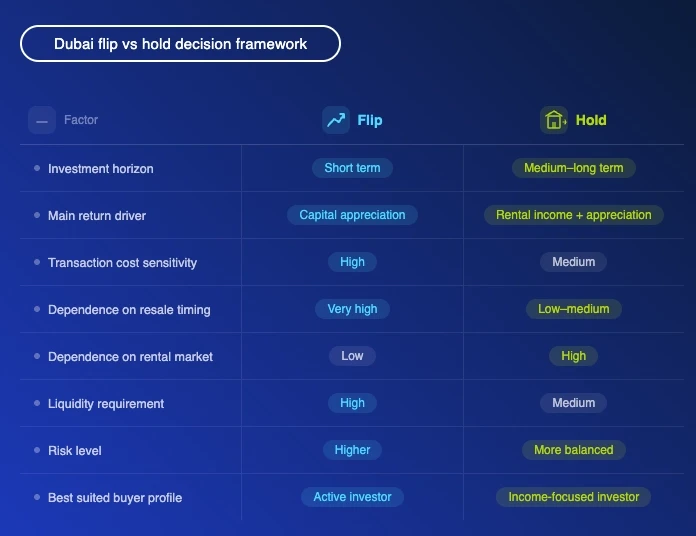
Flip vs hold: which Dubai property investment strategy fits which investor
Choose flipping if you have a high tolerance for timing risk, you understand launch pricing, you can compare supply pipelines, and you are disciplined about net margins after fees. It suits investors who want shorter capital cycles and can actively monitor the market. It works best when you secure a genuine pricing edge, not when you buy late in a crowded launch. The evidence of strong transaction volume and sub-3-year residential resale activity supports this route, but only for selective deals.
Choose holding if you want recurring income, more flexibility on exit timing, and a stronger buffer against market noise. It suits investors who care about occupancy, tenant demand, service-charge control, and long-term appreciation. Dubai’s 1.38 million tenancy contracts in 2025 and AED 126.4 billion in rental contract value make the hold case especially relevant for investors who want predictable portfolio behavior rather than event-driven gains.
My view is that the better Dubai property investment strategy for most investors in 2026 is still hold-first, flip-selectively. The reason is not that flipping does not work. It does. The reason is that transaction costs are fixed, but rental cash flow can compensate for imperfect timing. A weak hold can recover with time and leasing. A weak flip often has no second chance. That is an inference from the fee structure, rental-market depth, and turnover patterns shown across DLD and CBRE data.
How to build a smarter Dubai property investment strategy now
Start with product type. If the aim is flipping, focus on assets with an obvious resale story: strong developer brand, low competing pipeline in the same handover window, and a buyer pool that is broad enough to absorb your exit. If the aim is holding, focus on rentability first: practical layouts, proven tenant demand, and service charges that do not crush net returns. DLD’s latest releases show a large and growing investor base, but that also means better deals usually come from better underwriting, not from simply entering the market.
Then stress-test costs. Use 4% DLD transfer fees as a fixed line item. If financing, include mortgage registration at 0.25% of mortgage value. For resale deals, include a typical 2% brokerage assumption and VAT on that service. This cost discipline alone will stop many bad flip decisions before they happen.
Finally, match strategy to horizon. Dubai is liquid, but it is not frictionless. That distinction is everything. The market is broad enough for traders and long-term landlords, yet the safer route for many buyers is still to let rental income do part of the work. In 2026, the numbers support a simple conclusion: flip only when the discount is obvious, and hold when the income case is strong. That is the most practical Dubai property investment strategy in the current market.
If you want to turn this analysis into an actual buying plan, speak with Eivan Properties, a Dubai real estate agency with more than 25 years of experience. The right deal depends on your budget, target hold period, financing structure, and exit plan. Eivan Properties can help you compare off-plan and ready opportunities, review cost assumptions, and build a cleaner ROI model before you commit.