Downtown Dubai Investment Guide 2026: Is It Still Worth Buying?
Downtown Dubai remains one of the most recognized residential addresses in the city. It combines brand value, central location, luxury inventory, and strong tenant demand. That is why many investors still start their Dubai shortlist here. But in 2026, the right question is not whether Downtown Dubai is famous. The real question is whether the numbers still make sense.
This Downtown Dubai investment guide 2026 looks at that question with a strict investor lens. The latest live market snapshots show that Downtown Dubai apartment sale transactions over the last 12 months reached 2,940 deals, with an average sale price of AED 4.623 million and an average price of AED 3,145 per sq ft. On the rental side, the last 12 months recorded 9,863 rental contracts, with an average annual rent of AED 185,152 across property types in the area. At city level, Dubai’s residential market also stayed active in Q1 2026, with more than 45,000 residential transactions worth about AED 137 billion, even as price and rent growth began to moderate.
So, is it still worth buying? Yes, but not for every investor and not at every entry point. Downtown Dubai is strongest for buyers who want a prime core location, solid leasing depth, and long term resale liquidity. It is less ideal for buyers who only want the highest yield in Dubai, because many outer communities produce stronger income returns at a lower ticket size. That means success here depends on unit selection, total buying cost, service charge discipline, and exit strategy.
Downtown Dubai investment guide 2026: market snapshot
The cleanest way to understand the area is to separate prestige from performance. Prestige is obvious. Performance needs numbers.
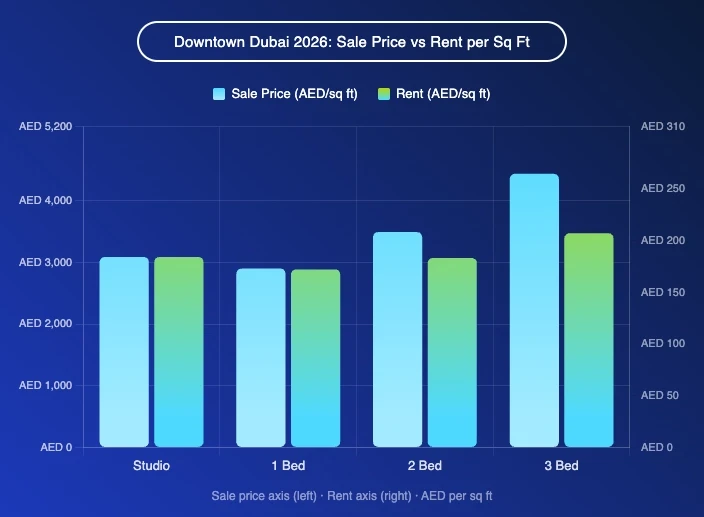
Bayut’s latest transaction snapshot for Downtown Dubai apartments shows an average of AED 3,145 per sq ft across the last 12 months. Bedroom level pricing shows a more nuanced picture. The same market tracker places studio apartments at AED 3,087 per sq ft, 1 bedroom units at AED 2,898 per sq ft, 2 bedroom units at AED 3,490 per sq ft, and 3 bedroom units at AED 4,434 per sq ft. That tells you two things. First, this is a premium district with a clear price gap over mainstream Dubai communities. Second, the sweet spot for investors is usually not the largest unit type.
Rental pricing supports that view. Downtown Dubai apartment rent trends currently show AED 184 per sq ft for studios, AED 172 per sq ft for 1 beds, AED 183 per sq ft for 2 beds, and AED 207 per sq ft for 3 beds. In practical terms, Bayut also shows average annual rents of around AED 130,000 for 1 bedroom units, AED 192,000 for 2 bedroom units, and AED 295,000 for 3 bedroom units in popular Downtown rental stock. This is strong rental depth, but the sale prices are also high, so gross yields need to be read carefully rather than assumed.
The broader Dubai backdrop also matters. CBRE says Q1 2026 residential activity stayed robust, but price and rental growth are moderating as more supply is expected later in the year. That is actually healthy for disciplined buyers. It reduces the chance of emotional pricing and creates room for selective negotiation in parts of the market.
What investors are really buying in Downtown Dubai
Investors do not buy Downtown Dubai only for yield. They buy a package of advantages.
The first advantage is location strength. Downtown sits close to DIFC, Business Bay, Sheikh Zayed Road, Dubai Mall, and major corporate and hospitality nodes. That supports demand from executives, business owners, short stay users, and high income tenants. The second advantage is global recognition. Burj Khalifa and Dubai Mall are not just landmarks. They are demand magnets that protect the area’s visibility in the international buyer market. The third advantage is liquidity. Prime branded and well located Downtown stock usually remains easier to market than equivalent stock in less established luxury districts.
That said, investors are also buying into a mature district. Downtown Dubai is not an early cycle undervaluation play. It is a core location strategy. Buyers should expect better wealth preservation, strong tenant appeal, and stable exit depth rather than the city’s cheapest entry or highest headline yield.
In this Downtown Dubai investment guide 2026, yield matters more than hype
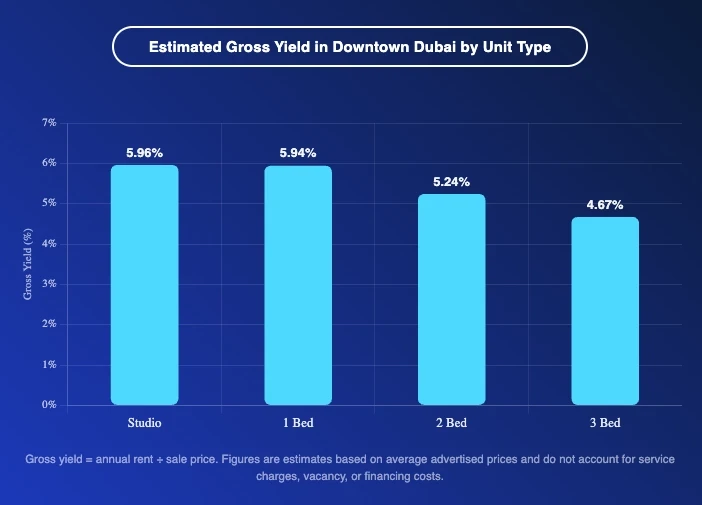
Using the current Bayut sale and rent per sq ft data, estimated gross yields work out to about 5.96% for studios, 5.94% for 1 beds, 5.24% for 2 beds, and 4.67% for 3 beds before service charges, vacancy, maintenance, and leasing costs. That means the best income efficiency is usually in smaller units, while larger units rely more on lifestyle demand and capital preservation.
This matches the wider market pattern. Engel & Völkers, citing Property Monitor data, says Dubai’s apartment rental yield average is 7.15% and the overall Dubai average is 6.68%. Downtown Dubai therefore sits below the city’s strongest yield districts, but still within a reasonable prime market range for a core luxury address.
For many investors, that is acceptable. A buyer choosing Downtown is often trading some yield for stronger tenant quality, landmark positioning, and better long term resale recognition.
What still looks attractive in 2026
The best value in Downtown Dubai is usually not “cheap” stock. It is mispriced stock relative to the micro location, view, building quality, and service charge burden.
A practical way to screen opportunity is this:
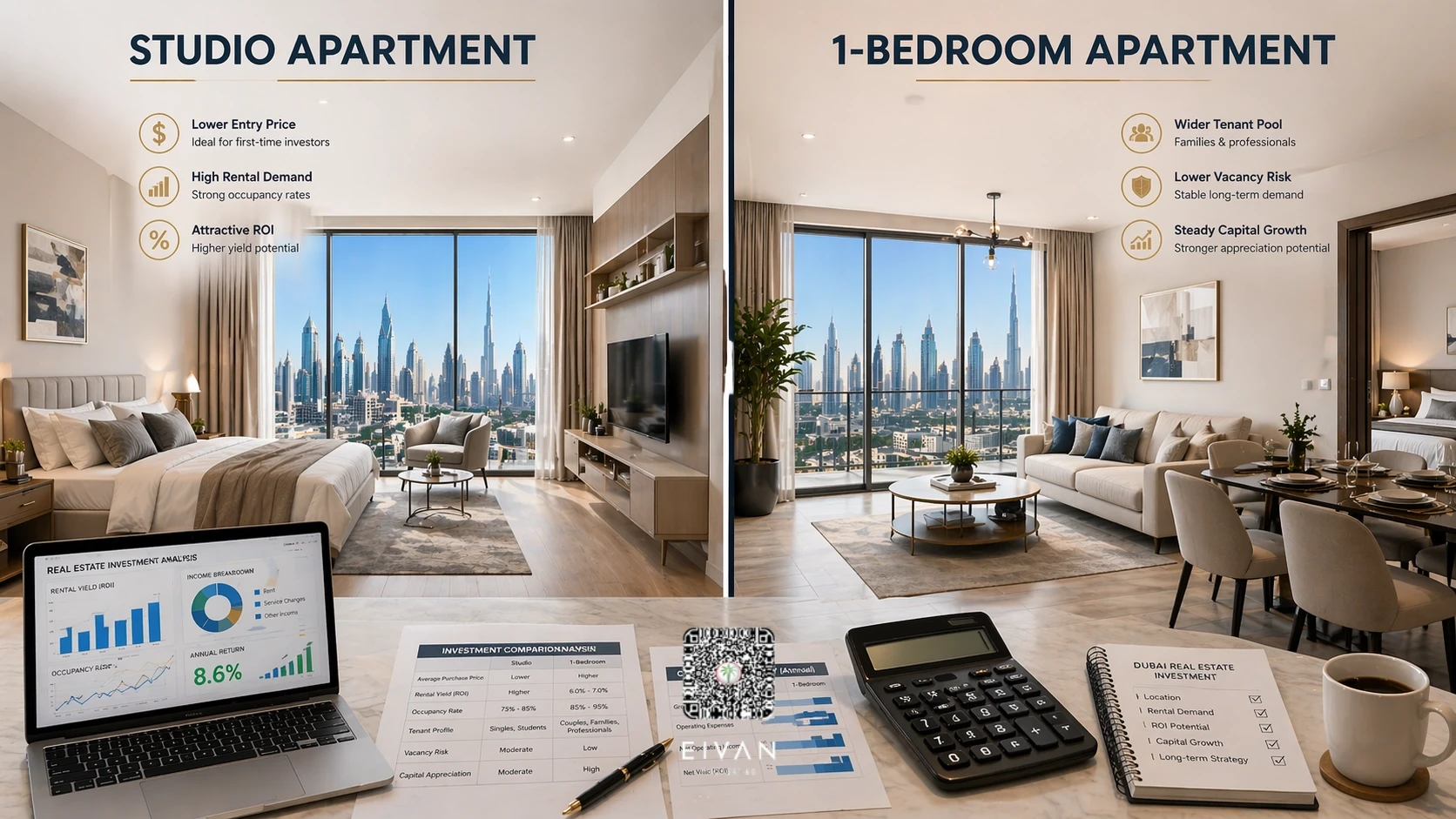
Look first at 1 bedroom apartments in established towers with proven leasing demand. Current pricing of AED 2,898 per sq ft and current rent of AED 172 per sq ft make this segment the most balanced mix of affordability, tenant pool, and gross yield in the area. Studios can match or slightly exceed that yield, but the buyer pool can be narrower depending on building quality and layout.
Then look at 2 bedroom units only if the layout is highly functional, the tower is professionally managed, and the unit has real end user appeal. At AED 3,490 per sq ft and AED 183 per sq ft in rent, the margin compresses. A weak tower or an inferior view can make the investment case much less attractive.
Be more selective with 3 bedroom stock unless your strategy is long term capital protection or premium end user resale. The current math is weaker for pure income investors, with a derived gross yield of about 4.67%.
Buyer costs you cannot ignore
A lot of buyers make the mistake of underwriting Downtown Dubai only on purchase price and rent. That is incomplete.
Dubai Land Department’s official fees remain a core part of the acquisition cost. For a standard purchase, the main items investors track are the 4% registration fee, AED 4,000 trustee office registration fee, and AED 250 title deed issuance fee. If the unit is financed, DLD also lists 0.25% of the mortgage value for mortgage registration, plus title related minor charges.
Then comes the issue that matters a lot in Downtown Dubai: service charges. DLD’s Service Charge Index is the official reference point for approved service fees in jointly owned properties. In luxury districts, service charges can materially reduce net yield, especially in towers with heavy amenities, concierge systems, or large common areas. That is why two units with similar rent and sale price can deliver very different net returns. Always underwrite using the specific building’s approved service charge, not the area average.
Risks investors should price in
No serious Downtown Dubai investment guide 2026 is complete without the downside.
The first risk is yield compression. If you buy the wrong unit at a premium entry price, your gross yield falls quickly and your net yield falls even faster after service charges.
The second risk is supply competition across Dubai. CBRE says more deliveries are expected later in 2026, which can slow rent growth and give tenants more options across the city. Prime areas usually absorb this better than secondary areas, but they are not immune.
The third risk is building selection. Downtown Dubai is not one homogeneous product. Tower age, facilities, floorplate efficiency, management quality, parking, and view all change leasing performance. Investors should think like underwriters, not tourists.
Final verdict: is it still worth buying?
Yes, Downtown Dubai is still worth buying in 2026, but only with a precise strategy.
It is worth buying for investors who want a prime Dubai address, strong rental demand, landmark driven resale appeal, and a more defensive long term holding. It is less compelling for buyers whose only goal is to maximize yield on a small budget.
The numbers support a selective buy case, not a blind buy case. The area’s rolling 12 month averages show real depth in both sales and rentals. Smaller units still produce workable gross yields near the 6% mark before costs. Dubai’s wider market remains active, but 2026 is more price sensitive than the peak momentum phase. That means disciplined buyers can still find value.
For most investors, the best route is simple: target a strong 1 bedroom or well bought studio in a proven Downtown tower, verify the building’s official service charges, model full acquisition costs, and buy only when the entry price supports your exit plan.
If you want expert help filtering Downtown towers, comparing net yield after service charges, and avoiding overpaid stock, Eivan Properties can help you shortlist the right options. Eivan Properties is a Dubai real estate agency with 25+ years of experience. Start with eivanproperties.ae and ask for a Downtown Dubai investor shortlist based on your budget, target yield, and holding period.