Emaar vs Sobha Investment: Which Dubai Developer Is Better for Long Term Investment?
Dubai investors often ask one direct question: Emaar vs Sobha investment which developer is better for long-term returns? The answer is not the same for every buyer. Emaar wins on scale, brand power, and large master communities. Sobha stands out for finish quality, tighter execution control, and a more design led premium product. The better choice depends on whether you value liquidity and community depth more, or quality led scarcity more.
For long term investors, this comparison should not be based on marketing alone. It should be based on measurable factors: developer sales momentum, community scale, construction model, product positioning, and how easy the asset may be to rent or resell later. On those points, both developers are strong, but they are strong in different ways.
Emaar vs Sobha investment: the short answer
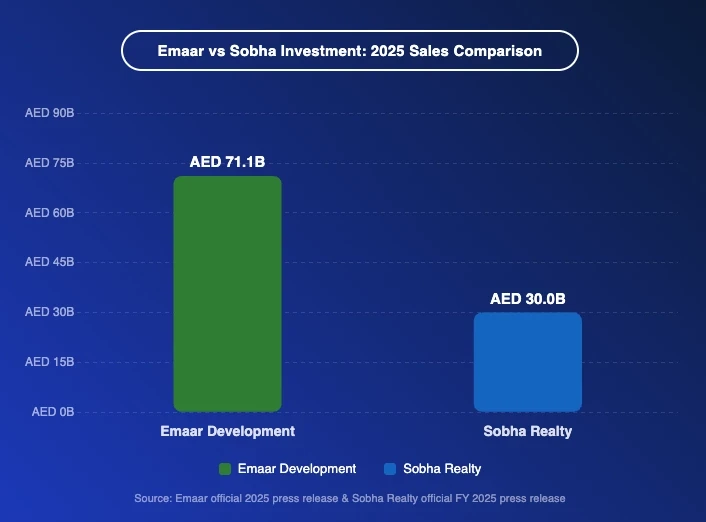
If your goal is broad market liquidity and exposure to Dubai’s biggest branded communities, Emaar is usually the safer long term choice. Emaar Development reported AED 71.1 billion in property sales in 2025, with a revenue backlog of AED 125.2 billion at year end. That is a scale advantage very few developers can match. Its parent, Emaar Properties, reported a broader AED 155 billion revenue backlog for 2025, showing how deep the overall platform is.
If your goal is premium product quality and a more tightly controlled construction model, Sobha is one of the strongest alternatives in Dubai. Sobha Realty announced AED 30 billion in sales for FY 2025, up 30% from 2024. Sobha also differentiates itself through its backward integrated operating model, where design, engineering, contracting, manufacturing, and facilities capabilities are more closely controlled in house. That is a real advantage for buyers who prioritize finish quality and consistency.
So the simple conclusion is this: Emaar is stronger for scale, brand reach, and exit liquidity; Sobha is stronger for product led differentiation and quality perception. For most long term mainstream investors, Emaar has the edge. For investors targeting the upper mid to premium segment and willing to back a more design driven proposition, Sobha can be the better fit.
Why Emaar is so strong for long term investment
Emaar’s biggest advantage is not just one tower or one launch. It is the ecosystem around the asset. The company’s communities include Downtown Dubai, Dubai Hills Estate, and Dubai Creek Harbour. These are not small standalone projects. They are large, recognizable districts with retail, leisure, green space, schools, and long-term placemaking value. That matters because long term investment in Dubai is often driven by community strength, not just unit specs.
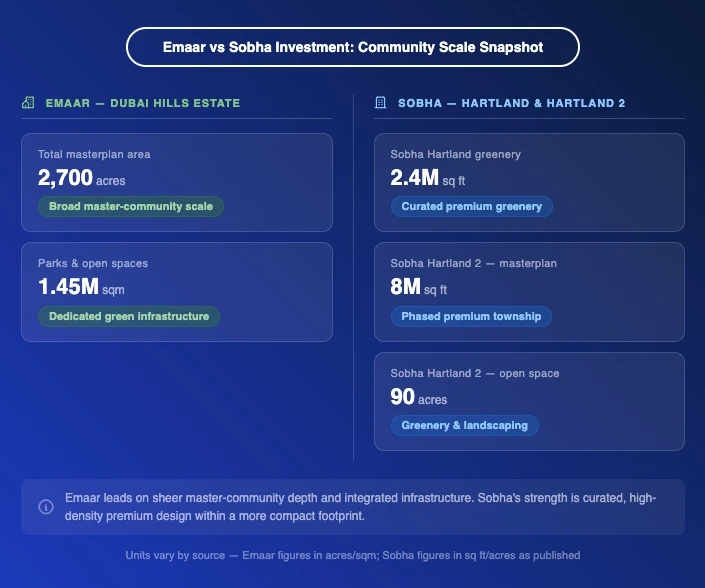
Dubai Hills Estate is a clear example. Emaar describes it as a 2,700 acre multi purpose development with 1,450,000 square metres of parks and open spaces, an 18 hole championship golf course, 180,000 square metres of Dubai Hills Park, 282,000 square metres of Dubai Hills Mall, and 3 schools. That kind of infrastructure supports long term end user demand, which usually helps both rental depth and resale appeal.
Emaar also benefits from financial visibility. In 2025, Emaar Development recorded AED 27.5 billion in revenue and proposed a AED 4 billion dividend, while its revenue backlog reached AED 125.2 billion. For investors, backlog matters because it signals a large pipeline of contracted future revenue. It does not guarantee performance in every project, but it does show that the platform is operating from a position of scale and demand.
There is also a brand effect. Communities like Downtown Dubai and Dubai Creek Harbour carry international recognition. Dubai Creek Harbour is positioned by Emaar as a waterfront district with strong access to major city landmarks, schools, healthcare, and the planned metro expansion. For long term investors, recognized destinations tend to support stronger buyer familiarity and easier resale conversations.
Why Sobha remains a serious long term investment contender
Sobha’s case is different. It is less about being everywhere and more about being known for how it builds. That distinction matters. Sobha’s investor materials highlight its backward integrated model, and the company says this allows greater control over design, engineering, contracting, selected manufacturing, and post handover services. In practical investment terms, that can support product consistency and quality perception, which are both important in the premium end of the market.
Sobha Hartland remains the clearest proof of the brand’s positioning. Sobha describes the community as an award-winning enclave in MBR City with 2.4 million square feet of greenery. Its ESG report adds that this green cover includes over 300 species of trees. That creates a very different product story from the larger, more mass-scaled master plan model used by some competitors.
Sobha Hartland 2 adds scale to that story. Sobha says the project spans 8 million square feet and includes 90 acres of open space and greenery. That is important because one traditional criticism of boutique premium developers is limited community depth. Sobha Hartland 2 shows the company is trying to keep its quality led identity while moving into a larger master community format.
Sobha’s 2025 sales result also deserves attention. The company announced AED 30 billion in FY 2025 sales, a 30% increase over 2024. That implies 2024 sales of about AED 23.1 billion, based on the company’s own growth rate. The number is far below Emaar’s scale, but it is still large enough to confirm that Sobha has real market traction rather than just niche appeal.
Emaar vs Sobha investment by community strategy
This is where the comparison becomes clearer. Emaar’s strategy is to build city scale, highly recognizable destinations. Dubai Hills Estate alone combines parkland, golf, education, mall infrastructure, and a large residential base. Dubai Creek Harbour adds waterfront placemaking and strategic connectivity. This tends to create broader demand across both owner occupiers and investors.
Sobha’s strategy is more curated. Sobha Hartland focuses on greenery, design, and premium residential identity close to central Dubai. Sobha One and other MBR City linked projects are positioned around premium living and connectivity to Downtown and DXB. For example, Sobha One states 15 minutes to The Dubai Mall and 12 minutes to Dubai International Airport on one project page, while Golf Ridges at Sobha One shows similar central access. That centrality supports long term appeal, especially for buyers who want a premium address near core business and lifestyle zones without buying directly inside Downtown.
Which developer is better for resale value and exit strategy?
For resale liquidity, Emaar usually has the stronger case. The reason is not that every Emaar unit will outperform every Sobha unit. The reason is that Emaar’s communities are easier for the average buyer to recognize quickly. Downtown Dubai, Dubai Hills Estate, and Dubai Creek Harbour already function as powerful location brands. That often makes the resale conversation simpler.
Sobha can still perform very well on resale, especially when the unit has strong views, a premium layout, and sits in a tightly held sub community. But Sobha’s resale strength is usually more product specific. Emaar’s resale strength is often more community driven. That distinction is important. If your exit plan depends on appealing to the widest possible buyer pool, Emaar is usually easier to defend.
Which developer is better for rental demand?
In long term investment, rental demand follows livability. On that front, both developers have strengths. Emaar performs well because its communities are deep, practical, and familiar. Dubai Hills Estate, for example, combines schools, parkland, mall access, and a large residential environment that appeals to families and professionals.
Sobha performs well when tenants are quality sensitive and location sensitive. Sobha Hartland’s greenery, premium finish reputation, and MBR City access make it attractive to tenants who want a more upscale residential feel close to central Dubai. The rental audience may be narrower than in the broadest Emaar communities, but it can also be more quality focused.
The main risk in the Emaar vs Sobha investment debate
The biggest mistake is to compare these developers in the abstract. A weak Emaar unit can underperform a strong Sobha unit. A weak Sobha unit can underperform a strong Emaar unit. Long term returns still depend on entry price, view, layout, building position, handover timing, and the micro supply around the unit. Developer choice matters, but asset selection still matters more.
The second risk is ignoring the wider market cycle. Dubai Land Department said Q1 2026 real estate transactions reached AED 252 billion, up 31% year on year, with 60,303 real estate transactions and AED 173 billion in investments across 57,744 transactions. That is a strong market backdrop, but investors should still focus on projects that can hold demand if the market becomes more selective later. Strong communities and strong product quality become even more important in that environment.
Final verdict: which Dubai developer is better for long term investment?
The best balanced answer is this: Emaar is the better all round long term investment developer, while Sobha is the better quality led challenger for investors who prioritize finish and premium positioning.
Choose Emaar if you want the comfort of scale, stronger location branding, deeper master community infrastructure, and potentially easier resale liquidity. Emaar’s AED 71.1 billion in 2025 sales and AED 125.2 billion year end backlog support that case.
Choose Sobha if you want a more design led, premium product and you believe build quality and controlled execution will matter more over time in the submarket you are targeting. Sobha’s AED 30 billion in 2025 sales and its integrated operating model support that thesis.
For a typical overseas investor, a family office, or a buyer who values community depth and easier exits, Emaar is usually the safer first choice. For a buyer who knows the MBR City premium segment well and wants a more quality focused product story, Sobha can be the smarter specialist play. That is the most accurate conclusion to the Emaar vs Sobha investment question today.
If you want a real investment comparison between specific Emaar and Sobha projects, speak to Eivan Properties. With more than 25 years of Dubai real estate experience, Eivan Properties can help you compare launch pricing, community depth, exit strategy, and long-term fit across both developers before you commit. See: eivanproperties.ae.