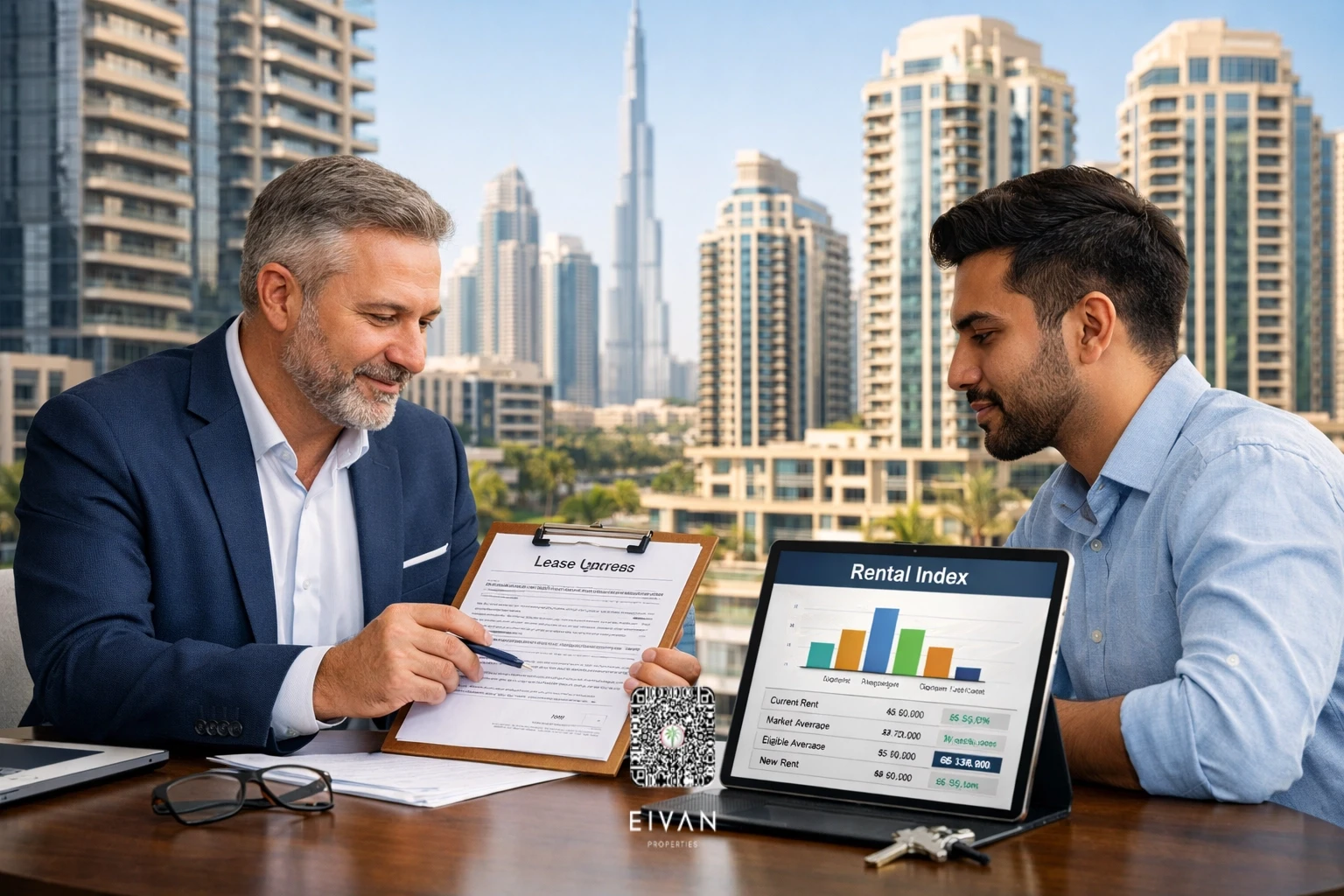
Dubai remains attractive to property investors for one simple reason: rental income can still produce strong returns relative to the property's purchase price.
For most investors, a realistic Dubai rental yield in 2026 is around 6% to 8% gross per year. Selected studios and one-bedroom apartments in lower-entry-price communities can move beyond 8%. Some individual segments are currently approaching 9% to 9.6% gross yield.
That does not mean every Dubai property produces an 8% return.
Location matters. Unit size matters. Purchase price matters even more. Service charges, vacancy, maintenance and property management can also turn an attractive headline yield into a substantially lower net return.
For an investor, the right question is therefore not simply, "What is the rental yield in Dubai?"
It is:
How much income will this specific property generate compared with the total amount I am paying for it?
This guide examines the numbers.
What Is the Average Dubai Rental Yield in 2026?
A useful benchmark for Dubai rental yield in 2026 is approximately 6% to 8% gross for investment properties in communities with healthy tenant demand.
Property Finder's 2026 analysis identifies the 6% to 8% range as common across many Dubai communities. Smaller properties can produce even higher percentages because the purchase price is relatively low compared with achievable annual rent.
Dubai Silicon Oasis, International City, Dubai Sports City, Jumeirah Village Circle and parts of Dubailand are among the areas where current data shows particularly competitive rental returns.
This is also happening while Dubai's rental market moves into a more moderate phase.
Bayut's H1 2026 rental analysis described the market as relatively stable, with more balanced rental movements across affordable, mid-market and luxury communities. CBRE also reported moderation in Dubai's residential market during Q2 2026 as additional supply helped reduce pricing pressure.
For investors, that makes purchase price discipline increasingly important.
Rapid rent increases cannot automatically be assumed.
What Is Considered a Good Dubai Rental Yield in 2026?
A Dubai rental yield in 2026 of 6% or higher can generally be considered competitive, while 7% to 8% represents a strong gross-income position for many residential investments.
A gross yield above 8% deserves attention. However, investors should check why it is high.
A 9% property is not automatically superior to a 7% property.
The higher-yield unit may have higher service charges, greater tenant turnover, more maintenance requirements or more competing supply nearby. It may also offer lower expected capital appreciation or weaker resale liquidity.
The strongest investment usually combines sustainable rental income with acceptable operating costs, tenant demand and resale potential.
Highest Rental Yields in Dubai by Area
Current 2026 market data shows a clear trend: affordable and mid-market apartments frequently outperform expensive prime properties on gross rental yield.
Several areas currently stand out.
Dubai Investments Park studios can reach approximately 9.59% gross yield.
Dubai Silicon Oasis studios are around 9.4% in selected market data.
International City one-bedroom apartments can generate approximately 9.21%.
Dubai Sports City studios are around 8.86%, while one-bedroom apartments can reach approximately 8.80%.
Dubailand studios can generate around 8.6% gross yield.
Jumeirah Village Circle studios are around 8.2%, while one-bedroom units can produce approximately 7.4%.
These figures should be treated as market benchmarks rather than guaranteed returns. The actual yield of two apartments in the same neighbourhood can differ considerably.
Chart: Dubai Areas With High Gross Rental Yields
Recommended chart type: Horizontal bar chart
Chart title: Highest Gross Rental Yields in Selected Dubai Apartment Markets — 2026
Use the following values:
Dubai Investments Park studio — 9.59%
Dubai Silicon Oasis studio — 9.40%
International City 1BR — 9.21%
Dubai Sports City studio — 8.86%
Dubai Sports City 1BR — 8.80%
Dubailand studio — 8.60%
JVC studio — 8.20%
JVC 1BR — 7.40%
Design recommendation: Use dark navy bars with one gold highlight for the highest-yield area. Display the percentage at the end of every bar. Keep the horizontal scale between 0% and 10%. Add the note: "Gross market yields; actual property performance varies."
Why Studios and One-Bedroom Apartments Often Have Higher Rental Yields
Smaller apartments frequently produce better percentage returns.
The reason is mathematical.
Their annual rent does not fall in proportion to their lower purchase price.
Consider a studio purchased for AED 600,000 and rented for AED 51,000 per year.
Its gross yield is:
AED 51,000 ÷ AED 600,000 × 100 = 8.5%
Now consider an apartment costing AED 2 million and renting for AED 120,000 annually.
Its gross yield is:
AED 120,000 ÷ AED 2,000,000 × 100 = 6%
The second property generates much more rental income in dirham terms.
Yet the first investment produces a substantially higher percentage return.
Current Dubai data reflects the same pattern. Studios and one-bedroom apartments can frequently produce yields in the 7% to 10% range in suitable communities.
This is why investors focused on cash flow often start their search with smaller units.
Gross Rental Yield vs Net Rental Yield in Dubai
One of the biggest mistakes an investor can make is confusing gross yield with the actual return received after expenses.
Gross yield is simple:
Gross Rental Yield = Annual Rent ÷ Property Purchase Price × 100
Suppose you buy an apartment for AED 1,000,000.
It generates AED 80,000 per year in rent.
Your gross yield is:
AED 80,000 ÷ AED 1,000,000 = 8%
But you will rarely keep all AED 80,000.
For example, assume annual service charges of AED 12,000, a maintenance reserve of AED 3,000, approximately AED 4,000 for property management or leasing, and an additional AED 2,000 vacancy allowance.
That creates total estimated annual operating costs of AED 21,000.
Your estimated net operating income becomes:
AED 80,000 - AED 21,000 = AED 59,000
Your net operating yield is therefore approximately:
AED 59,000 ÷ AED 1,000,000 = 5.9%
An advertised 8% gross yield has therefore become approximately 5.9% net in this example.
These expenses are illustrative. Actual service charges, vacancy periods, maintenance and management costs must be calculated property by property.
Purchase Costs Also Affect Your Real Return
Acquisition costs matter because your total investment is normally higher than the property's advertised selling price.
Dubai Land Department currently lists a total sale-registration fee equal to 4% of the sale value, divided between the buyer and seller according to the registration structure. Additional title-deed, map and Real Estate Registration Trustee charges may also apply.
The exact allocation of transaction costs should therefore be confirmed before purchase rather than assumed.
If an investor spends AED 1 million on the property but additional acquisition costs take the actual capital deployed materially above AED 1 million, calculating yield only against the advertised property price can make the return appear better than it really is.
For serious investment analysis, calculate both the gross yield on purchase price and the net return on total invested capital.
The second figure is usually much more useful.
Which Dubai Areas Are Best for Rental Yield?
There is no single "best area" for every investor.
Different communities suit different investment strategies.
Dubai Investments Park
Dubai Investments Park currently stands out for high apartment yields.
Studios can generate approximately 9.59% gross yield, while two-bedroom apartments can reach approximately 8.61% in selected 2026 data.
The relatively affordable entry price is a major part of the yield equation.
International City
International City remains one of Dubai's strongest cash-flow markets.
One-bedroom apartments can achieve approximately 9.21% gross yield. Studios can reach around 8.46%, while two-bedroom units can generate approximately 8.18%.
Another 2026 market analysis placed the community's overall average yield at approximately 8.6%.
The exact result depends on building, layout and entry price.
Dubai Sports City
Dubai Sports City combines relatively accessible prices with established rental demand.
Current market data puts studio and one-bedroom gross yields at roughly 8.8% in selected properties.
For investors looking for a sub-AED 1 million apartment strategy, this is one area worth analysing building by building.
Dubai Silicon Oasis
Dubai Silicon Oasis also remains competitive.
Selected 2026 data shows approximately 9.4% for studios, 8.7% for one-bedroom units and around 7.4% for two-bedroom apartments.
Its combination of residential stock, workplaces and road connectivity supports a broad tenant base.
Jumeirah Village Circle
JVC is one of the most closely watched investment communities in Dubai.
Current data indicates approximately 8.2% gross return for studios, 7.4% for one-bedroom apartments and around 7.2% for two-bedroom units in selected stock.
Its large supply pipeline means investors should avoid evaluating JVC only at community level.
Building quality can make a major difference.
Do Luxury Properties Have Lower Rental Yields?
Often, yes.
Luxury property can generate substantial rental income, but its purchase price is also substantially higher.
That tends to compress percentage yield.
A premium waterfront apartment can therefore produce more annual rental income than several affordable apartments while delivering a lower percentage return on the capital invested.
Prime communities such as Downtown Dubai and Palm Jumeirah often produce gross yields closer to the 5% to 6% range, while some mid-market and emerging areas can move significantly higher.
Luxury investors may accept the lower rental yield because they are also targeting scarcity, prestige, premium tenants, capital appreciation, international buyer demand and strong resale positioning.
A cash-flow investor and a luxury capital-growth investor therefore should not evaluate properties using the same criteria.
What Is Happening to Dubai Rents in 2026?
Rental growth has become more balanced.
Bayut reported that Dubai's residential rental market remained relatively stable in H1 2026.
International City rents increased approximately 4.25% overall, while Arjan recorded an increase of around 3.43%. Palm Jumeirah recorded approximately 5.31% overall rental growth in its apartment segment.
CBRE also reported that Dubai's residential sector moderated during Q2 2026 as new supply started easing pricing pressure.
This is important.
An investor buying in 2026 should not build a financial model that depends on double-digit annual rent increases continuing indefinitely.
A more conservative model is safer.
Buy a property that makes financial sense using today's achievable rent.
Treat future rent growth as additional upside rather than something required to make the investment work.
How Investors Can Improve Their Rental Yield
Improving yield begins at the purchase stage.
A property bought at the wrong price is difficult to fix later.
Start by comparing recent transaction prices with realistic annual rental income.
Then calculate the gross yield.
After that, deduct every predictable operating cost.
Check annual service charges, historical maintenance requirements, current occupancy, comparable achieved rents, the number of competing units, building age, furnished versus unfurnished demand, property-management costs, vacancy assumptions, upcoming supply and exit liquidity.
A discounted unit in an average building can sometimes outperform an expensive property in a famous community.
Price paid matters enormously.
Long-Term Rental vs Short-Term Rental Yield
Short-term rentals can produce higher gross revenue in suitable locations, but they also involve higher operating costs and greater income variability.
Professionally managed short-term rental properties in strong locations may approach 9% gross yield under suitable conditions.
However, investors must account for management, furnishing, utilities, cleaning, vacancy and seasonal changes.
Long-term rentals are usually simpler to model.
They generally offer more predictable annual income, lower tenant turnover, fewer operating requirements and easier cash-flow forecasting.
Short-term strategies can make sense, but investors should compare net income against net income, not short-term gross revenue against long-term net yield.
Is Rental Income Tax-Free in Dubai?
For a natural person, UAE Federal Tax Authority guidance states that qualifying real estate investment income is not treated as a business or business activity for Corporate Tax purposes.
The treatment depends on the circumstances and whether the activity is conducted or required to be conducted through a licence.
Tax circumstances can differ for companies, licensed activities and individual investors with more complicated structures.
Investors should therefore obtain professional tax advice for their specific ownership arrangement rather than relying on a general statement that every form of property income is "tax-free."
How Much Rental Income Can AED 1 Million Generate?
Using a gross rental yield of 6%, an AED 1 million property would generate approximately AED 60,000 per year, equivalent to around AED 5,000 per month before expenses.
At a 7% gross yield, annual rental income would be approximately AED 70,000, or around AED 5,833 per month.
At an 8% gross yield, annual rent would reach approximately AED 80,000, equivalent to about AED 6,667 per month.
At a 9% gross yield, the property would generate approximately AED 90,000 annually, or about AED 7,500 per month.
These figures are mathematical illustrations, not rental guarantees.
The achievable rent depends on the exact property.
An investor purchasing at AED 1 million should therefore avoid selecting a property simply because someone says it "offers 8% ROI."
Ask for the numbers.
If the expected annual rent is AED 80,000, verify comparable rentals.
Check the building's service charges.
Calculate maintenance.
Allow for vacancy.
Then determine whether the property genuinely produces an acceptable net return.
Is Dubai Property Still Attractive for Rental Income in 2026?
Yes, but selection has become increasingly important.
Dubai still contains residential segments capable of producing gross yields above 8%, with selected apartments approaching the 9% to 9.6% range.
At the same time, the rental market is becoming more balanced as supply increases and rental growth moderates.
That environment rewards investors who analyse individual properties rather than buying based purely on market momentum.
A realistic strategy in 2026 is to target:
6%–8% gross yield for a solid investment, with higher returns possible in selected affordable apartment markets.
Then calculate the property's net yield before making the final decision.
Find a High-Yield Dubai Investment Property With Eivan Properties
Rental yield is determined before the tenant moves in.
It begins with purchasing the right property at the right price.
Eivan Properties brings more than 25 years of real estate experience to investors evaluating opportunities across Dubai.
Whether your priority is rental income, capital appreciation or a balance of both, the team can help compare communities, property prices, expected rent and exit potential before you commit.
Speak with Eivan Properties to identify Dubai investment properties that match your target budget and return strategy.
Visit eivanproperties.ae to explore available investment opportunities in Dubai.
Frequently Asked Questions
What rental yield can I expect in Dubai in 2026?
A realistic gross rental yield for many Dubai residential investments is approximately 6% to 8%, while selected affordable studios and one-bedroom apartments can achieve more than 8%. Some current market examples approach 9% to 9.6%.
Is 7% rental yield good in Dubai?
Yes. A 7% gross rental yield is competitive for a residential investment, provided service charges, maintenance, vacancy and other operating costs remain reasonable.
Which area has the highest rental yield in Dubai?
There is no permanently fixed winner because property prices and rents change. In 2026 datasets, Dubai Investments Park, Dubai Silicon Oasis, International City and Dubai Sports City all contain apartment segments offering approximately 8.8% to 9.6% gross returns.
Do studios have better rental yields in Dubai?
Often they do. Their lower acquisition prices combined with relatively strong rent can produce higher percentage returns. Current Dubai data shows several studio markets above 8%.
Is gross rental yield the same as ROI?
No. Gross rental yield measures annual rent against property price. ROI can account for a wider range of income, costs, financing and capital gains. Investors should also calculate net yield after annual ownership expenses.
Can Dubai property generate a 10% rental yield?
It is possible for particular properties or strategies to approach or exceed that level, but it should not be treated as a normal city-wide expectation.
Current mainstream 2026 data supports approximately 6% to 8% as a more realistic general gross-yield benchmark, with selected properties exceeding 9%.
Conclusion
The headline answer is straightforward.
Dubai rental yield in 2026 generally sits around 6% to 8% gross for well-selected residential investments.
Investors seeking maximum cash flow can find higher numbers.
Studios and one-bedroom apartments in areas such as Dubai Investments Park, Dubai Silicon Oasis, International City and Dubai Sports City currently offer some of the strongest percentage returns, with individual segments around 9% or higher.
But headline yield should never be the final decision metric.
Calculate net income.
Check service charges.
Verify achievable rent.
Study competing supply.
Analyse the building.
And most importantly, negotiate the purchase price carefully.
A property advertised at 9% is not automatically a better investment than one producing 7%.
The best Dubai investment is the property that delivers sustainable rental income, manageable costs and a sensible exit strategy at the price you actually pay.