
Dubai Rent Increase Law Explained: How the RERA Rental Index Works in 2026
Dubai rent increase law is one of the most searched rental topics in the emirate, and for good reason. In 2026, rents remain a major concern for both tenants and landlords. Many residents want to know one thing: can the landlord legally raise the rent at renewal, and if yes, by how much? The answer depends on the official index, the timing of the notice, and the gap between the current rent and the market benchmark for similar units. Dubai Land Department states that rent increases on renewal are tied to the approved rental index, while the current residential system is now supported by the Smart Residential Rent Index launched in January 2025.
The big shift is that Dubai no longer relies only on broad area averages in the old way. The current framework uses a smarter building-based approach. According to Dubai Land Department, the Smart Residential Rent Index uses artificial intelligence and building classification criteria such as construction quality, finishes, maintenance, services, parking, energy efficiency, and location. That matters because two apartments in the same area may not justify the same rent if the buildings are very different in quality.
For readers, the practical takeaway is simple. The Dubai rent increase law does not allow a landlord to raise rent whenever they want. The increase must be connected to the official index, and the landlord must give proper notice before renewal. If those requirements are not met, the increase is generally not enforceable at that renewal. Dubai Land Department’s FAQ says an owner can increase rent based on the rental index with prior notice of three months, and DLD’s 2025 guidance says the increase applies only when the Smart Rent Index confirms eligibility.
What is the Dubai rent increase law in 2026?
In 2026, the core legal cap still comes from Decree No. 43 of 2013, which sets the maximum increase bands for renewals in Dubai. That decree says there is no increase when the current rent is up to 10% below the average rental value of similar units. The maximum legal increase then rises by band: 5%, 10%, 15%, and 20%, depending on how far below the benchmark the tenant’s current rent sits.
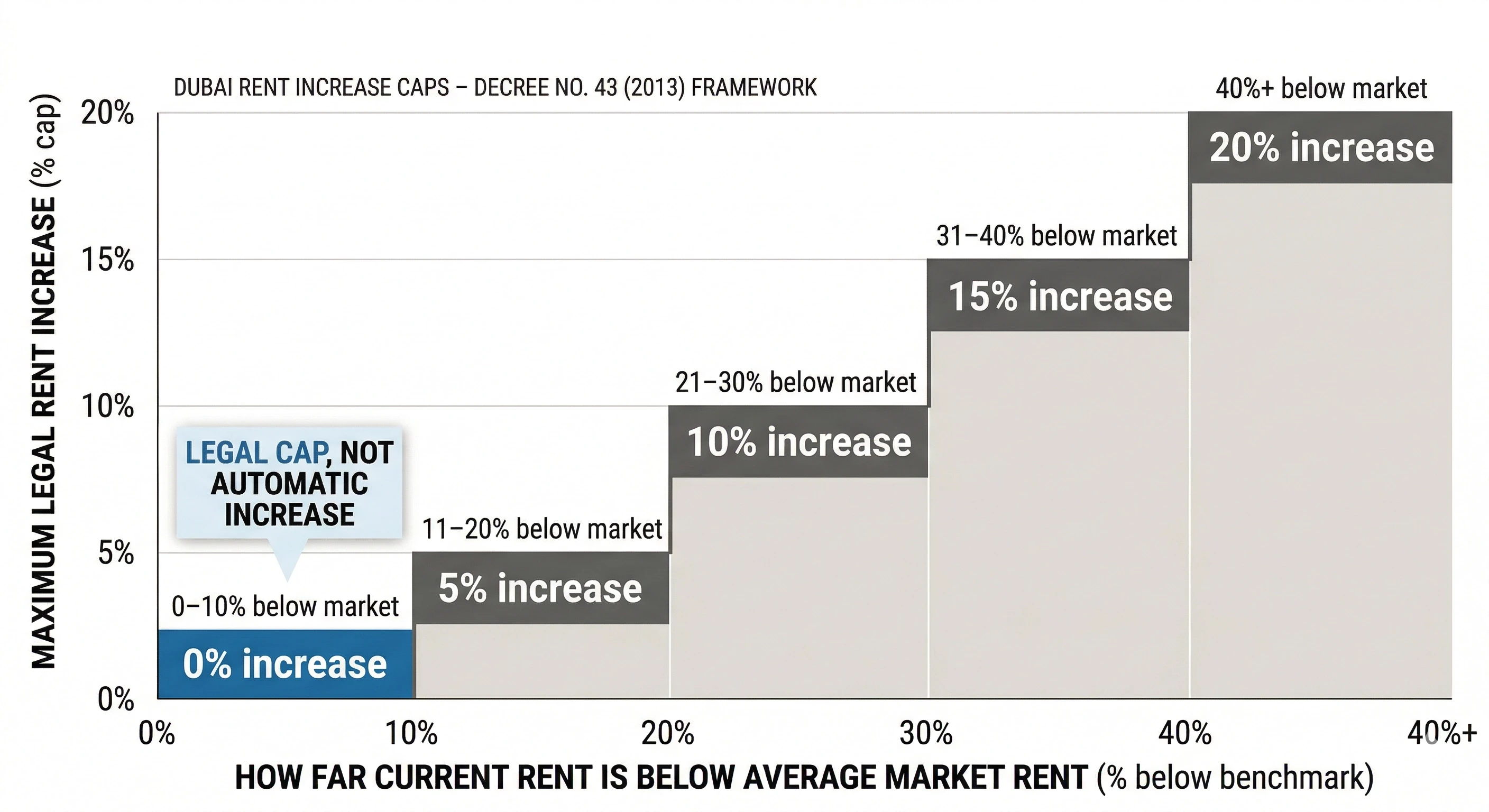
Here is the cap structure used for renewal calculations:
0% increase if the current rent is up to 10% below average market rent
5% increase if the current rent is 11% to 20% below average
10% increase if the current rent is 21% to 30% below average
15% increase if the current rent is 31% to 40% below average
20% increase if the current rent is more than 40% below average
These percentages are the legal ceiling, not an automatic entitlement. A landlord still needs the official index to show that the unit qualifies for an increase. In other words, Decree 43 gives the cap bands, while the index determines whether the property actually falls into one of those bands.
How the RERA rental index works in 2026
The RERA rental index in 2026 is now driven by the Smart Residential Rent Index
A lot of tenants still use the phrase “RERA rental index,” and that remains common in the market. But in practice, Dubai Land Department says the residential rental benchmark now operates through the Smart Residential Rent Index introduced on 2 January 2025. DLD describes it as a more advanced system built around actual building classification and continuously updated market criteria.
That means the RERA rental index in 2026 is not just a rough neighborhood average. It is more granular. It considers the building itself, not only the area. DLD says the system factors in technical and structural characteristics, maintenance quality, finishes, strategic location, and services such as cleanliness and parking management. This makes the result more defensible when landlords or tenants compare similar units.
For content and client education, this is an important point to stress: the Dubai rent increase law in 2026 is increasingly data-led. That is good for serious landlords, because quality assets can be measured more fairly. It is also good for tenants, because poor building quality or weak management should not command the same rent level as better-run stock in the same district.
How to check whether a rent increase is legal
Dubai Land Department provides a Rental Index service on its website. The service allows users to search the index using data such as Ejari contract number, DEWA premise number, or area details. This is the official starting point for checking whether a proposed rent revision fits the current benchmark.
In practice, tenants and landlords should follow this sequence:
Check the current annual rent in the existing Ejari contract.
Verify the lease expiry date.
Review whether written notice was served at least 90 days before expiry.
Use the official Rental Index service to assess whether the property qualifies for an increase.
Confirm the increase does not exceed the legal cap under Decree 43.
This process reduces disputes. It also stops a common mistake in the market, where parties rely on portal asking prices instead of the official benchmark. Asking rent is not the legal test. The DLD-approved index is what matters for a standard renewal dispute.

The 90-day notice rule that many landlords miss
The 90-day notice rule is one of the most important parts of Dubai tenancy renewals. Article 14 of the tenancy framework requires that if either party wants to amend contract terms, including rent, they must notify the other party at least 90 days before the tenancy contract expires, unless both sides agreed otherwise. Dubai Land Department’s FAQ also summarizes this as a three-month prior notice requirement for rent increases.
DLD’s 2025 explanation of the Smart Rent Index adds an important operational detail. Even when the property qualifies for an increase under the new index, the increase will not apply if the landlord failed to notify the tenant at least 90 days before contract expiry. This is a crucial point for 2026 renewals. Eligibility under the index alone is not enough. Timing matters.
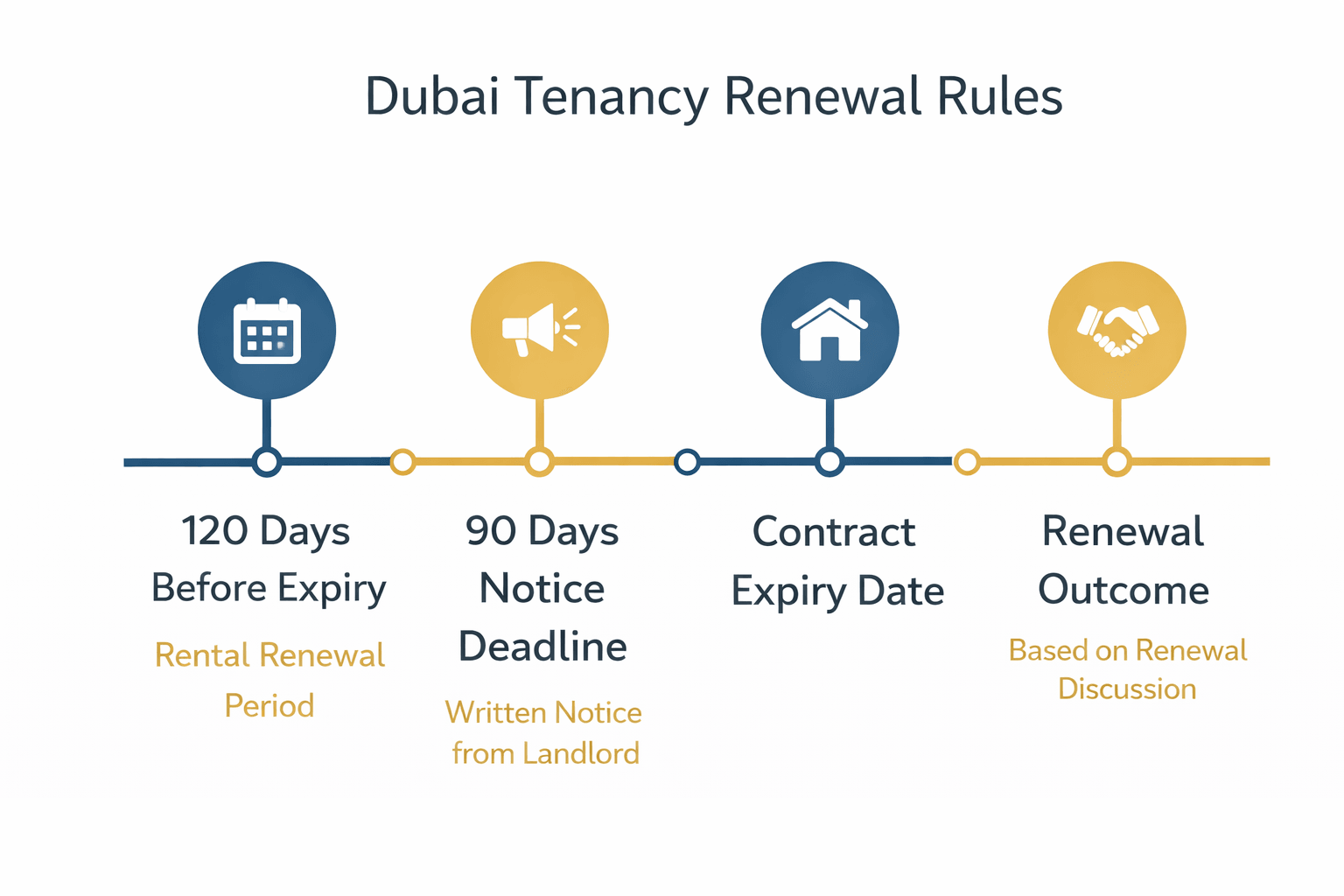
For example, if a tenant’s lease ends on 30 June 2026, the landlord normally needs to serve notice no later than 31 March 2026 unless the contract sets a different valid arrangement. If that deadline is missed, the rent usually continues on the existing terms for that renewal cycle even if the building’s benchmark has moved upward.
What happens if the landlord and tenant do not agree?
Dubai law allows the parties to discuss and amend the terms before expiry. If they do not agree, the matter can move to formal determination under the applicable legal framework. The legislation compilation cited by Dubai’s Rental Disputes Centre explains that the tribunal may determine fair rent by considering RERA criteria, market conditions, the property condition, and average rent of similar property in the same area.
This means a dispute is not decided by emotion or by verbal claims. It is decided by documented evidence, legal procedure, and the official benchmark. For this reason, both sides should keep records of notice delivery, Ejari details, current rent, proposed renewal terms, and screenshots or outputs from the official index service.
Does the lease renew automatically if the tenant stays?
Yes, in many cases it can. Dubai Land Department said in its 2020 clarification that if the tenant continues to occupy the property after expiry without objection from the landlord, the lease may renew automatically for a similar term or for one year, whichever is shorter, and on the same terms of the previous lease.
This matters for the Dubai rent increase law because passive conduct can affect renewal outcomes. If the landlord wants a change, including a legal rent increase, it is far safer to follow the notice rules properly and document the proposed renewal terms before expiry. Waiting until the last minute creates avoidable disputes and weakens the landlord’s position.
Can landlords charge lease renewal fees?
Dubai Land Department reported that landlords, management companies, or leasing offices are prohibited from claiming lease renewal fees from tenants at the time of lease renewal. RDC said these charges should not be inserted as a renewal clause and are not treated as rent.
That does not mean there are never administrative costs in the wider renewal process, but it does mean that a landlord cannot simply invent a “renewal fee” and treat it like part of the rent increase. For tenants, this is one of the easiest compliance checks to make. For landlords, it is a reminder that revenue at renewal should come from lawful rent, not unsupported side charges.
Market context: why the 2026 rental index matters more now
Dubai Land Department said the total number of registered rental contracts in 2024 exceeded 900,000, up 8% from the previous year. That tells you why DLD moved toward a smarter index system. A larger and more active rental market needs more precise benchmarking, especially when large gaps emerge between older sitting rents and current market levels.
In practical terms, a more dynamic city creates more renewal friction. Some tenants are still on contracts signed before the sharp rent resets seen in many communities. Some landlords own better-quality buildings that were undervalued under older area-wide methods. The Smart Residential Rent Index is designed to reduce that mismatch by using more property-specific inputs.
Dubai rent increase law: key mistakes to avoid in 2026
Common mistakes tenants and landlords still make
The first mistake is relying on broker opinions or listing portals instead of the official benchmark. The second is missing the 90-day notice deadline. The third is assuming that every renewal allows an increase. The fourth is confusing the maximum legal cap with the actual permitted increase for a specific unit. The fifth is ignoring building quality differences that the Smart Residential Rent Index now captures.
For tenants, the best defense is evidence. For landlords, the best strategy is compliance. Use the official DLD index, serve notice on time, keep communications in writing, and avoid unsupported fees or informal pressure tactics. These steps are not just legally safer. They are faster and cheaper than a dispute.
Final word on the Dubai rent increase law in 2026
The Dubai rent increase law in 2026 is clearer than many people think. The legal cap still comes from Decree No. 43 of 2013, but the benchmark for residential renewals is now shaped by Dubai’s Smart Residential Rent Index, launched in January 2025. That means legal rent increases depend on both the cap band and the property’s actual eligibility under the current official index.
The rule set is practical:
a landlord must check the official index, stay within the legal cap, and serve at least 90 days’ notice before expiry. If any of those elements fail, the increase may not stand. For both tenants and investors, understanding this framework is now essential because Dubai’s rental market is larger, more transparent, and more data-driven than before.
For expert advice on Dubai rentals, tenancy renewals, and investment-led leasing strategy, Eivan Properties can help. With 25+ years of experience in Dubai real estate, the team can support landlords, investors, and tenants with practical guidance grounded in today’s market. Visit eivanproperties.ae to explore advisory support, leasing strategy, and property opportunities across Dubai.