
Can a Tenant Break a Lease Early in Dubai? Rules, Penalties and Exit Options
Many tenants ask the same question: can you break lease early in Dubai without major legal or financial trouble? The short answer is yes, but only in limited ways. Dubai rental law does not give tenants an automatic right to walk away from a valid lease whenever they want. The starting point is Article 7 of Law No. 26 of 2007, which says a valid lease cannot be unilaterally terminated during its term by either the landlord or the tenant unless both sides agree or the law allows it.
That legal point matters because many tenants assume there is a fixed statutory exit fee. There is not. Dubai law does not set one universal early termination penalty for tenants. In practice, the result usually depends on one of three things: the wording of the tenancy contract, a separate signed addendum, or a negotiated settlement with the landlord. Recent Dubai market guidance also shows that a two month rent penalty is common in residential contracts, but that is a market practice, not a penalty fixed by statute.
For that reason, anyone trying to break lease early in Dubai should first read the contract before talking about notice, penalty, deposit, or handover dates. One clause can change the whole outcome.
Can a tenant legally break lease early in Dubai?
A tenant can leave early in Dubai, but usually only through one of these routes:
mutual agreement with the landlord
an early termination clause already written into the tenancy contract
a later written settlement signed by both sides
a dispute process through the Rental Disputes Center if there is a legal disagreement
The key legal principle is simple. If the lease is valid and active, the tenant cannot just stop the contract alone. Article 7 makes that clear. That is why early exit cases in Dubai are usually solved through negotiation, not assumption.
This is also where many people confuse early termination with non renewal. They are not the same thing. Under Article 14, if either party does not want to renew the lease or wants to change its terms at expiry, that party must notify the other side at least 90 days before the contract expires, unless the contract says otherwise. That 90 day rule is mainly about expiry and renewal, not a guaranteed right to leave mid term without consequences.
What penalty applies if you break lease early in Dubai?
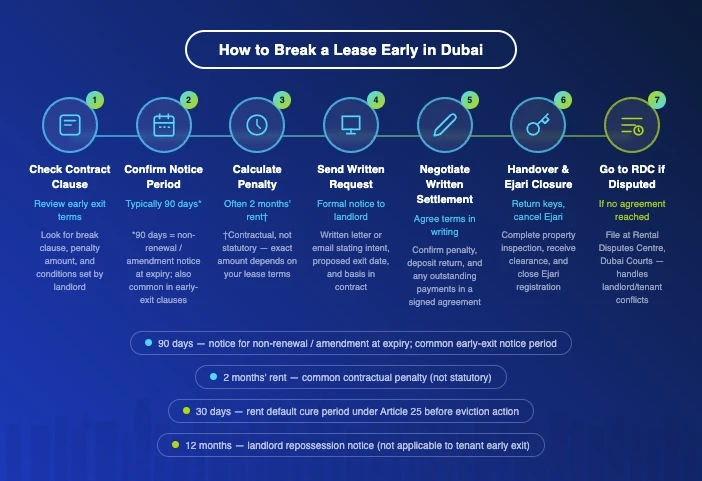
The most important answer here is accuracy: there is no single penalty written into Dubai tenancy law for every tenant who leaves early. The most common market outcome is a penalty equal to 2 months’ rent, but only if the contract says so or the landlord agrees to accept that settlement.
That means your actual exposure can fall into one of these patterns:
no penalty, if the landlord agrees to release you
a penalty of 2 months’ rent, which is common in practice
rent liability until a replacement tenant is found, if that is what both sides agree
loss of part of the security deposit if there are valid deductions for damage, unpaid bills, or unpaid rent
A tenant should also remember that the security deposit is not supposed to become an automatic penalty pool. Article 20 says the landlord may take a security deposit to ensure maintenance obligations and must refund the deposit, or the remaining balance of it, when the lease ends. So if the landlord keeps money, there should be a valid reason tied to rent arrears, actual damage, or contractually agreed deductions.
Break lease early in Dubai with a contract clause
The safest way to break lease early in Dubai is to have a clear early termination clause in the signed contract or addendum. That clause should state four points in plain language:
1. Notice period
Many residential contracts use 90 days’ written notice for an early exit clause, though some contracts use different wording. The enforceable position depends on the signed document, not on an automatic legal standard for early termination.
2. Penalty amount
A penalty of 2 months’ rent is common in market practice and is often easier to negotiate because both sides already understand it. But it is still contractual, not statutory.
3. Final payment date
The clause should make clear whether the tenant pays only the agreed penalty or must also pay rent until the move out date. This removes later argument.
4. Deposit and utility settlement
The clause should confirm how the deposit is handled and that utility bills, service usage, and key handover are settled before the file is closed. The DLD tenancy guide also notes that final settlement and final utility billing are part of contract closure practice.
If the contract has no early exit clause, that does not automatically mean the tenant is trapped. It means the tenant has to negotiate from a weaker legal position because Article 7 still applies.
What if the contract does not mention early termination?
This is the most common real life scenario. The contract is silent, the tenant gets relocated, changes jobs, or needs to move, and both sides need a practical answer.
In that case, the tenant should avoid informal promises over phone calls or WhatsApp only. The better route is to ask for a written settlement that states:
the agreed move out date
the agreed penalty, if any
the final rent position
the deposit adjustment method
the Ejari cancellation and handover process
In many cases, landlords accept a practical compromise because a cooperative exit is better than a dispute. A landlord may agree if the tenant gives enough lead time, keeps the unit in good condition, and helps make viewings possible for a replacement tenant. That is not guaranteed by law, but it is common commercial behavior in Dubai’s rental market.
Notice periods tenants should not confuse
Dubai tenancy disputes often happen because tenants mix up three different timeframes.
First, there is the 90 day notice before expiry under Article 14 for non renewal or change of lease terms, unless the parties agree otherwise.
Second, there is the landlord eviction framework under Article 25. For some eviction grounds linked to lease expiry, the law requires advance notice, and the tenancy guide also records a 12 month notice requirement in the amended framework for qualifying eviction reasons, served through notary public or registered post.
Third, there is the contractual notice period for early termination, which is not fixed by statute. If your contract says 90 days, then 90 days is the number that matters for your early exit discussion.
Keeping these timelines separate avoids one of the biggest mistakes tenants make when trying to break lease early in Dubai.
What happens if the landlord refuses?
If the landlord refuses an early exit request, the tenant still has options, but none should start with simply abandoning the property.
A tenant who leaves without a written settlement may still face claims for unpaid rent, agreed penalties, or other contract losses. Article 31 also shows the broader legal principle that rent liability can continue while a dispute is being considered until an award is rendered and executed.
The safer path is to keep a written record of all communication, send a formal notice email or letter, and ask for a signed settlement. If that fails, the dispute can be taken to the Rental Disputes Center, which is Dubai’s specialist forum for rental disputes and conciliation procedures.
When should a tenant go to the Rental Disputes Center?
The Rental Disputes Center is relevant when there is a real disagreement over rights or money, such as:
the landlord refuses to honor a signed early termination clause
the landlord keeps the deposit without support
the landlord claims more than the contract allows
the tenant says the landlord accepted an early release and then changed position
The RDC’s official site confirms that it handles rental disputes and amicable settlement procedures. Its contact page also lists official support channels and working hours.
Ejari and move out steps after early termination
Once the landlord and tenant agree on an early release, the file should be closed properly. A practical checklist includes:
signed settlement or termination confirmation
final rent reconciliation
DEWA and other utility closure or transfer
handover inspection
key and access card return
Ejari cancellation or update where required
This matters because an informal exit can create later issues around deposit recovery, outstanding bills, or proof of vacating date. A clean paper trail protects both sides.
Best negotiation strategy if you need to leave early
If you need to leave early, the strongest approach is not emotional. It is documented and commercial.
Start with the contract. Confirm whether there is an early termination clause. Then send a written proposal that offers a realistic exit date and a clean handover. If the contract is silent, asking for a settlement based on 2 months’ rent is often commercially understandable because that is a common market benchmark in Dubai residential leasing.
You should also make it easy for the landlord to say yes. Offer access for viewings, confirm the unit will be returned in good condition, and propose a settlement date for deposit and final bills. That usually works better than arguing that Dubai law gives a free right to cancel, because it does not.
Final answer: can you break lease early in Dubai?
Yes, a tenant can break lease early in Dubai, but not as an automatic legal right. The legal baseline is that a valid lease cannot be unilaterally ended mid term. Early exit usually works only through mutual agreement, a written termination clause, or a dispute outcome. There is no single statutory early termination penalty, but 2 months’ rent is a common contractual benchmark in the market. The 90 day rule in Dubai law mainly applies to renewal or amendment at expiry, while eviction rules and longer notice rules apply in different situations.
For tenants, the practical rule is simple: read the contract first, negotiate second, and document everything in writing. That is the safest way to break lease early in Dubai with the least risk.
Need help reviewing a Dubai tenancy clause before you sign, renew, or exit? Eivan Properties brings more than 25 years of Dubai real estate experience and can help you understand rental terms, negotiation points, and market practice before a small clause becomes a costly dispute. Visit eivanproperties.ae to speak with a team that understands Dubai leasing from both the tenant and landlord side.