
Secondary Market Property Purchase Dubai: Full Resale Buying Process
Buying a ready property in Dubai is not the same as buying off plan. In the resale market, the asset already exists, the seller already owns it, and the transaction moves through a defined transfer route that usually includes due diligence, offer acceptance, Contract F, developer NOC, and final title transfer through Dubai Land Department channels. Dubai Land Department states that property sale registration for a standard sale is processed through its approved system and trustee channels, with a listed service time of about 20 minutes once the file is complete.
That speed at the end can create a false impression. The real work happens before transfer day. A buyer needs to confirm ownership, check whether the property is mortgaged, understand building charges, review the seller’s documents, and prepare the right manager’s cheques and payment schedule. Dubai Land Department’s investor guide recommends legal due diligence before transfer and specifically advises the buyer to verify the seller’s ownership and the property’s status before moving ahead.
This guide explains the full secondary market property purchase Dubai process in the right order, with the official fee items that are fixed, the items that are variable, and the practical checks that matter most.
What secondary market property purchase Dubai means
In Dubai, a secondary market purchase means buying a property from an existing owner rather than directly from a developer at first sale. In practical terms, this usually means a completed apartment, villa, townhouse, or office that already has an issued title deed. Dubai Land Department’s sale registration service for completed property covers the registration of a sale transaction between the seller and the buyer for land, property, or a completed real estate unit.
For buyers, the resale route has three main advantages. First, you can inspect the actual unit, building, and community. Second, you can verify service quality and occupancy on the ground. Third, the path to legal ownership is more direct because title transfer happens after the required approvals and fee payments are completed. The trade off is that you need stronger transaction discipline. You are not just assessing the asset. You are also assessing the seller’s paperwork, the developer’s NOC requirements, and any mortgage linked to the property.
Why due diligence comes before the offer
The most important mistake buyers make is treating the offer stage as the start of legal checking. It should be the opposite. Basic checks should happen before the offer becomes binding.
Dubai Land Department’s investor guidance says the buyer should verify that the seller is the current owner and confirm the property’s legal status before proceeding. In a resale transaction, that means checking these points first:
Secondary market property purchase Dubai due diligence checklist
Confirm that the seller matches the title deed or is represented by a valid legal power of attorney. Dubai Land Department’s sale contract template states that the seller confirms he is the current owner of the property or a legal representative under a duly authorized power of attorney.
Confirm whether the property is free of mortgage or subject to bank finance. If there is a mortgage, the transaction path changes and additional mortgage related procedures and fees may apply. Dubai Land Department has a separate service for registering the sale of a mortgaged property, with a listed processing time of 15 to 20 minutes once the case is ready.
Check service charges, outstanding community charges, and any building level issues that may delay the NOC. Dubai Land Department’s investor guide notes that the developer checks for outstanding service charges and other jointly owned property issues before transfer.
Check the title deed details, unit number, area, parking, and seller ID details against the draft contract. Small data mismatches create avoidable transfer day delays.
Step 1: Offer, negotiation, and deal terms
The first live step is commercial agreement. Buyer and seller agree on the price, transfer timeline, inclusions, and payment method. This is also where the parties decide who will bear which fees. Dubai Land Department’s property sale registration page lists the transfer fee as 4% of the sale value, shown operationally as 2% seller and 2% buyer in its service breakdown. In practice, parties can still allocate some costs differently by contract, so the signed documentation matters.
At this stage, a buyer should lock five points in writing before moving to the MOU:
Sale price.
Target transfer date.
Whether the property is vacant or tenanted.
Whether the property is mortgaged.
Which party pays each transaction cost.
This sounds simple, but it removes most of the friction that appears later.
Step 2: Memorandum of Understanding and Contract F
Once terms are agreed, the parties move to the sale agreement, commonly called the MOU or Form F. Dubai Land Department publishes the property sales contract between seller and buyer, and broker workflows also refer to the creation of Unified Sale Contract F through Dubai REST processes.
The MOU records the key deal terms, the parties, the property, the price, deadlines, and payment obligations. Dubai Land Department’s contract template also shows that the buyer pays a deposit or security amount at signing, but the exact amount is filled into the contract and is not fixed by the template itself.
That matters because many buyers assume there is one mandatory deposit rule for all deals. There is not. The deposit amount is a transaction term and should be written clearly in the MOU. Do not assume. Confirm.
A strong MOU should also state:
The latest date for obtaining the NOC.
The latest date for transfer.
What happens if the property has a mortgage.
Which cheques are required on transfer day.
Who pays brokerage, DLD fee, trustee fee, and NOC fee.
Step 3: Apply for the developer NOC
For most resale transactions in jointly owned developments, the seller needs a No Objection Certificate from the developer before title transfer can proceed. Dubai Land Department also provides an electronic No Objection Certification framework, and its investor guide explains that the developer checks whether there are unpaid service charges or other issues before issuing the NOC.
The same DLD investor guide says the developer may charge an administrative fee of AED 500 for the NOC. However, in market practice, NOC fees can differ by developer and project workflow, so the safest way to write this for publication is:
Use AED 500 as the figure cited in the DLD investor guide, but state clearly that the actual administrative charge and process can vary depending on the developer and the project.
This avoids giving readers a false fixed fee where the actual operational charge may differ.
Step 4: Prepare the transfer file and manager’s cheques
Once the NOC is ready, the parties prepare for transfer at a registration trustee office or the approved DLD channel. This is the stage where most practical errors happen.
Dubai Land Department’s sale registration service lists these core official fee items for a standard sale:
The transfer fee is 4% of the sale value.
The title deed certificate issuance fee is AED 250.
The unified map fee is AED 225, while a villa or apartment map is AED 250.
Knowledge fee is AED 10.
Innovation fee is AED 10.
Service partner fee is AED 4,000 plus VAT if the sale value is AED 500,000 or more, or AED 2,000 plus VAT if the sale value is below AED 500,000.
For an apartment or villa sale above AED 500,000, the fixed official transfer side admin number commonly used in buyer budgeting is:
4% transfer fee
AED 4,200 trustee fee including VAT
AED 250 title deed fee
AED 250 apartment or villa map fee
AED 20 knowledge and innovation fees
That total equals 4% of the sale price plus AED 4,720 for the standard official items on an apartment or villa transfer above AED 500,000.
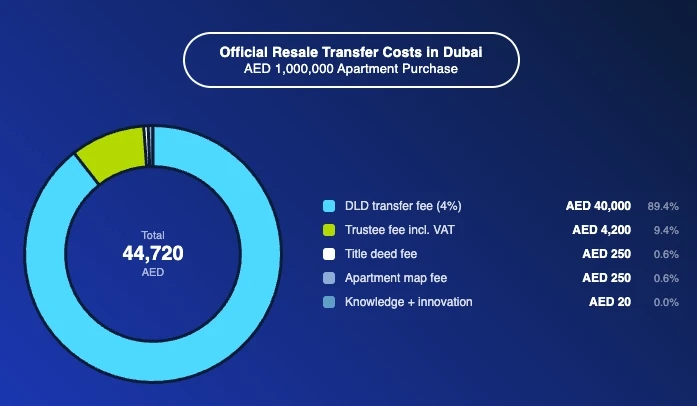
So, on a AED 1,000,000 resale apartment purchase, the standard official transfer side total is:
AED 40,000 transfer fee
AED 4,200 trustee fee including VAT
AED 250 title deed fee
AED 250 apartment map fee
AED 20 knowledge and innovation fees
Total: AED 44,720.
That figure excludes brokerage, NOC, and any mortgage related costs.
Step 5: Transfer day at the trustee office
On transfer day, the trustee office or DLD authorized channel verifies the file, collects the required cheques, and processes the ownership transfer. Dubai Land Department lists a service time of about 20 minutes for property sale registration once the transaction is complete and ready for processing.
The transfer day file usually depends on the transaction structure, but the parties should expect to provide identity documents, the signed sale contract, title deed details, NOC, and the manager’s cheques for the seller and the government fees. Where a representative signs, a valid legal power of attorney must be in place. The sale contract template and DLD service pages support that structure.
Once the transaction is approved and paid, the title is updated and the new owner receives the issued ownership document through the official process. Dubai Land Department’s title transfer and sale registration services both confirm title issuance and registration as the outcome of the completed process.
How a mortgaged resale purchase is different
A financed deal adds another layer. If the seller has an existing mortgage, the bank release process must be coordinated before or during transfer. Dubai Land Department’s mortgaged sale registration service lists a separate route for such cases and shows additional mortgage related fees. It also states a mortgage fee of 0.25% of the mortgage value if applicable.
This is why buyers should ask one question very early: is the property cash clear or mortgaged?
That one answer affects timeline, bank coordination, and closing cost structure.
The biggest cost mistakes buyers make
The first mistake is budgeting only for the price. The second is mixing fixed official fees with variable market fees.
Use this rule:
Treat DLD and trustee charges as fixed according to the official schedule. Treat brokerage, NOC, and any bank related charges as variable unless your signed deal already fixes them. The official DLD fee schedule for sale registration is clear on the transfer fee and trustee charges.
The third mistake is not checking service charge clearance before the NOC stage. If there are outstanding amounts, the transfer can stall.
The fourth mistake is poor cheque preparation. One wrong payee name or one missing manager’s cheque can delay transfer even when the legal file is otherwise ready.
A practical timeline for buyers
A straightforward cash resale purchase can move fast once documents are ready, but the real timeline depends on seller responsiveness, NOC issuance, and mortgage status. The final DLD registration step is fast. The pre transfer preparation is what controls the deal speed. Dubai Land Department’s own timings show that the official registration step is measured in minutes, not days, after the file is complete.
That is why the best buyers focus less on the ceremony of transfer and more on document readiness.
Final thoughts on secondary market property purchase Dubai
The secondary market property purchase Dubai process is simple only when it is managed in order. The right order is due diligence, agreed terms, MOU, NOC, cheque planning, and title transfer. Skip the early checks, and the transaction becomes expensive and slow. Follow the sequence, and the process becomes predictable.
For buyers, the most useful mindset is this: do not treat resale as just a negotiation. Treat it as a legal and operational transfer project. Every successful purchase depends on document accuracy, fee clarity, and timing discipline.
If you want a resale purchase handled properly from the first viewing to the final transfer, Eivan Properties brings more than 25 years of Dubai market experience. Their team can help buyers review the file, understand the real closing costs, coordinate the MOU and NOC process, and move to transfer with fewer surprises through eivanproperties.ae.