
How Landlords in Dubai Should Screen Tenants in Dubai Before Signing a Lease
Landlords who screen tenants in Dubai properly reduce payment risk, avoid occupancy problems, and keep the lease process smoother from viewing to Ejari registration. The goal is not to create delays. The goal is to confirm that the applicant can legally occupy the unit, pay on time, and submit the documents needed for a valid tenancy contract. In Dubai, the tenancy contract must clearly state the property, lease purpose, lease term, rent, payment method, and owner details when the landlord is not the owner. Lease contracts are also meant to be registered through Ejari.
A good screening process is simple. Ask for the same core information from every applicant. Check identity, payment ability, intended occupancy, and contract readiness. Then move to signing only when the file is complete. That approach protects the landlord and also gives the tenant a cleaner experience. It matters even more in 2026 because Dubai has tightened its position on shared housing, overcrowding, and occupancy compliance.
Why landlords should screen tenants in Dubai before signing
Many rental problems begin before the contract is signed. They start when a landlord accepts an applicant without checking income stability, who will live in the property, or whether the use matches the property type. Dubai Land Department’s FAQ makes one point very clear: a residential apartment cannot be rented for commercial office use. The tenancy law also allows action where a tenant uses the property for an unlawful purpose, uses it in a way that violates planning or land use rules, sublets without written approval, or damages the property through deliberate action or gross negligence.
That is why screening is not just about asking for salary proof. It is about checking fit. Can this applicant afford the rent structure? Does the intended occupancy match the unit? Are they planning to live in the property in a normal residential way? Is the file strong enough to move into contract signing and Ejari without missing documents? Those are the questions that matter most.
Start with a standard tenant screening checklist
Every landlord should use one checklist for every applicant. That keeps the process fair and faster. A practical Dubai checklist should include passport copy or Emirates ID details, visa or residency status when relevant, employer and job title, monthly income, number of occupiers, proposed move in date, payment method, and the documents needed to prepare the unified tenancy contract and complete Ejari. Dubai Land Department states that Ejari registration requires the unified tenancy contract, and trustee centre registration also requires presentation of the applicant’s Emirates ID. If someone is represented by another person, an official power of attorney is required.
This is why incomplete applications should not move straight to signing. If the tenant cannot produce the basics, the delay will happen later anyway. Good landlords shift that delay to the screening stage, where it is cheaper and easier to manage.
How to screen tenants in Dubai without slowing the deal
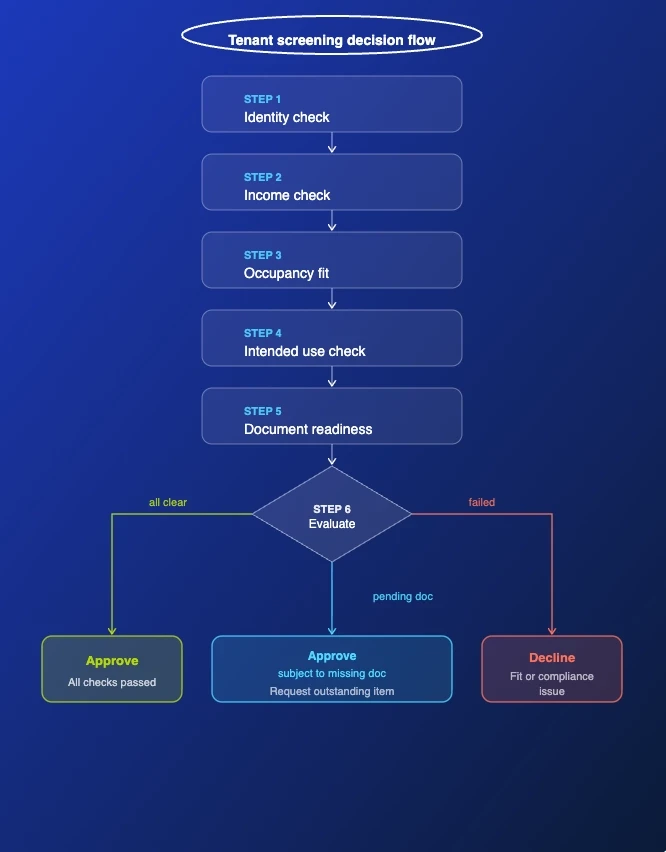
The fastest way to screen tenants in Dubai is to separate the process into four checks.
First, check identity. Make sure the applicant is the same person who will sign the lease. Second, check affordability. Confirm salary, business income, or another reliable source of funds. Third, check occupancy fit. Confirm exactly who will live in the unit and whether the setup is normal for that property. Fourth, check contract readiness. Make sure the documents and payment structure are ready so the contract can be signed and registered without last minute problems. This method keeps screening focused and prevents landlords from wasting time on low value questions.
Check income and payment ability early
Income verification should happen before negotiation goes too far. For employed tenants, landlords usually ask for a salary certificate, recent payslips, or recent bank statements. For self employed tenants, recent bank statements, trade licence documents, or business proof are more useful. The point is not to collect every paper available. The point is to confirm that the tenant can handle rent, deposit, and move in costs without stress. This is a best practice screening step, and it aligns with the lease law’s emphasis on rent and payment method being clearly set in the contract.
In May 2026, the UAE also launched a new Tenant Screening solution through Etihad Credit Bureau in collaboration with UAE PASS. It allows private landlords to request a prospective tenant’s credit score, but only after the tenant gives consent through UAE PASS. That means Dubai landlords now have an optional additional tool for financial screening, but it should be used carefully and with the applicant’s approval.
A smart rule is to decide your affordability benchmark before you advertise. That keeps decisions consistent. For example, if you want proof of stable monthly income, ask every applicant for the same type of evidence. Do not improvise one rule for one applicant and another rule for the next. Consistency is what makes screening efficient and defensible.
Verify who will occupy the property
Occupancy fit is one of the most overlooked parts of rental screening in Dubai. It is also one of the most important. On 11 March 2026, Dubai issued Law No. 4 of 2026 regulating the management and occupancy of shared housing. Dubai Municipality is responsible for oversight. The law says shared housing needs a permit, and it sets a framework around maximum occupancy, space per resident, and required shared facilities. Violations can lead to fines from AED 500 to AED 500,000, and repeated violations within one year can be doubled up to AED 1 million.
For landlords, the practical lesson is simple. Ask exactly who will live in the unit. Ask whether the tenant plans to share rooms or sublease any part of the property. If the arrangement sounds like shared housing rather than a standard family or individual residential tenancy, stop and check the compliance position before signing. The law also states that no person or entity may allocate a unit for shared housing without a permit.
You do not need a complicated questionnaire here. A clear occupancy declaration is enough for most leases. Ask for the number of adults, number of children, and relationship of the occupiers to the main tenant. That one step can prevent the biggest mismatch between the advertised use of the unit and the actual intended use.
Confirm the intended use matches the lease
Dubai’s tenancy framework expects the contract to state the purpose of the lease. That sounds basic, but it matters. If the property is residential, the use should stay residential. Dubai Land Department’s FAQ says a residential apartment cannot be used as a commercial office. The tenancy law also allows eviction grounds where the property is used for an unlawful purpose or in a way that violates planning, construction, or land use rules.
This means screening should include one direct question: “What is the unit being rented for?” For most applicants, the answer is obvious. But landlords should still record it. If the answer is vague, inconsistent, or suggests staff housing, partitioning, or another non standard use, the file needs deeper review before any commitment is made.
Check subletting risk before it becomes a dispute
Some landlords only discover subletting risk after move in. That is too late. Dubai tenancy law allows a landlord to request eviction before lease expiry where the tenant sublets the property, or any part of it, without the landlord’s written approval. That makes subletting one of the clearest issues to address during screening and in the lease wording itself.
The screening step is simple. Ask whether the tenant will be the only contracting party, whether any unrelated occupiers will contribute to rent, and whether any room sharing is planned. Then make the answer part of your file notes. Clear questions before signing reduce arguments later.
Do not leave documentation to the last minute
A lease often gets delayed not because the tenant was weak, but because the file was incomplete. Dubai Land Department states that registering or renewing a tenancy contract through Dubai REST or Ejari requires the relevant contract and uploaded documents. At trustee centres, the original unified tenancy contract is required, along with the applicant’s Emirates ID, and an official power of attorney if the applicant is acting as a representative.
The service fees are also clear on the DLD website. Registering a tenancy contract through Dubai REST or the department website costs AED 177.75 in total. Through Real Estate Services Trustee Centres, the total is AED 220. These are fixed numbers you can share with applicants early, so no one is surprised at the last step.
One more detail matters on renewals. DLD’s FAQ says that if previous rental contracts were not registered, the missed contracts must be registered before the current year’s rental contract can be registered. That is not a screening point for a brand new tenant, but it is relevant for landlords managing renewals and replacement tenants in the same portfolio.
Build a simple approval system
The best landlords do not screen by instinct alone. They use a simple approval system. Rate each applicant on identity verification, affordability, occupancy fit, intended use, and document readiness. You do not need public scoring. You only need an internal framework that helps you compare applicants on the same basis. That makes decisions faster and reduces emotional choices. This is an operational recommendation, but it is grounded in the same compliance issues that Dubai law and DLD procedures make important: valid identity, lawful use, clear contract terms, and complete registration paperwork.
Common mistakes landlords make when they screen tenants in Dubai
The first mistake is focusing only on rent amount and ignoring occupancy. The second is accepting vague explanations about who will live in the property. The third is checking documents only after verbal agreement. The fourth is failing to ask about subletting. The fifth is treating all applicants differently, which makes decisions slower and harder to justify. Each of these mistakes connects back to issues that Dubai’s tenancy framework already flags: use, occupancy, contract terms, and document completeness.
Final word for landlords
The best way to screen tenants in Dubai is to keep the process short, structured, and evidence based. Verify identity. Check income. Confirm occupancy. Confirm intended use. Make sure the file is ready for the unified tenancy contract and Ejari. That is enough to filter weak applications without losing speed on good ones. It also keeps the landlord closer to the legal and operational rules that matter in Dubai’s rental market.
If you want help leasing a property, reviewing tenant quality, or structuring a smoother landlord process, Eivan Properties can support you with on ground Dubai market experience built over more than 25 years. For landlords who want better tenants without unnecessary vacancy time, a professional screening process is one of the highest return improvements you can make.