Palm Jumeirah vs Downtown Dubai Investment: Which Luxury Property Market Is Better?
Data note: To keep the article consistent, all area pricing figures below use one comparison set: Palm Jumeirah apartments at AED 4,153 per sq ft and Downtown Dubai apartments at AED 2,980 per sq ft, based on the latest Property Monitor based averages published by Engel & Völkers in February 2026. Yield figures use Bayut’s latest reported returns: 3.96% for Palm Jumeirah apartments and 5.24% for Downtown Dubai apartments. Ultra prime demand evidence uses Knight Frank’s 2025 luxury sales data.
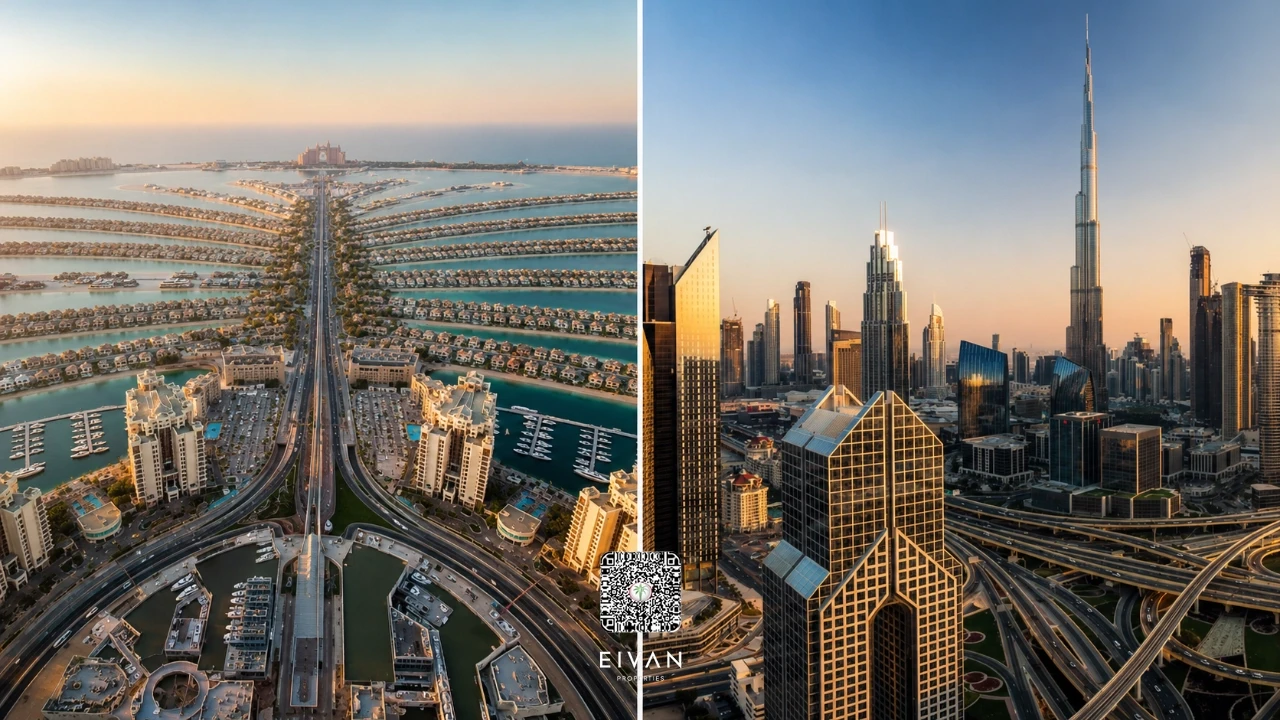
Dubai has many prime districts, but for luxury investors, the real debate usually narrows to two names: Palm Jumeirah and Downtown Dubai. Both are globally recognized. Both attract overseas capital. Both have strong branding. But they serve different investment goals. Palm Jumeirah is a scarcity driven waterfront market. Downtown Dubai is a landmark led urban core with deeper rental liquidity. That means the better choice depends less on hype and more on what you want your asset to do over the next five to ten years.
The simplest way to frame Palm Jumeirah vs Downtown Dubai investment is this. Palm Jumeirah is usually stronger for trophy positioning, ultra prime resale potential, and scarcity. Downtown Dubai is usually stronger for rental income, broader demand, and easier exits into a wider buyer pool. Investors who mix up those two profiles often buy the wrong asset in the right area.
Palm Jumeirah vs Downtown Dubai investment at a glance
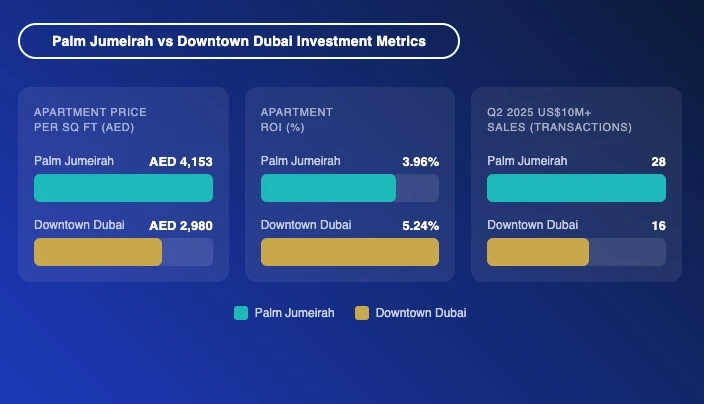
On entry price, Palm Jumeirah is clearly more expensive. The latest published average apartment price is AED 4,153 per sq ft on Palm Jumeirah, versus AED 2,980 per sq ft in Downtown Dubai. That means Palm carries roughly a 39% premium on this dataset. For investors, that matters because a higher entry basis raises the bar for yield but can also protect prestige value when supply is limited.
On rental yield, Downtown leads. Bayut reports an expected apartment ROI of 5.24% in Downtown Dubai, while its 2026 Palm Jumeirah comparison places Palm apartment ROI at 3.96%. That gap is large enough to matter for leveraged buyers, income focused investors, and anyone comparing cash flow after service charges. In plain terms, Downtown is the more efficient income play, while Palm asks you to lean more on wealth preservation and long term capital upside.
On ultra prime demand, Palm leads again. Knight Frank reported that in Q2 2025, Palm Jumeirah recorded 28 home sales above US$10 million, compared with 16 in Downtown Dubai. Palm also stayed the top performer in Q4 2025 with 28 transactions above that threshold. That does not mean Downtown is weak. It means the very top end of Dubai’s luxury market still treats Palm as the stronger badge asset.
Why Palm Jumeirah attracts a different type of luxury investor
Palm Jumeirah wins on uniqueness. It is one of the few addresses in Dubai where the location itself is part of the product. Waterfront frontage, limited island geography, branded residences, beach access, and global name recognition combine to create a scarcity premium that is hard to replicate elsewhere in the city. Even in a market with many new launches, true beachfront luxury stock remains limited. CBRE’s branded residences report notes that ready branded inventory is concentrated in mature prime areas including Palm Jumeirah and Downtown, which helps support pricing in both, but Palm benefits more from its island format and shoreline constraint.
The buyer profile on Palm is also narrower but richer. It attracts end users, second home buyers, family offices, and global high net worth buyers who are less sensitive to yield and more sensitive to address quality, privacy, sea view, and resale storytelling. That is a major reason Palm keeps appearing at the top of Dubai’s US$10 million plus sales rankings. In luxury markets, the deepest emotional demand often sits in rare waterfront property, not in standard prime apartments, even when those apartments are in the city center.
That said, Palm is not automatically the better investment for every luxury buyer. The lower reported apartment ROI of 3.96% means the holding case needs to be built around capital quality and prestige led demand, not just annual income. Investors also need to be selective by submarket. A generic apartment on Palm is not the same as a premium branded residence, a top floor full sea view unit, or a well positioned villa plot. Asset selection matters more on Palm because pricing dispersion is wider.
Palm Jumeirah vs Downtown Dubai investment for prestige buyers
For prestige driven investors, Palm Jumeirah usually has the edge. The address is more resort like, more internationally recognizable in beachfront terms, and more closely linked to trophy ownership. The strongest resale stories on Palm are often simple: private beach, iconic island, branded product, full sea view, limited comparable stock. Those points travel well with global buyers.
Downtown can still compete at the top end, especially for branded or Burj Khalifa view stock, but its prestige is more urban than coastal. Buyers who want the center of the city, immediate access to Dubai Mall, and the Burj Khalifa district may still choose Downtown first. But on pure luxury symbolism, Palm tends to command the stronger emotional premium.
Why Downtown Dubai is stronger for income and liquidity
Downtown Dubai works because demand comes from more than one source. It attracts end users, corporate tenants, professionals, frequent visitors, and investors who want a central address with year round relevance. Burj Khalifa, Dubai Mall, DIFC access, and the broader Sheikh Zayed Road corridor all support tenant demand. That creates a larger rental audience than Palm, where the entry ticket is higher and the user profile is more niche.
The pricing also makes Downtown more liquid. At AED 2,980 per sq ft, Downtown is still expensive, but it sits far below Palm’s AED 4,153 per sq ft apartment average. That lower basis matters at resale because more buyers can afford the unit, more investors can underwrite the deal, and more banks can support conventional mortgage driven demand. When a market softens or pauses, broader affordability within the prime segment usually improves exit flexibility.
Downtown’s reported apartment ROI of 5.24% is another major advantage. The yield is not “high” by outer community Dubai standards, but in the luxury bracket it is strong enough to make the hold strategy easier. For investors who care about annual carrying efficiency, especially after service charges and financing costs, Downtown offers a more balanced profile. It is still a prime address, but it behaves more like an income producing urban core than a trophy asset.
Who should choose Downtown Dubai over Palm Jumeirah
Downtown is usually the better fit for buyers who want one asset to do three jobs at once: preserve capital, stay rentable, and remain resellable to a broad market. That includes first time luxury investors in Dubai, overseas buyers who want less niche exposure, and landlords who care about occupancy depth more than beachfront scarcity. In a moderating market, that flexibility becomes more valuable. CBRE says Dubai’s residential sector may be shifting toward moderation and rental stabilization in some locations, which makes liquidity and realistic pricing even more important.
Exit strategy is where the real decision gets made
Most investors spend too much time on entry and not enough on exit. In Palm Jumeirah vs Downtown Dubai investment, exit strategy is the clearest separator. Palm’s best exits happen when the product is rare enough to stand out even in a premium cycle. That means beach access, iconic view, branded affiliation, a large layout, or villa scarcity. The wrong Palm asset can be slow because the buyer pool is smaller. The right Palm asset can outperform because it is hard to replace.
Downtown exits are usually more volume driven. The market is deeper. More buyers understand the area. More investors can compare rent and serviceability quickly. More overseas buyers recognize the Burj Khalifa district instantly. That does not guarantee a higher sale price multiple than Palm, but it often improves time to sale and buyer depth. For practical investors, that matters a lot.
Palm Jumeirah vs Downtown Dubai investment exit strategy
A simple rule works well here. Buy Palm when the asset itself is special enough to justify a scarcity premium. Buy Downtown when you want a prime address that can be sold again without needing a highly specialized buyer. In other words, Palm can produce a stronger “story exit.” Downtown can produce an easier “market exit.”
Costs, fees, and what investors should not ignore
Investors comparing only price per square foot miss the transaction layer. Dubai Land Department lists a AED 4,000 registration fee at Real Estate Registration Trustee offices, and DLD service pages also reference a 4% of sale value registration fee structure for sale transactions. Those costs apply regardless of whether you buy in Palm or Downtown, so they do not change the area ranking, but they do affect entry yield and break even timing.
The more important hidden variable is service charges. In luxury property, service charges can materially change net yield. That matters more on Palm because gross rental returns are already lower on the published data. A buyer who ignores service charge intensity can think they are buying a luxury income asset when they are actually buying a capital preservation asset with modest income support.
Which is better?
For most income focused luxury investors, Downtown Dubai is the better all round investment. It has the lower entry price at AED 2,980 per sq ft, the higher reported apartment ROI at 5.24%, and a broader buyer and tenant base. That combination usually makes it the safer choice for investors who want cleaner numbers and easier exits.
For buyers targeting ultra prime positioning, beachfront scarcity, and prestige led resale upside, Palm Jumeirah is the stronger strategic luxury bet. Its apartment average of AED 4,153 per sq ft and lower 3.96% apartment ROI only make sense if you value rarity and believe your exact unit can compete for the best global capital, not just local rental demand. Knight Frank’s luxury sales data strongly supports that Palm still dominates Dubai’s top end buyer attention.
So the answer to Palm Jumeirah vs Downtown Dubai investment is not one size fits all. Choose Downtown Dubai for stronger yield, broader demand, and more liquid exits. Choose Palm Jumeirah for trophy ownership, scarcity, and a better shot at prestige driven capital appreciation. The wrong move is buying either area without matching the unit to your exit plan.
If you want a deal level shortlist, Eivan Properties can help you compare Palm and Downtown stock by real entry price, service charge burden, rentability, and exit quality. With more than 25 years of market experience in Dubai, the team can structure a smarter buy around your target, whether that is cash flow, capital growth, or a luxury end use play. Explore options at eivanproperties.ae.