
Dubai Eviction Notice Rules: When a Landlord Can Legally Remove a Tenant
Dubai eviction notice rules are strict. A landlord cannot remove a tenant just because the market rent has risen or because a buyer is interested. Dubai law gives landlords specific legal routes, fixed notice periods, and formal service requirements. If those steps are not followed, the eviction can fail at the Rental Disputes Centre.
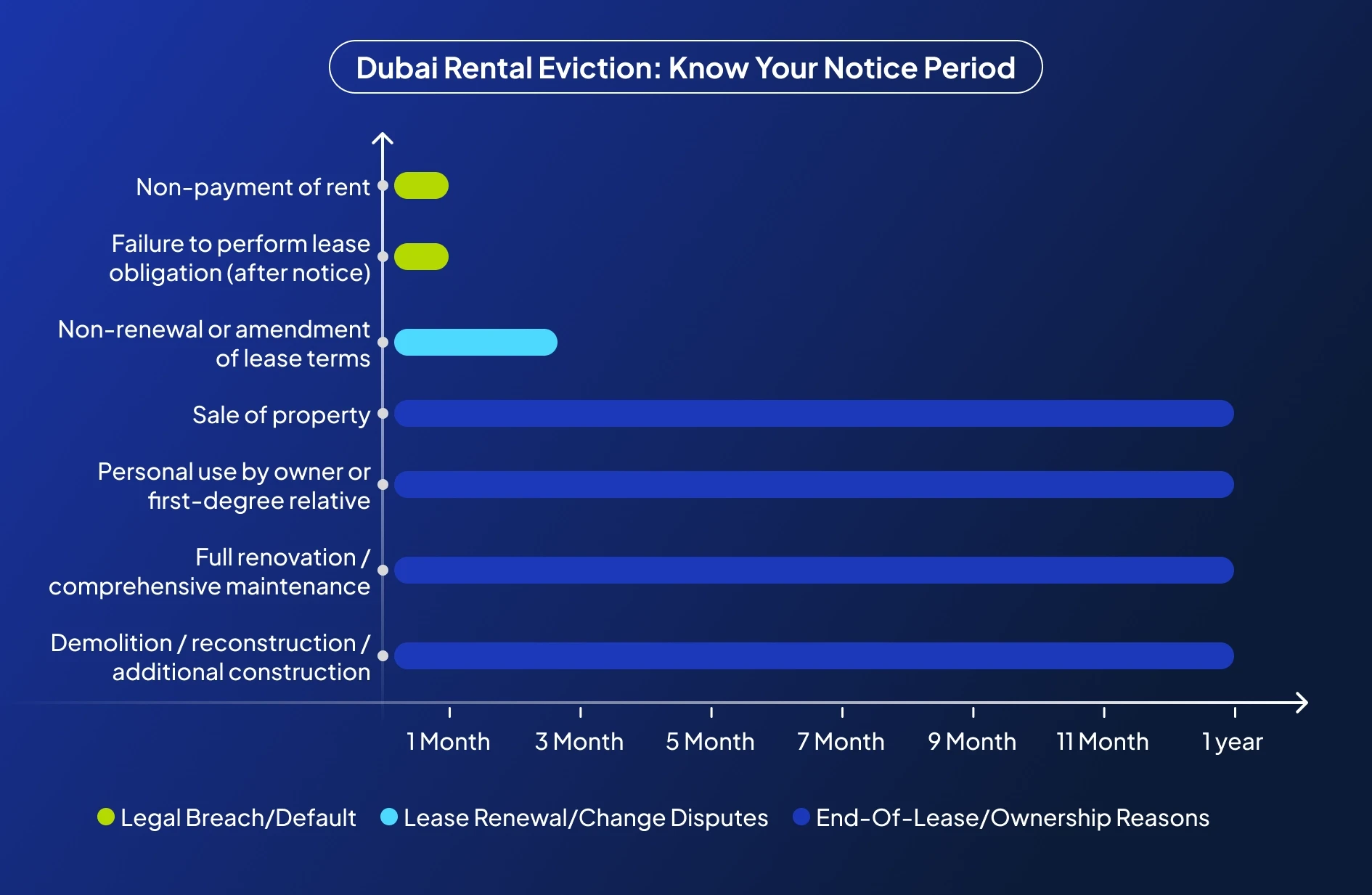
For landlords, that means process matters as much as reason. For tenants, that means a message on WhatsApp or email is not always enough. The most important numbers are simple: 30 days for certain breach cases, 90 days for non-renewal or contract changes, and 12 months for specific end-of-lease eviction grounds served through a notary public or registered mail.
This guide explains Dubai eviction notice rules in plain English. It covers when eviction is legal, what notice period applies, what mistakes landlords make, and what tenants should check before moving out.
Dubai eviction notice rules every tenant and landlord should know
The legal framework mainly comes from Law No. 26 of 2007 and Law No. 33 of 2008, which amended the earlier law. Under these laws, eviction in Dubai usually falls into two categories. The first is eviction before the lease expires because the tenant breached the contract or the law. The second is eviction at the end of the lease for a limited list of legal reasons.
That distinction matters because the notice rules are different. A landlord dealing with non-payment of rent does not use the same process as a landlord who wants to sell the property. Many disputes happen because owners mix up these two routes.
Another key point is that Dubai law protects the lease even when ownership changes. If a property is sold, the tenant’s right to continue in the unit does not automatically disappear, as long as the lease has a fixed term. The new owner must still follow the legal eviction process.
When can a landlord evict a tenant before the lease ends?
Article 25 of Law No. 26 of 2007 lists the main cases where a landlord may seek eviction before the lease term expires. These cases are not open-ended. They are specific legal grounds.
The first major case is non-payment of rent. If the tenant does not pay the rent, or part of it, within 30 days from the date a notice to pay is served, the landlord may seek eviction. That 30-day period is a fixed legal number, so it should not change from one paragraph to another or from one notice to another.
Other grounds include subletting without written approval, using the property for an illegal purpose, causing serious damage, using the property for a purpose different from the agreed use, occupying a condemned property, and failing to perform a legal or contractual obligation within 30 days after notice. These grounds exist, but the landlord still needs evidence. In practice, a weak file often fails even when the owner believes the reason is obvious.
For example, if the claim is about dangerous alteration or damage, the landlord will usually need documents, photos, expert evidence, or official reports. If the claim is about the condition of the building, the law refers to technical proof such as a report attested by Dubai Municipality in the relevant cases.
What notice period applies in Dubai?
The answer depends on the reason.
For certain tenant breaches, the key number is 30 days. That includes non-payment of rent and failure to perform an obligation after notice. The landlord serves notice, the tenant gets 30 days to fix the issue, and only then can the landlord move forward if the problem remains.
For renewal and contract changes, the key number is 90 days. Article 14 says that if either party does not want to renew the lease, or wants to amend any term, that party must notify the other side at least 90 days before expiry, unless the parties agreed otherwise. This is important because many people confuse a 90-day non-renewal notice with a 12-month eviction notice. They are not the same thing.
For certain no-fault end-of-lease evictions, the key number is 12 months. Law No. 33 of 2008 states that for these cases, the landlord must notify the tenant of the eviction reason at least 12 months before the eviction date, and the notice must be served through a notary public or by registered mail.
Which reasons allow a 12-month eviction notice?
A landlord cannot use a 12-month notice for just any reason. The law allows it for a limited list of end-of-lease cases.
Those grounds include:
demolition and reconstruction required by a competent government entity,
full renovation or comprehensive maintenance that cannot be done while the tenant remains,
demolition to rebuild or add new construction that prevents use,
repossession for the owner’s personal use or the use of first-degree relatives, and
sale of the property.
That fifth ground matters a lot in today’s market. Many owners believe they can ask a tenant to leave because they plan to list the property. The law does allow eviction for sale, but it still requires the formal 12-month notice route. A buyer also does not automatically remove the tenant by completing the purchase.
How Dubai eviction notice rules apply when the owner wants to sell
This is one of the most searched parts of Dubai eviction notice rules, and it is also one of the most misunderstood.
If the owner wants to sell, the tenant does not lose protection simply because a transfer is coming. Article 28 states that transfer of ownership does not affect the tenant’s right to continue occupying the property under a fixed-term lease. The RDC also states that if a property is sold during a notice period, the new owner must send a legal notice in accordance with the law if that owner wants the property vacated.
In simple terms, sale is a legal ground for eviction, but sale itself is not instant eviction. The correct notice and method still matter. This is where many landlords make costly errors.
Personal use eviction: an area where landlords must be careful
Personal use is another lawful ground, but it is tightly controlled. If the owner wants the property back for personal use, or for a first-degree relative, the landlord must follow the formal end-of-lease route and give the required 12-month notice. The RDC FAQ also confirms the 12-month rule for personal use cases.
There is also an important anti-abuse rule. Under the amended law, if the landlord reclaims possession for personal use or first-degree relatives, the landlord may not rent the residential property to a third party for at least 2 years. For non-residential property, that restriction is 3 years. If the landlord does re-rent in violation of the rule, the former tenant may request fair compensation.
This rule is a major reason tenants challenge bad-faith eviction claims. If the true goal is only to raise the rent by replacing the current tenant, the landlord can face legal and financial risk.
Renovation, demolition, and redevelopment cases
Some landlords assume “I want to renovate” is enough. It is not. The law requires more than intention.
If the landlord says the property needs full renovation or comprehensive maintenance that cannot be carried out while the tenant is inside, the condition must be verified by a technical report attested by Dubai Municipality. If the claim is about demolition and reconstruction, or adding new structures that block use, the owner must have the required permits from the competent entities. These are document-heavy cases.
This is one reason a simple letter from the owner often fails in practice. The legal ground may exist, but the file still needs the right supporting proof.
90-day notice is not the same as a 12-month eviction notice
This is probably the most common legal misunderstanding in Dubai rentals.
Article 14 says either party must give 90 days’ notice before lease expiry if they do not wish to renew or if they want to amend contract terms, unless the contract states otherwise. That rule governs renewal and amendments. It does not replace the 12-month notary or registered mail notice needed for sale, personal use, demolition, or major renovation cases.
So if a landlord sends a 90-day email saying, “I will sell the unit, so you must vacate,” that is usually mixing two different legal concepts. The 90-day rule may relate to renewal timing. The 12-month formal notice relates to certain eviction grounds. In many disputes, that difference decides the case.
Common mistakes landlords make under Dubai eviction notice rules
The first mistake is using the wrong notice period. Landlords often send a 90-day notice when the law requires 12 months, or they try to move straight to eviction without giving the tenant the 30-day cure period in breach cases.
The second mistake is using the wrong delivery method. For the 12-month end-of-lease eviction grounds, the law specifically says the notice must be served through a notary public or by registered mail. Informal communication can still be useful for discussion, but it should not be treated as a substitute for the legal notice.
The third mistake is weak documentation. Claims based on renovation, structural condition, or legal breach need evidence. In some cases, the law itself requires technical reports or permits.
The fourth mistake is assuming a sale automatically cancels the lease. It does not. The lease survives a transfer of ownership if it has a fixed term.
The fifth mistake is using eviction as a rent reset tool. Rent increases in Dubai are regulated separately under Decree No. 43 of 2013, which links the maximum increase to how far the current rent sits below the average rental value in the RERA Rent Index. The permitted increase bands are 0%, 5%, 10%, 15%, or 20% depending on that gap. Eviction should not be used to bypass that framework.
What tenants should do after receiving an eviction notice
Tenants should first check the reason. Is the notice for non-payment, for non-renewal, for sale, or for personal use? Each route has different rules.
Second, check the service method. If the landlord is relying on one of the 12-month end-of-lease grounds, was the notice sent through a notary public or by registered mail?
Third, check the dates. The countdown should be measured from valid service of the legal notice, not from an earlier casual message. Fourth, keep the Ejari, the tenancy contract, payment records, and the notice copy. Lease registration with RERA is central to how disputes are handled.
If the notice looks defective, the tenant may challenge it before the Rental Disputes Centre. The RDC handles eviction claims, appeals in eviction matters, and enforcement procedures.
Final takeaway on Dubai eviction notice rules
Dubai eviction notice rules are clearer than many people think. The law is strict, but it is not vague. 30 days applies to certain breach situations. 90 days applies to non-renewal or changes to lease terms. 12 months, served through a notary public or registered mail, applies to major end-of-lease grounds such as sale, personal use, demolition, and major renovation.
For landlords, the safest path is to match the legal reason, notice period, and service method correctly from day one. For tenants, the safest move is to verify the legal basis before accepting that a notice is valid. In a market where rents, resale values, and investor activity move quickly, process discipline matters.
If you are buying, selling, leasing, or managing property in Dubai, Eivan Properties can help you assess tenancy risk before you commit. With more than 25 years of experience, Eivan Properties supports owners, investors, and occupiers with practical property guidance across Dubai. Visit eivanproperties.ae to speak with a team that understands the market as well as the rules.